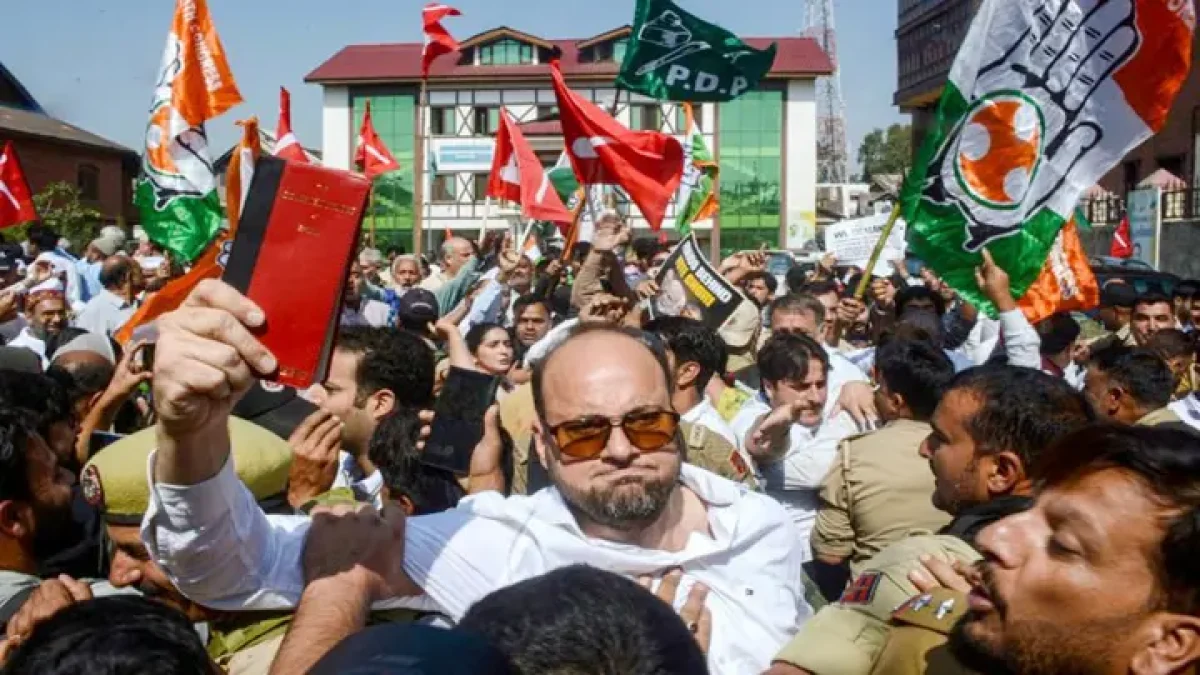
Jammu and Kashmir’s regional parties, the National Conference (NC) and the People’s Democratic Party (PDP), have joined the Congress-led protests demanding the resignation of India’s chief election commissioner (CEC), Gyanesh Kumar. The protests were held in various parts of Kashmir on Saturday at the call of the opposition INDIA alliance, over alleged fraud in the voter rolls.
Jammu and Kashmir Chief Minister Omar Abdullah and PDP leader Mehbooba Mufti, meanwhile, compared the tightened security, internet shutdown and restrictions on movement around the protests in Delhi with the situation after Kashmir’s special status was revoked in 2019.
Several dozen NC and PDP leaders and workers, women among them, gathered at the Congress office in Srinagar. Carrying party flags, they tried to march towards Lal Chowk and were stopped by security forces.
The protesters carried placards with pictures of Prime Minister Narendra Modi and Gyanesh Kumar. Alleging “vote theft”, they demanded the CEC’s resignation.
Partners in the INDIA alliance also held joint protests in Ganderbal in central Kashmir and Anantnag in the south.
Ghiyas Ahmad, who took part in the protest in Ganderbal, said workers of the National Conference, the PDP and the CPI(M) were protesting together peacefully. They demand that Gyanesh Kumar’s conduct be investigated and that he resign.
He also demanded that those involved in vote theft be brought to justice, and expressed solidarity with the opposition leaders’ movement at the national level.
Delhi compared with Kashmir in 2019
Security was tightened in Delhi from Friday, ahead of the protest. Internet services were shut in various areas, restrictions were placed on movement and routes to the protest site were blocked. Omar Abdullah responded on social media.
In a post on X the chief minister said: “The Kashmir model has been exported to Delhi. Welcome to the new Delhi, modelled on the new Jammu and Kashmir.”
His remark was aimed at the tough security measures taken in Delhi to suppress the protest.
In August 2019 India’s central government revoked Jammu and Kashmir’s special constitutional status and in effect withdrew most provisions of Article 370 of the constitution. Restrictions were then placed on communications in the region, the internet was shut and security was tightened. Omar Abdullah’s comment recalled that time.
PDP leader and former chief minister Mehbooba Mufti voiced similar concern. She wrote on X that Delhi today brought back a frightening memory of Kashmir after what she called the unconstitutional revocation of Article 370, when people were confined to their homes, the internet was shut and the whole region was locked down.
She said the BJP had then claimed publicly that no one protested, and feared the same would be said after the restrictions on protesters in Delhi.
“Today Delhi is under siege, trains have been stopped and the roads to Jantar Mantar have been closed. Then perhaps they will tell the same lie again: no one protested against Gyanesh Kumar,” she said.
In her words: “First crush the protest, then deny it as if it never happened. That is how a silence imposed by force is presented as consent.”
The comments of Omar Abdullah and Mehbooba Mufti have added a new dimension to India’s opposition politics, raising questions about the right to peaceful protest and the government’s security measures alongside the opposition’s allegations over the voter rolls.
The allegation of fraud in the voter rolls remains the opposition’s claim.
বাংলায় মূল প্রতিবেদন পড়ুন · Read the original Bengali report