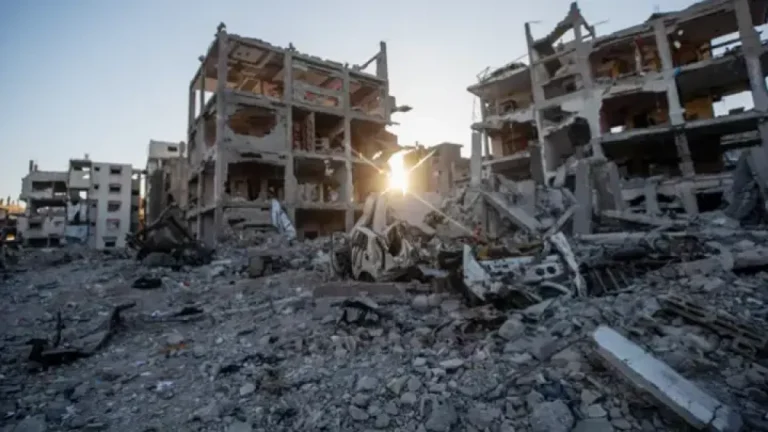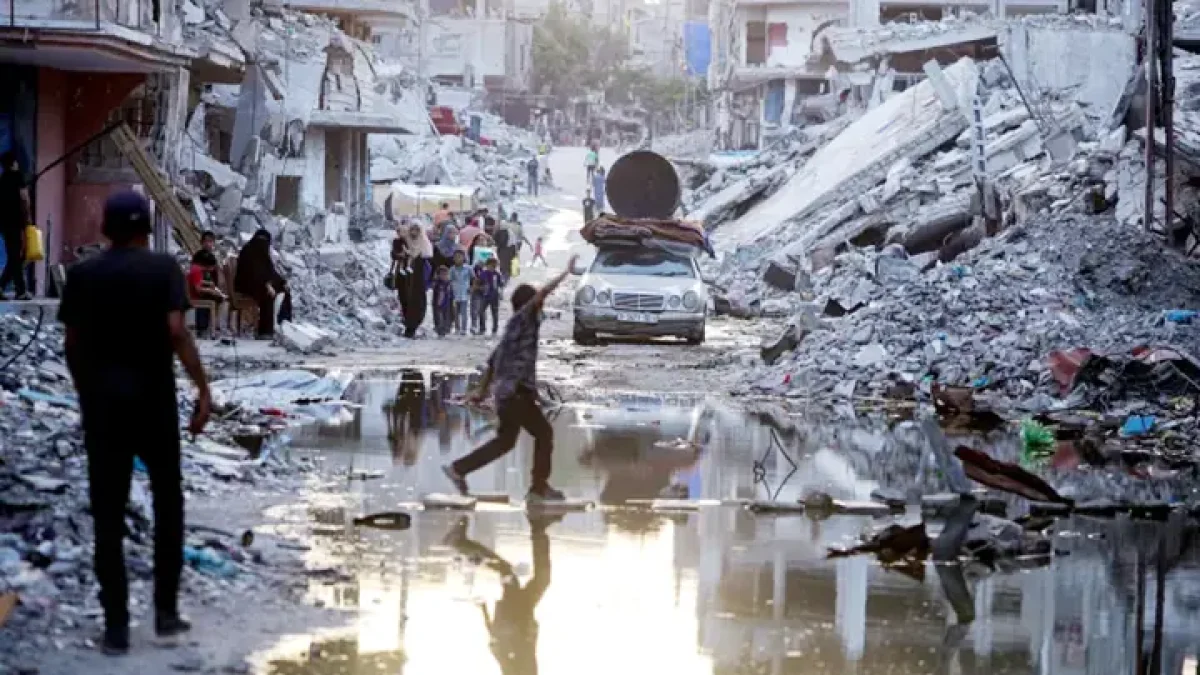
Oxfam has identified at least one potential pollution source affecting Palestinians in Palestine and at least one potential source of pollution across more than 99% of the Gaza Strip, warning that military destruction is exposing Palestinians to toxic substances in air, soil, water and food.
The international charity based its report on satellite imagery, remote sensing, scientific analysis and open data. It called for a comprehensive independent investigation into risks to current and future generations.
Oxfam International executive director Amitabh Behar described the environmental destruction as part of what the organization calls genocide and alleged that it could constitute war crimes against the environment and violations of international humanitarian and human rights law.
Israel rejects allegations that it is committing genocide. A case alleging genocide is before the International Court of Justice. Legal responsibility has not been finally determined.
Oxfam said pollutants from explosions, fires, debris and untreated sewage could enter bodies through breathing, drinking water, food and direct contact with contaminated soil.
Deaths and legal context
The report said Israeli attacks had killed more than 74,000 Palestinians and more than 1,500 since an October 2025 ceasefire agreement. The figures come from Palestinian authorities and could not be independently verified here.
A United Nations commission of inquiry said in September 2025 that Israel had committed genocide. The ICJ case remains ongoing; the court has issued provisional measures but has not delivered a final judgment on the merits.
Air pollution and emissions
Oxfam said explosions, fires and destroyed buildings released pollutants that settled in soil and rubble and were later resuspended by wind, traffic and debris removal. Potential concentrations were highest in Gaza City, Jabalia and North Gaza.
One study cited by Oxfam estimated more than 1.3 million tonnes of carbon-dioxide equivalent emissions from direct conflict through January 2025. Another estimated 33.2 million tonnes over the conflict and reconstruction, including 31.4 million tonnes from rebuilding.
61 million tonnes of debris
About 283 of Gaza's 365 square kilometers, or 78%, had been directly affected by Israeli ground operations by October 11, 2025, Oxfam said.
The United Nations Environment Programme estimated 61 million tonnes of debris since October 7, 2023, about 29 tonnes per current resident. Oxfam said removing it would require about 2.1 million dump-truck loads, enough travel to circle the Earth 736 times, according to the report.
That volume is about eight times the 7.65 million tonnes estimated after conflict in Mosul, Iraq, in 2017.
More than 90% of Palestinians in Gaza had been forcibly displaced, many repeatedly, the report said.
Areas with multiple potential pollution sources included Gaza City, Khan Younis, Rafah, Jabalia and the Salah al-Din road corridor. Unexploded ordnance, military vehicles, batteries and fuel stores posed risks to soil and groundwater.
Water and sewage collapse
Daily water supply fell from 334,107 cubic meters before October 2023 to 54,747 in June 2024, an 84% decline, according to Palestinian Water Authority figures cited by Oxfam.
Emergency repairs raised supply to 130,315 cubic meters a day by April 2026, still 61% below the prewar level.
Only nine of Gaza's 61 reservoirs were operating, storing enough to provide about 18 liters per person for one day.
The coastal aquifer historically supplied 81% of Gaza's water needs, but 97% of its water was already chemically polluted before October 2023 because of over-extraction, seawater intrusion, untreated sewage, agricultural waste and dumping.
Gaza's Health Ministry tested 79 groundwater wells in July 2026 and found fecal coliform bacteria in 15, or 19%. A 2021 assessment had found such bacteria in 2%.
Another 61 wells, or 77.2%, had total dissolved solids above 1,000 milligrams per liter.
All six wastewater treatment plants had been destroyed by April 2024, the report said. About 40,000 cubic meters of untreated sewage was entering the Mediterranean daily, equivalent to 16 Olympic swimming pools.
Only 19% of pumping stations and about 30% of the sewage network were partly operational by April 2026.
Waste-collection vehicles fell from 261 to 48. Gaza's two main landfills were inaccessible, and only 11 of at least 56 temporary dumps could be reached and operated. About 1.45 million people lived in areas affected by rats and other pests.
Agriculture and food security
Before the attacks, Gaza's farmland supplied about 95% of residents' fresh vegetables. More than 87% of agricultural land was damaged by the end of 2025 and only 3% remained usable and intact, Oxfam said.
The United Nations said more than one million olive trees had been uprooted by October 2024. Oxfam identified more than 7,200 damaged greenhouses and said seed-storage and distribution sites were destroyed.
Fishing had produced about 4,660 tonnes a year and fish farms another 750 tonnes. From October 2023 to April 2024, daily catches averaged 7.3% of their 2022 level. About 95% of livestock was also lost, the report said.
Oxfam warned that toxic substances could enter crops and seafood even if farming and fishing resumed.
Food-security data cited in the report indicated that about 1.2 million people, or 59% of Gaza's population, faced crisis-level acute food insecurity or worse in July 2026.
Economic destruction
Gaza's gross domestic product fell 83% in 2024 to $362 million, the report said. Destruction of farmland, workshops and factories eliminated livelihoods and exposed future cleanup workers to asbestos, silica and other hazards.
Of commercial and industrial sites assessed, 92% were damaged and 72% completely destroyed.
A joint World Bank, EU and UN assessment put direct infrastructure damage at $35.2 billion and economic losses at $22.7 billion through October 2025.
Recovery and reconstruction were estimated to require $71.4 billion over 10 years, including $26.3 billion in the first 18 months.
Oxfam's recommendations
Oxfam proposed five stages: secure access and reduce exposure; test pollution; identify priority sites and make emergency repairs; clean contaminated sites and manage hazardous waste; and rebuild with safeguards and long-term environmental monitoring.
The organization said destruction of water, food and sewage systems could be relevant to investigations under the Rome Statute and Genocide Convention. Proving genocide requires evidence of intent to destroy a protected group in whole or in part.