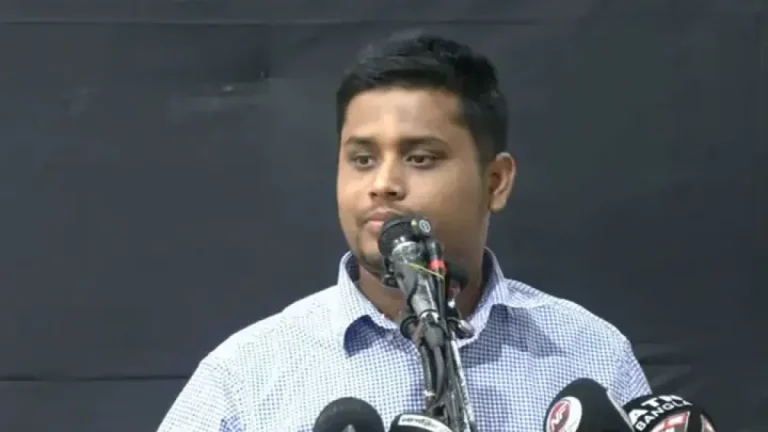
Inqilab Mancha Convener Abdullah Al Jaber says Osman Hadi had warned that Gopalganj could become the center of disorder in Bangladesh and that his fear has now come true.
At a news conference Wednesday, November 25, Jaber alleged that the state had failed to deliver justice 10 months after Hadi's killing and that efforts were being made to malign his character and obscure demands for a trial.
Referring to recent violence in Gopalganj, Jaber said an additional superintendent of police serving as an SRB company commander was questioned Tuesday. He alleged the officer maintained contact with the Awami League while in office and encouraged the violence. The allegations have not been proven in court.
Jaber said what he called a long-standing show of civility would not be enough to resist the Awami League.
He said that whenever the government was urged to accelerate the murder case, some people questioned Hadi's contribution. Jaber described this as an attempt to halt the work of a patriot who spoke for independence and sovereignty.
Jaber criticized civil society and political figures for focusing on Hadi's angry language and portraying him as abusive rather than asking why the state had not secured justice in 10 months.
He said a BNP member of Parliament had stated that Prime Minister Tareque Rahman also embraced Hadi's ideals. "You recognize people in times of danger," Jaber said, arguing the current situation proved the point.
Jaber described Hadi as not only a street activist but also a university teacher, poet and philosopher whose words had become especially relevant.
He said Inqilab Mancha wanted not only a trial but disclosure of whose interests were served by the killing and why it occurred.
Jaber said the platform's central goal was to revive Hadi's cultural and anti-hegemonic struggle and build a strong cultural movement that changed public thinking, rather than merely removing authoritarian leaders from power.