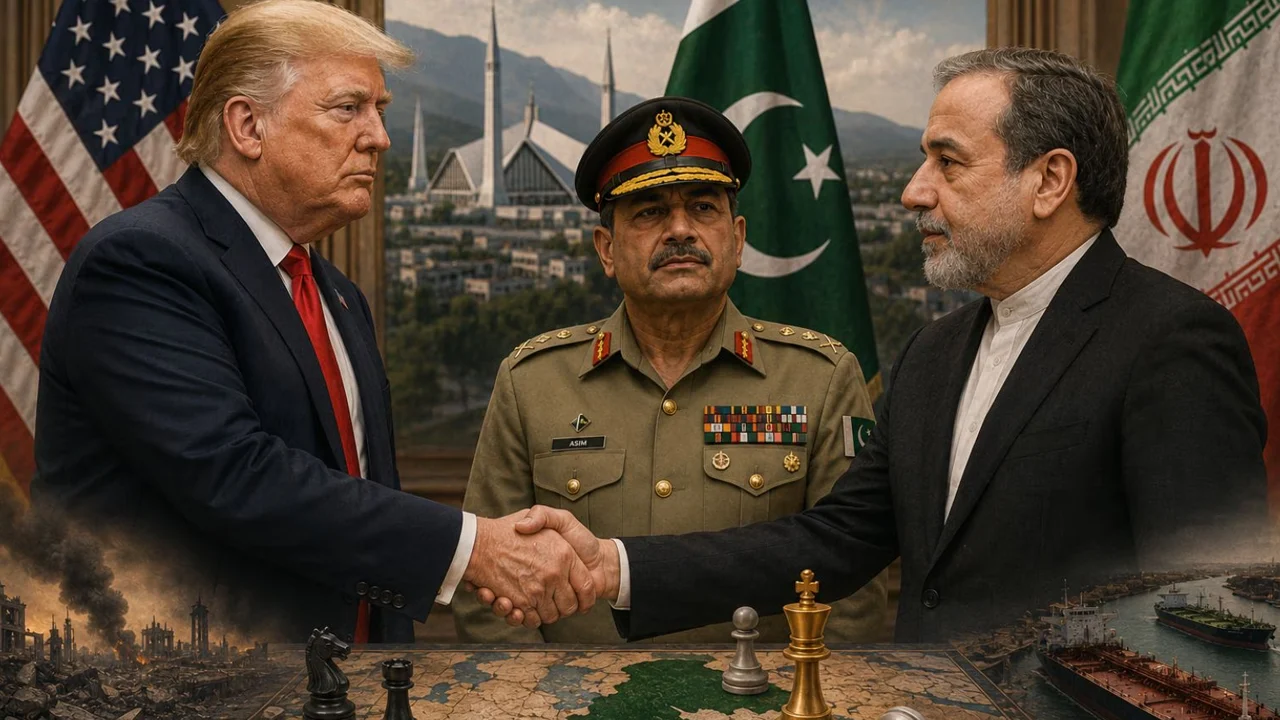
The United States and Iran have reached a peace agreement. Iranian state media have published the details of what the agreement contains, though this could not be confirmed with officials from either the United States or Iran.
Pakistani Prime Minister Shehbaz Sharif, who mediated the peace talks between the United States and Iran, announced early on Monday that the two countries had reached an agreement. Shortly afterwards, US President Donald Trump said in a post on Truth Social that a deal had been reached with Iran.
Iran’s semi-official state news agency Mehr News then published the terms said to be in the memorandum of understanding. They are: a permanent ceasefire on all fronts, including Lebanon; a US commitment not to interfere in Iran’s internal affairs; the withdrawal within 30 days of the US naval blockade around Iran’s ports; the withdrawal of US forces from Iran; the reopening of the Strait of Hormuz within 30 days under Iranian management; a plan by the United States and its allies to rebuild Iran at a cost of at least $300 billion; the lifting of sanctions on Iranian oil and energy products; a reaffirmed Iranian commitment not to build nuclear weapons; and US commitments not to increase its military strength in the region and not to impose new sanctions.
The Mehr report said final negotiations would not begin until half of Iran’s frozen funds under sanctions were released, the sanctions on Iranian oil were lifted, and the US naval blockade was withdrawn.
Besides this, the final agreement between the United States and Iran would be approved through a UN Security Council resolution.
US President Donald Trump confirmed the deal with Iran in a post on Truth Social. “I am allowing the Strait of Hormuz to be opened for completely toll-free passage. At the same time, I am ordering the immediate lifting of the blockade imposed by the US Navy,” he wrote.
Calling on the world’s ships to start their engines, the US president said oil transport would continue. He later clarified the matter somewhat in another post. Trump wrote that he had succeeded where others had failed.
“This great deal will bring peace and security to the entire region,” Trump wrote on Truth Social. “Many presidents have tried to make peace with Iran and all before me failed. The region’s leaders have for the first time found a president who can help them achieve real peace,” he wrote.
The report said these media outlets are known to be loyal to Israeli Prime Minister Benjamin Netanyahu. This sudden stance by the outlets against the US president is a highly unusual development. Even in opinion polls a short time earlier, US President Donald Trump was found to be more popular than the Israeli prime minister.
That, the report said, has become the main reason for the anger of Israeli hardliners. They see it as a political defeat for Israel. They understand that the deal will be seen in Tehran as a victory, and Iran’s victory will in fact be counted as a “strategic defeat” for Israel.
বাংলায় মূল প্রতিবেদন পড়ুন · Read the original Bengali report