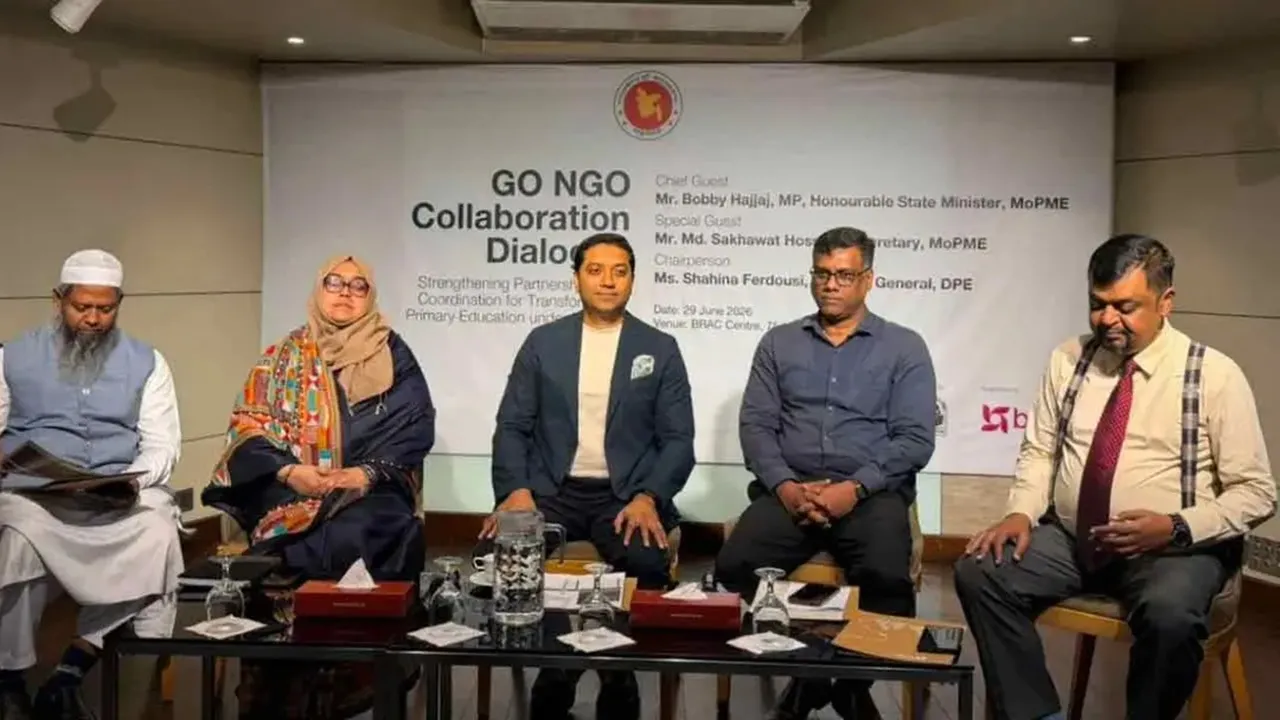
The government’s main goal in education reform is to raise learning outcomes, and to that end it is giving top priority to five areas — curriculum, teachers, administration, infrastructure and technology — State Minister for Primary and Mass Education Bobby Hajjaj said. Future education reform would be built around these five areas, he said.
He made the remarks as chief guest at a programme titled “GO-NGO Collaboration Dialogue” at the BRAC Centre in the capital on Monday (29 June).
Hajjaj said the government wanted to work with NGOs in a coordinated way, on the basis of effective partnership, to improve the quality of primary education. The desired change in education, he said, could be achieved not by the government alone but through the combined efforts of the state apparatus and development partners.
The state minister said the government wanted to make primary education more modern, efficient and technology-driven. New initiatives were being taken in teacher training, transparency in teacher recruitment and transfers, administrative capacity, digital monitoring and technology-based education management, he said. Bringing change at once to the country’s more than 65,000 government primary schools required realistic, scalable and sustainable measures, and the government wanted to draw on NGOs’ field experience and innovative models.
Hajjaj said the government was working in coordination with various stakeholders to ensure educational opportunities for children with disabilities, pre-primary education, non-formal education, urban migrant children, children in tea-garden areas and marginalised communities.
Directorate of Primary Education director general Shahina Ferdousi and officials from the Ministry of Primary and Mass Education, the Directorate of Primary Education, BRAC and various other NGOs attended.
বাংলায় মূল প্রতিবেদন পড়ুন · Read the original Bengali report