CHATTOGRAM, Sept. 26 — Chattogram city is reeling from dengue fever. No government or private hospital has beds available for patients. Even after repeated efforts, patients are not finding beds in hospital corridors or inside wards. Some are being forced to take treatment at home, while others are suffering in intensive care units. After several days of fighting the fever, patients are losing their lives.
Even as deaths and infections rise rapidly, Chattogram City Corporation, upazila administrations, municipalities and union parishads are failing to reduce the mosquito menace.
Urban areas have now surpassed villages in infections. Children, young people and the elderly are being added to the death toll almost every day. In this situation, public confidence in the city corporation and local upazila administrations has fallen sharply. Many residents have also questioned the effectiveness of the insecticide used by the city corporation.
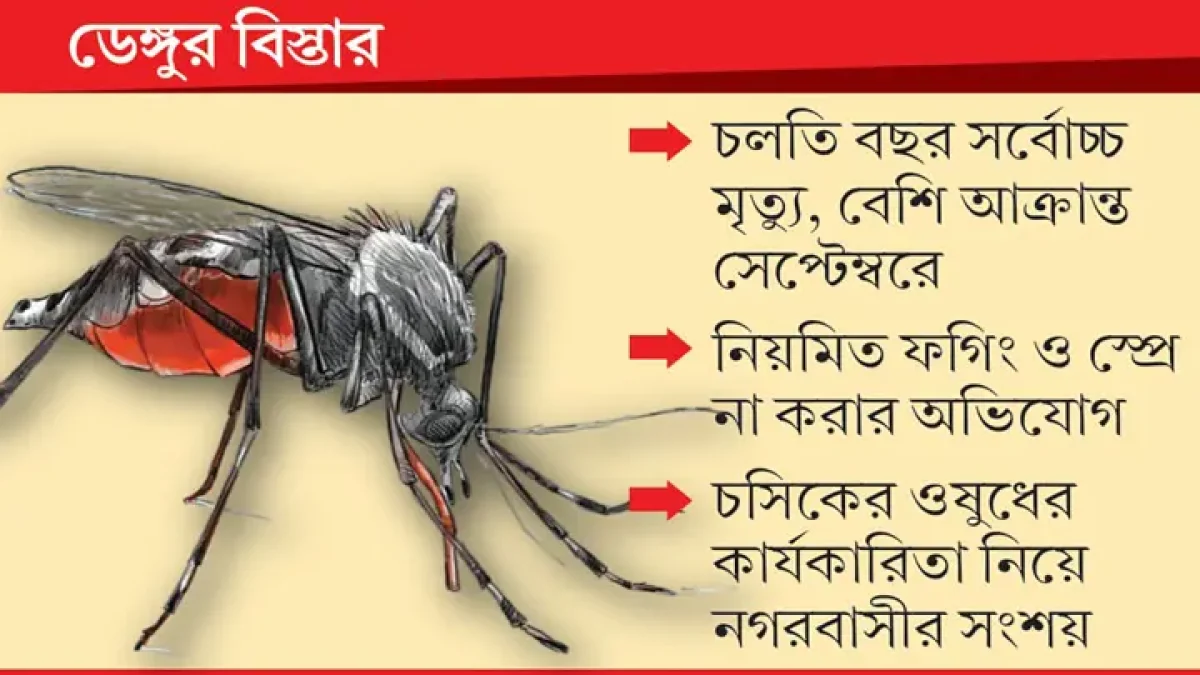
Residents allege that although the city corporation is running a crash program, regular fogging and spraying are not being carried out in 41 wards. They also say cleaning should receive more emphasis than chemical use, but the city corporation is not doing so. Residents expressed doubt over whether the BTI product being used is effective against mosquitoes at all.
Visits to different government and private hospitals in the city found no empty beds in dengue wards. Chattogram Medical College Hospital had 104 patients, while 231 dengue patients were admitted across private hospitals and upazila health complexes. Hospital authorities were unwilling to admit new patients. Most infected patients are receiving treatment at home. Crowds are growing daily at dengue testing centers in clinics and diagnostic centers.
At Chattogram Maa-O-Shishu Hospital, Ishtiaq Ahmed Mehraj said he had found a bed for his child only after much difficulty. His four-year-old child has had fever for 20 days, but no virus has been detected, he said. He said Halishahar is a dengue hotspot in the city, yet little spraying is being done there. He believes mosquitoes are not dying because of negligence by city corporation workers or incompetence in applying insecticide.
Hosne Ara Begum, a resident of Akbar Shah, said her daughter-in-law was infected with dengue twice in August and September. She said even if a hospital bed is found, there is almost no treatment there. She said she had not seen city corporation workers spraying insecticide. Workers came once three months ago and left after doing fogging their own way, she said, adding that mosquito breeding sites are not being destroyed.
Rezaul Raju, a resident of the No. 2 Gate area, said mosquitoes increase in the evening. After returning from work, he and his wife have to make different arrangements to kill mosquitoes, he said. Yet he sees little initiative from the city corporation. He alleged that the crash program is mostly show. He said he doubts whether the insecticide works.
Meanwhile, dengue is claiming many lives in Chattogram. Thirteen people have died in Chattogram this month. Last Saturday, a woman named Moni Akhter left the private Sajinas Hospital after signing a bond for discharge. She died on the way home. Her eight-year-old son Abu Zahed is now also suffering from dengue fever in hospital.
Abu Zahed’s father, Al Amin, said his son was infected with fever before he lost his wife. His wife’s treatment bill at Sajinas Hospital reached 1 lakh 21 thousand taka. He paid 30 thousand taka in cash and left with the rest unpaid. His wife died that same day. He said he has not yet overcome that grief and is now anxious over his son at Chattogram Medical College Hospital.
The dengue situation in the district’s 15 upazilas is also fragile. Sitakunda has the highest number of infections. In that upazila, a five-year-old child named Sirajul Munira died of dengue Sept. 17. A 16-year-old teenager named Korban Ali Rifat died Sept. 22. Four people have died of dengue in Sitakunda in the past 10 days. Residents said no meaningful steps have been taken there to reduce the mosquito menace. Infections are rising sharply in other upazilas as well.
Residents said municipalities and union parishads currently have no councilors, members, mayors or chairmen. Government officials are carrying out those duties and remain busy with other work. Residents said they cannot find a place to file complaints, while mosquitoes continue to increase.
According to district civil surgeon sources, dengue infections in Chattogram district rose 55.95 percent in the same January-September period compared with last year. In the first 9 months of 2025, 2 thousand 515 people were infected with dengue. By Sept. 24, 2026, the number had reached 3 thousand 922. Of them, 1 thousand 711 were in the district’s 15 upazilas and 1 thousand 770 in the city corporation area. In other words, infections increased by 1 thousand 407 in one year.
September figures alone are raising concern over dengue. In September last year, 935 people were infected and four died. In the first 24 days of this September, 1 thousand 786 people were infected and 13 died. Compared with the same period last year, infections rose 91.02 percent and deaths rose 225 percent.
Chattogram City Corporation mosquito control officer Sharful Islam Mahi said work is being carried out with 158 spray machines and 86 fogger machines. A specialized 60-member team is also in the field. Mosquito control is being conducted through both spraying and fogging, he said. BTI is a bacterial product that attacks mosquitoes directly in the stomach. It will be used until December, he said.
Commander Ikhtiar Uddin Ahmed Chowdhury, the recently transferred chief cleaning officer of Chattogram City Corporation, said regular crash programs are being conducted. Five hotspots are being prioritized. Some gaps remain when working across 41 wards, he said, adding that officials are trying. He said BTI is being used because it is performing better than before.
Chattogram Divisional Director for Health Dr. Fazle Rabbi said health officials would speak with the city corporation about the insecticide. Dengue season will continue until November, he said. Officials are raising awareness and working jointly, he added.
Prof. Mamunur Rashid, head of clinical tropical medicine at the Bangladesh Institute of Tropical and Infectious Diseases, said dengue is rising for three reasons: intermittent rain, the current temperature and humidity above 80 percent. These conditions support the growth and spread of Aedes mosquitoes, he said. Eggs laid by Aedes mosquitoes become adults within three days after coming into contact with rainwater. He said the situation is expected to continue until November, though it may ease earlier if intermittent rain declines.
He said patients in Bangladesh are currently being infected by four types of dengue. Samples have been sent abroad to identify the dengue strain in Chattogram.
বাংলায় মূল প্রতিবেদন পড়ুন · Read the original Bengali report