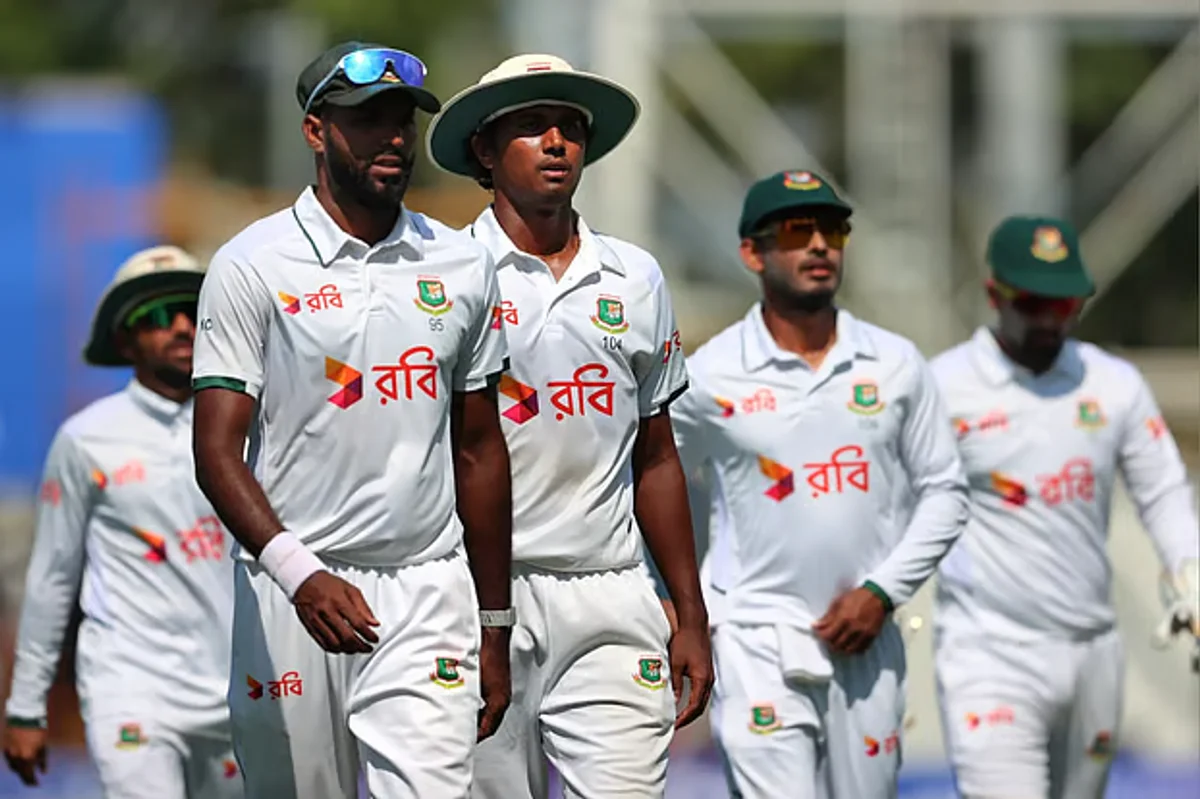
There had been doubt over whether the match would even reach a fourth day. In the end, it did — but spectators in Darwin went home today believing the odds of it stretching to a fifth day are slim.
Calling it “belief” might not be quite right — Australians would certainly want the Test to go the distance, since that would at least give them a chance to salvage some pride. The scenario being discussed, of the match finishing on the fourth day, is actually in Bangladesh’s favor. A Test ending tomorrow would effectively mean a Bangladesh win.
It feels almost surreal to imagine a Test match on Australian soil finishing inside four days, with Bangladesh the team pushing for that outcome. Host nation Australia, meanwhile, is desperately hoping that doesn’t happen — hoping their second innings tomorrow stretches long enough to at least put up a fight on the final day.
The reason for this discussion about the Test’s lifespan becomes clear from a glance at the Darwin scorecard. At the end of day three, Australia were 161 for 4 in their second innings, still trailing Bangladesh by 67 runs. Earlier, resilient batting from the tail helped Bangladesh post a 228-run lead, with the first innings ending at 426 shortly after lunch. It is Bangladesh’s second-highest Test score against Australia — their all-time high remains 427, scored in the first innings of the 2006 Fatullah Test.
Once Bangladesh’s lead crossed 206, the history books began to loom over Australia. They have never won a home Test after trailing by more than 206 runs in the first innings. To win in Darwin, they would need to overturn the largest first-innings deficit they have ever overcome at home.
But the way Australia began losing wickets in the final session of day three suggests rewriting that record will not come easily. Hasan Mahmud, who took 6 wickets in the first innings, rattled the hosts again early on. He bowled opener Jake Weatherald in the second over of the innings and dismissed Travis Head in the 11th. Head attempted to cut Hasan, but the ball, angling in close to his body, clipped the bat and knocked back the stumps.
With Australia down to 37 for 2, their hopes rested on the third-wicket partnership between Marnus Labuschagne and Steven Smith. The pair added 36 runs and looked reasonably settled. But off the last ball of the 20th over, Taijul Islam bowled Labuschagne, who had made 31 off 59 balls, rattling the hosts once again. Smith fell a little later, out for 44, caught and bowled off Mehedi Hasan Miraz. After Australia slipped to 122 for 4, talk in the Darwin press box turned to whether the Test would even make it to a fourth day.
Cameron Green — and Australia as a whole — enjoyed a slice of fortune when a Taskin Ahmed delivery struck his stumps without dislodging the bails, the ball incredibly clipping the stumps and still racing away for a boundary. On the back of that fortune, Australia closed the day without losing another wicket.
Much of the credit for the position the Darwin Test finds itself in after day three belongs to Bangladesh’s tail-end batting in the first innings. But which moment stood out? Ebadot Hossain’s towering slog-sweep six off Nathan Lyon over deep midwicket? Or Hasan Mahmud’s 92-ball vigil for just 14 runs?
Australians would say neither — the real trouble, they’d argue, was their own fielders. Who drops three catches in a single session, including two in one over? Drop enough catches, and even schoolchildren could make runs against you, let alone tail-end batters.
However one looks at it, Bangladesh made another day of this Darwin Test their own from the outset, and nearly all the credit belongs to superb batting from the tail. Building his innings around Miraz’s 65 off 154 balls, the not-out overnight pair of Hasan and Taijul, along with Taskin Ahmed and Ebadot, batted around him in turn.
Bangladesh’s lower order began batting on day two at the 83.3-over mark, with the score at 308 for 6 after Mushfiqur Rahim’s dismissal. From that point — across the final session of day two and the first session of today — the tail-enders, batting alongside Miraz, faced 52.3 overs from the Australian bowlers. During that stretch, the total grew by another 118 runs, 75 of which came today. This is likely why, even though Hazlewood took 6 wickets and reached the milestone of 300 Test wickets, Australians found little to celebrate in the achievement.
Consider the partnerships too: Miraz and Hasan added 46 for the seventh wicket, Miraz and Taijul 18 for the eighth, Miraz and Taskin 4 for the ninth, and even Taskin and Ebadot added 8 for the final wicket — which included Ebadot’s six.
It was this tail-end effort, worthy of a standing ovation, that allowed Bangladesh to bat through the first session of day three and five more overs after lunch. Beyond Hasan and Ebadot’s contributions, Taijul’s 17 off 23 balls, including a six and a four, and Taskin’s unbeaten 14 off 32 balls with two boundaries, showed little sign of discomfort against Australia’s pace and bounce. Yes, three catches were dropped in the first session, two of them in the same over.
But no matter — as Tanjim Hasan had said the day before, catching and dropping catches are simply part of the game.
Brief scores
Australia: 198 and 161/4 in 53 overs (Smith 44, Green 43*, Labuschagne 31, Head 17, Carey 7*; Hasan 2/33, Taskin 0/38, Ebadot 0/38, Taijul 1/28, Miraz 1/20). Bangladesh: 426.
বাংলায় মূল প্রতিবেদন পড়ুন · Read the original Bengali report