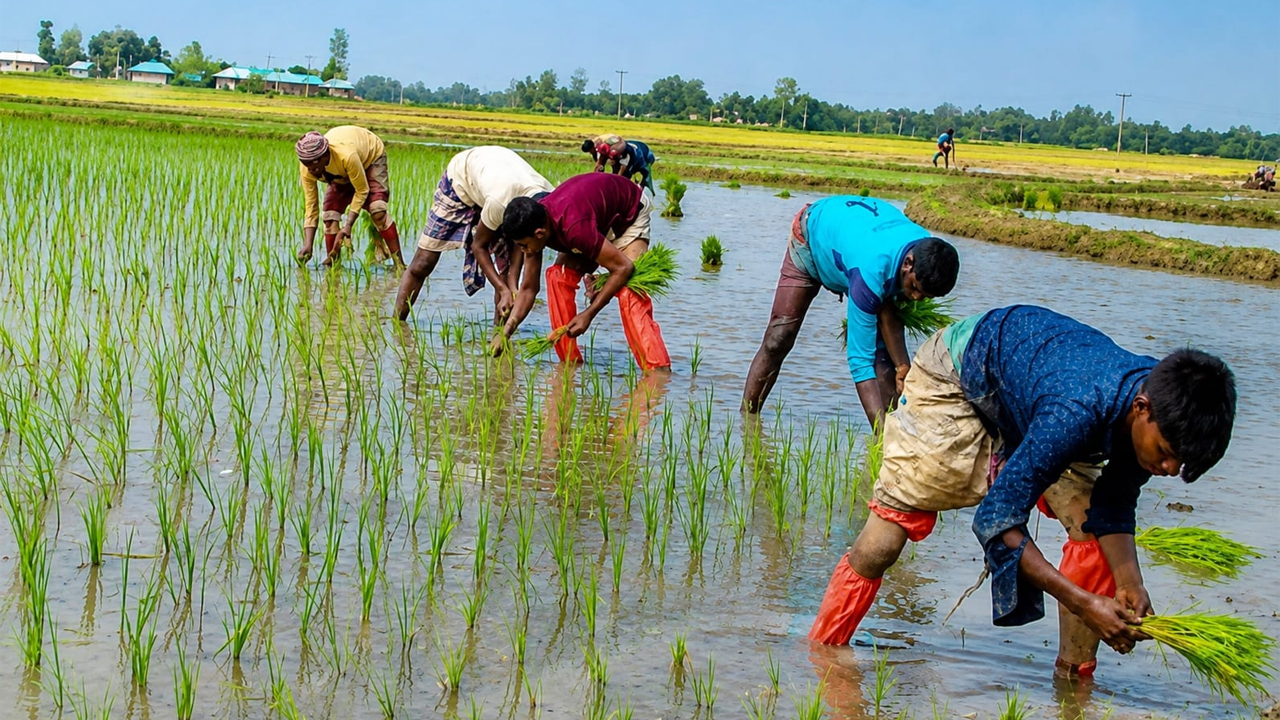
Monsoon rains have filled Chuadanga’s canals and wetlands, and farmers across the district have begun planting transplanted aman rice. But rising input costs have cast a shadow over the season, with per-bigha production expenses climbing by 4,000 to 5,000 taka compared to last year.
Field reports show that while rainfall has created favorable planting conditions, market prices for fertilizer, pesticides, and labor have risen sharply. Power tiller operators have increased per-bigha plowing charges by 300 taka — from 1,300 to 1,600 taka — citing higher diesel prices. Daily wages for transplanting labor have also risen by roughly 500 taka per bigha.
Farmers estimate that total per-bigha costs for aman production — including land rent, seed, irrigation, and fertilizer — have reached 24,000 to 25,000 taka this season, up from a maximum of 21,000 taka last year. Under favorable weather, a yield of 18 to 20 maunds (roughly 720 to 800 kilograms) per bigha is possible. But farmers warn that without fair paddy prices, they face heavy losses similar to those suffered during the recent potato, onion, and boro seasons.
Sohag Hossen, a farmer in Alokdia village in Chuadanga Sadar upazila, said he had taken loans after losing money on potatoes to plant boro rice, only to lose another 2,500 taka per bigha when paddy prices fell short. “Fertilizer is expensive, you can’t find a laborer for under 500 taka. Everything has gone up except the price of our paddy,” he said.
Rabiul Islam, another farmer in the same upazila, said his previous boro harvest was destroyed by excessive rainfall. He had planted it with loans from an NGO but has returned to the fields this season driven by the need to earn a livelihood.
Zakariya Alam, a farmer in Damurhuda, said farmers are falling deeper into debt because they are not receiving fair prices for their produce. If aman paddy prices also disappoint, making ends meet will become extremely difficult, he said.
Farmers have demanded that the government intervene to ensure fair and rational pricing for paddy.
According to the Chuadanga District Agriculture Extension Department, the district’s target for transplanted aman cultivation this season is 36,781 hectares. Approximately 30 percent of the planting has been completed so far.
Masudur Rahman Sarkar, Deputy Director of the Chuadanga Agriculture Extension Department, said the department is providing continuous field-level advice to help farmers increase yields and profit from the aman season. He added that the prime planting season is underway, and if weather remains favorable and yields are good, farmers should be able to overcome past losses.
বাংলায় মূল প্রতিবেদন পড়ুন · Read the original Bengali report