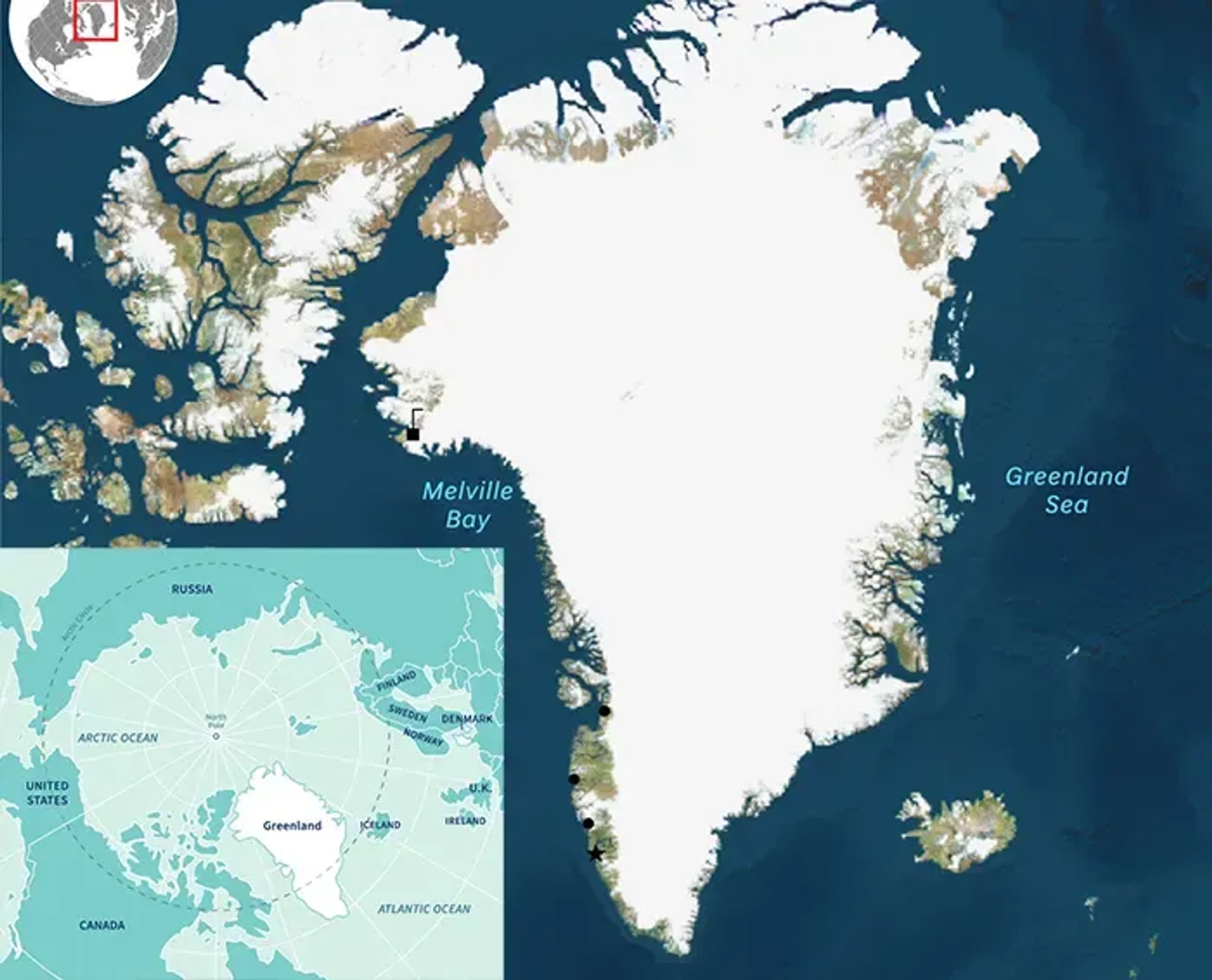
U.S. President Donald Trump has once again heated up tensions with longtime NATO ally Denmark. Ahead of a NATO summit in Ankara, he reiterated that the United States should have full control over Greenland, the semi-autonomous island in the North Atlantic. Danish Prime Minister Mette Frederiksen firmly rejected Trump’s claim, stating clearly that Greenland is not for sale. Roughly 80% of the world’s largest island lies above the Arctic Circle, home mainly to about 56,000 Inuit indigenous people.
Trump’s intense desire to bring this long-overlooked, ice-covered island under his control stems from deep strategic, military and mineral-related motives.
Claims of defending North America and global security: Trump’s core argument is that Danish control of Greenland serves no purpose, since it is directly tied to U.S. security. At the NATO meeting, Trump said Greenland is extremely important for the United States but not for Denmark. He said control is needed not just for the United States but for the security of the whole world. While Trump has, in his second term, also floated territorial expansion involving Canada and Venezuela, Greenland has come up most often in his remarks. He had earlier not ruled out the possibility of using military force to secure the island, though he has since said he has moved away from that option.
Growing military threats from China and Russia: Nuclear powers Russia and China are significantly expanding their military presence in the Arctic region. In 2018, China declared itself a “near-Arctic state” and unveiled plans for a Polar Silk Road as part of its global Belt and Road Initiative. Then-U.S. Secretary of State Mike Pompeo strongly opposed China’s move, asking whether the world really wanted the Arctic Ocean to turn into another South China Sea marked by militarization and competing territorial claims. Russia, meanwhile, has been renovating its old Soviet-era military infrastructure in the Arctic and has built several new military bases and airfields there since 2014. Russian President Vladimir Putin has expressed concern over NATO’s activities and announced plans to further boost his country’s armed forces capabilities there. Trump claims Russia’s historic nuclear weapons testing site and its Northern Fleet are located in this Arctic region, making control of Greenland essential to protecting the U.S. mainland.
Strategic location and the Pituffik Space Base: Greenland has played an extremely important role in North American defense since World War II. At the time, the United States occupied Greenland to keep it out of Nazi Germany’s hands and to protect North Atlantic shipping routes. Even today, under a 1951 treaty, the U.S. Defense Department operates the remote Pituffik Space Base (formerly Thule Air Base) in northwest Greenland. The base supports U.S. and NATO missile early-warning, missile defense and space surveillance operations. Greenland’s location is also strategically advantageous for monitoring any Russian naval vessel movement through the sea gap between Greenland, Iceland and Britain, known as the GIUK Gap.
Climate change and new trade routes: After the Cold War, the Arctic region was largely a zone of international cooperation. But due to global warming, the Arctic’s thick ice sheets have begun melting rapidly. This melting ice is opening up a new and significantly shorter maritime route for international trade — the Northwest Passage. Competition among major powers to control this new global trade route has intensified as a result.
Vast reserves of rare minerals: Beyond its natural and geopolitical advantages, Greenland’s subsoil also holds vast reserves of valuable minerals. The island is a major source of rare earth minerals essential for manufacturing the high-tech gadgets that keep the modern global economy running — smartphones, computers, advanced batteries and military equipment. China currently controls the lion’s share of this global mineral market. The United States and other Western powers are eyeing Greenland’s mineral resources to break China’s near-monopoly, although the region’s harsh weather and strict environmental laws remain major obstacles to mineral extraction.
Political reaction and Denmark’s warning: Military experts, however, believe that a U.S. flag flying over Greenland alone would not overnight improve U.S. security strategy. According to Thomas Crosbie, a military expert at the Royal Danish Defence College, the United States already enjoys all kinds of security and military benefits from Denmark as a trusted ally. As such, this is more Trump’s personal political ambition than a matter of boosting national security. Denmark’s parliament passed a bill last year allowing U.S. military bases on its soil, further strengthening a military agreement made with the Biden administration in 2023. However, then-Danish Foreign Minister Lars Lokke Rasmussen made clear that if the United States were to attempt to forcibly annex all or part of Greenland in any way, Denmark reserves the right to immediately cancel this military agreement. Meanwhile, local Greenlanders have also gathered in front of the new U.S. consulate in their capital, Nuuk, to stage strong protests against what they see as U.S. hegemonic aggression.
বাংলায় মূল প্রতিবেদন পড়ুন · Read the original Bengali report