A swift river once flowed along the south of the village, known to many simply as the "gang." That river is now all but dead, its current lost to time, but its memory remains. Magura, the village on the west of Kayemkola — part of which is called "Amritabazar" — was the birthplace of the noted subcontinental journalist and writer Shishir Kumar Ghosh, editor of the famous newspaper Amrita Bazar. So the area is rich not only in nature but in intellectual heritage.
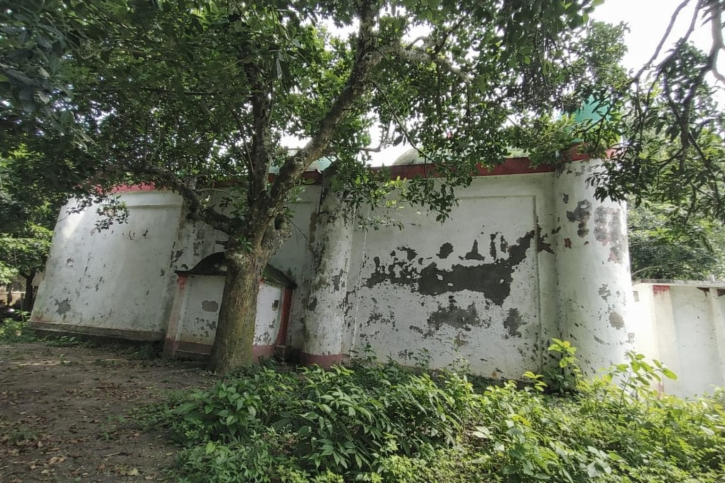
Kayemkola is now a large settlement, home to several thousand people, with a high school, a primary school, several Furkania madrasas and a large market attesting to its social progress. But the structure that carries Kayemkola's true historical importance is the one known locally as the "Jamadar Mosque" or "Boro Mosque." It stands near the junction of the Jashore-Kashipur and Jhikargacha-Chaugachha roads. Measuring 52.5 feet long and 21 feet wide, its walls are 4.5 feet thick — proof of the sturdiness of its old architectural style. There are three entrances on the east side and a mihrab in the west wall. The three-domed mosque has no minaret, making it comparable to the rural mosque architecture of the Sultanate and Mughal periods.
No reliable record has been found of exactly when the mosque was built. According to local tradition, a jamadar named "Aga Bakar" built it during the reign of the Nawab of Bengal, Alivardi Khan, which is why it is known as the "Jamadar Mosque" — placing its construction in the mid-18th century, though some history enthusiasts think its architectural style could also match the Sultanate period. Over the long span of time, salinity damage has become clear on the mosque's walls. Renovation has already been undertaken, but experts say parts of the structure have lost their original form as a result. Aware observers say it is urgent that such an important monument of history and heritage be taken under the supervision of the Bangladesh government's archaeology department. The Jamadar Mosque of Kayemkola is a historical record bearing witness to time, and with proper conservation and research it can present the rich history of the past to future generations.