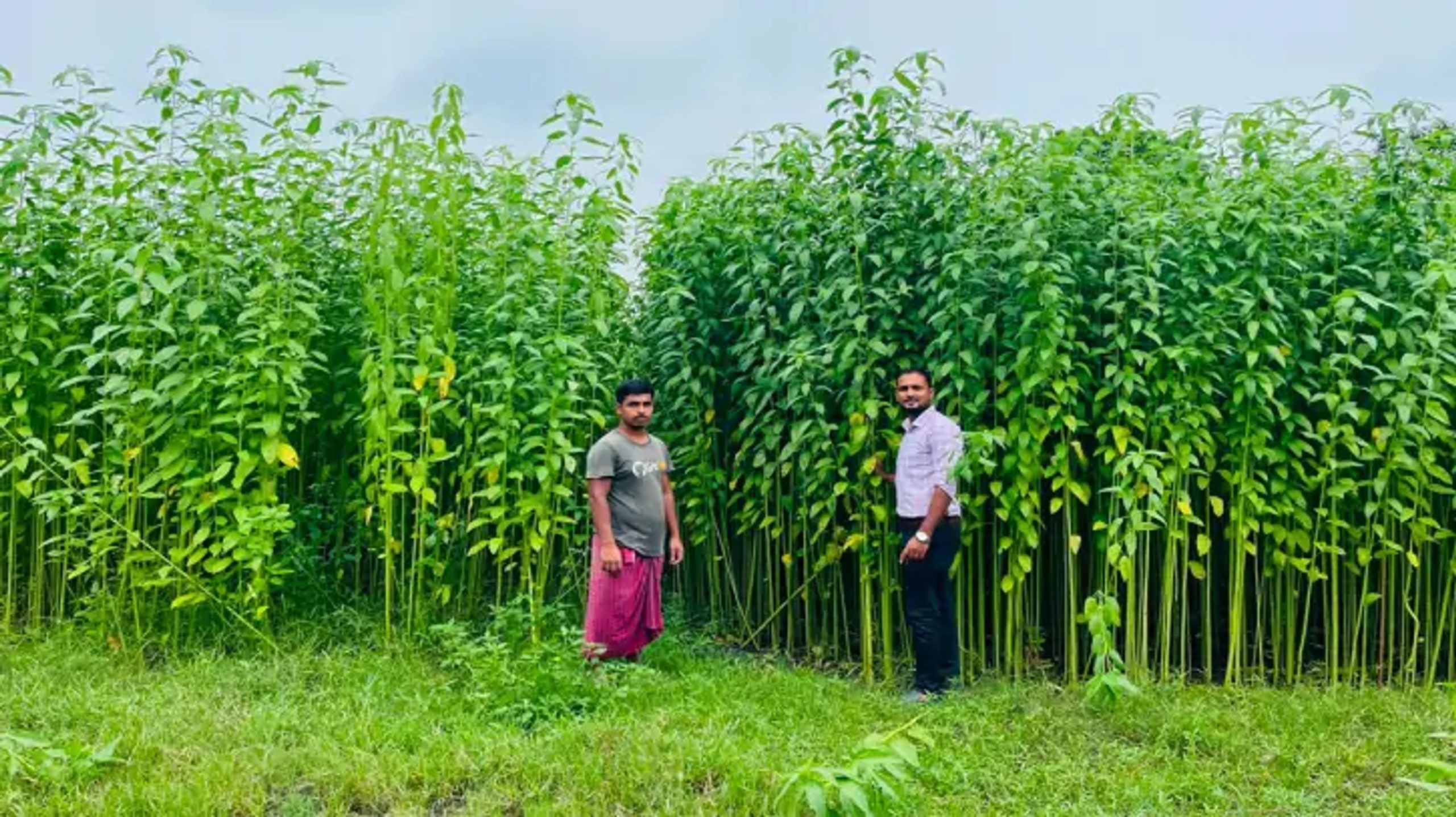
Regular rainfall and favourable weather have left jute plants growing well across the fields. If everything stays favourable, those linked to agriculture expect a bumper harvest in the Khulna region this season, exceeding the production target.
According to the Department of Agricultural Extension (DAE) Khulna region, a target had been set to cultivate tossa, local and mesta varieties of jute on 38,287 hectares this season. But because of farmers’ interest, jute was finally cultivated on 38,361 hectares — 74 hectares more than the target. Agricultural experts see this trend as reflecting not only farmers’ confidence but also a positive sign of the jute sector’s revival.
DAE Khulna region additional director Rafiqul Islam said: “Over the past few years, good jute yields and satisfactory market prices have significantly increased farmers’ interest. Steps have been taken to raise production further by expanding high-yielding varieties.” He said that although a target of 4,97,444 metric tonnes of jute had been set this season, production could exceed 5,02,000 metric tonnes if favourable weather continues.
A tour of various Khulna upazilas showed green jute plants swaying across vast fields. Farmers said regular rainfall had meant less need for irrigation this time, and with both plant height and growth good, they are optimistic about the yield. Jute cutting will begin in various areas from the middle of this month, followed by retting, fibre-stripping and drying.
Sohrab Ali, a farmer from Barasat village in Terokhada upazila, said: “Last year I sold jute at 5,500 to 6,000 taka per maund. If I get the same kind of price this time, jute farming will be even more profitable.” Farmers Mahtab Hossain, Shahed Mahmud, Abdul Awal and Apurba Kumar Roy of Fultala upazila said the jute in the fields was in very good condition and the yield could be better than expected if the weather holds; they are preparing to cut jute from late this month.
To raise jute production using modern technology, the DAE, the Bangladesh Agricultural Development Corporation (BADC) and various agricultural bodies are working together, supplying farmers with quality seed, technical advice and necessary inputs, and providing training in modern fibre-extraction technology, including ribbon retting, to maintain fibre quality when water is scarce. According to agricultural officials, using these technologies makes it possible to produce good-quality jute fibre with less water.
বাংলায় মূল প্রতিবেদন পড়ুন · Read the original Bengali report