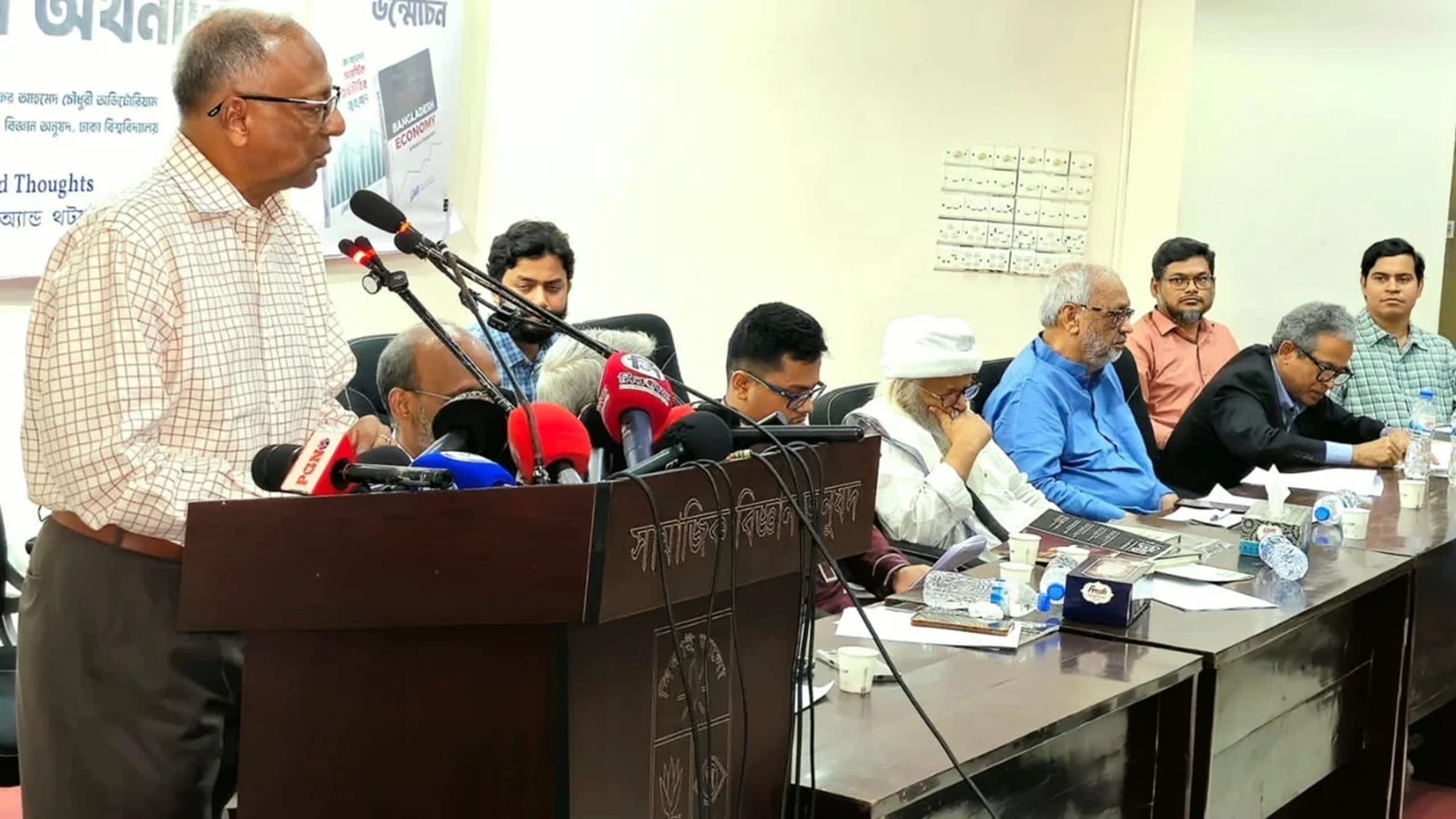
Dr. Mahmudur Rahman, editor of Amar Desh, has called for the highest priority to be given to creating new jobs if Bangladesh’s economy is to be turned round. Manufacturing industry and agriculture must be given the greatest importance in creating employment, he said. Without new jobs it is not possible to increase national wealth, and without the creation of wealth sustainable development cannot be ensured either. Alongside creating wealth, he stressed ensuring its fair distribution in order to build a state without inequality.
He was speaking as chief speaker at a seminar titled “Bangladesh’s economy in the aspirations of July,” organised by the Centre for Advanced Studies and Thoughts (CAST) at the Mozaffar Ahmed Chowdhury Auditorium of Dhaka University’s Faculty of Social Sciences on Thursday, July 23.
After the seminar, two books published by the Centre for Advanced Studies and Thoughts were launched: “An anatomy of Bangladesh’s recent economy” and “Bangladesh Economy: A Holistic Evaluation.”
The seminar discussed the current state of the economy in the light of the aspirations of the July uprising, economic management over the past decade and a half, inequality, employment, industrialisation and the future economic outline.
Dr. Mahmudur Rahman said that whenever the economy is discussed in Bangladesh everyone talks about GDP growth, but there is very little discussion of how that wealth is distributed among people. Unless both are given equal importance, he said, a state without inequality cannot be built.
The first task in emerging from the present economic crisis should be creating new wealth, and that is possible through employment, he said. “My thinking may seem old-fashioned to many. But I still believe job creation is the only effective path to reviving Bangladesh’s economy. A family card is no solution; the real solution is creating jobs.”
Productive industry and agriculture must be given the greatest importance in creating employment, he said, adding that over the past decade and a half priority went to mega-project-centred development rather than productive industry. Productive industry was neglected, he said, because mega projects offered greater scope for corruption.
Dr. Mahmudur Rahman also questioned the credibility of official economic statistics. Over the past 15 years, he said, “statistical engineering” presented a picture of development better than the reality. He said he had written to international organisations including the World Bank and the ADB about it.
Drawing on his experience as a former executive chairman of the Board of Investment, he said that if growth can be achieved in productive industry, employment also rises. He called for agriculture to be valued not only by its contribution to GDP but from the standpoint of employment and food security.
The government should set a strategy for increasing national wealth with all stakeholders, he said. At the same time, gas and electricity, infrastructure and skilled human resources must be ensured to raise production. In a country facing a gas and electricity crisis, foreign investment will not come simply by holding investment summits.
Dr. A K M Waresul Karim, dean of the Faculty of Business and Economics at North South University, also spoke. He said his research on the country’s macroeconomy, public debt, defaulted loans and the financial sector over the past decade had produced a worrying picture.
According to the figures he presented, defaulted loans in the country currently stand at about 6 lakh 40 thousand crore taka. Including loans stuck in rescheduling, write-offs and court stay orders, distressed loans amount to about 11 lakh crore taka. Calling rescheduled loans a sleight of hand, he said it does not solve the problem but conceals the real picture.
Dr. Waresul Karim said inflation has raised the cost of living for ordinary people. But farmers are not getting a fair price for what they produce, and the incomes of garment workers, transport workers, imams and muezzins and other low-income people have not risen in step with their expenses.
He said maximum transparency must be ensured in the 20,000 crore taka plan taken up to reopen closed industrial units and in the transfer of state-owned industrial enterprises. He also stressed increasing research opportunities and research funding for young people to tackle the economic crisis. In his view students are suffering because allocations for research, computer labs, electricity and sanitation in universities have fallen.
Calling for basic infrastructure to be ensured before technology-dependent projects are taken up in education, he said that before giving every teacher a tablet or installing CCTV in every classroom, schools should be assured of enough classrooms, laboratories, toilets and necessary teaching materials. He also stressed teacher training, moral education and awareness rather than technology in preventing child abuse.
DUCSU general secretary S M Farhad said inflation has risen but farmers are still forced to sell their paddy, vegetables and other produce at the same low prices. Prices rise for consumers in the market, but farmers do not get that benefit. Garment workers’ wages have not risen significantly. Mosque imams and muezzins are likewise still paid very little: a muezzin has to run a household on about seven thousand taka and an imam on about ten thousand. The position of transport workers and other low-income people is the same, while the prices of all essentials keep rising.
He said ordinary people save small amounts in banks, and some plunder that money and send it abroad. More regrettably, many loan defaulters were given nominations as members of parliament and stood in parliament presenting loan default as normal. That is a very negative message for the state and the economy.
On research, he said that if the country’s problems are really to be solved, opportunities for young people to do research must be created. In reality, however, universities do not have adequate allocations for research; instead there is a tendency to control research funds centrally, which risks discouraging research that is critical of the government in future.
The seminar was chaired by Dr. Abdur Rob, executive director of the Centre for Advanced Studies and Thoughts and vice-chancellor of Manarat International University. Discussants included the thinker and researcher Farhad Mazhar, economist Professor Abu Ahmed, DUCSU general secretary S M Farhad, Professor Dr. Abdul Quddus of the Western Norway University of Applied Sciences, Professor Dr. Deen Islam of Dhaka University’s economics department, political analyst Dr. Shibbir Ahmed, and teachers, researchers and distinguished figures from various universities.
বাংলায় মূল প্রতিবেদন পড়ুন · Read the original Bengali report