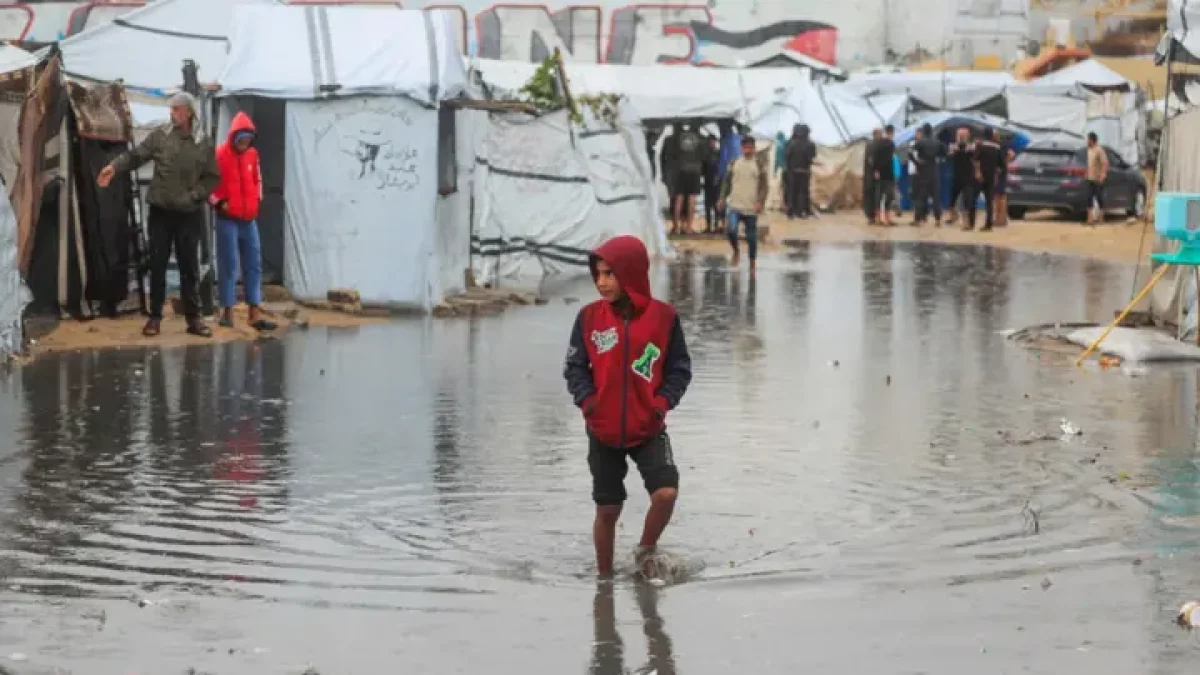
Winter cold and rain have brought a severe humanitarian disaster to Gaza. Bitter cold, waterlogging and floods are swamping the tents of displaced Palestinians and bringing down makeshift shelters. Aid agencies say thousands of tents, blankets, winter clothes and shelter materials are sitting in warehouses outside Gaza, unable to enter because the Israeli authorities have not given permission.
Human rights and aid workers say this winter crisis is not the inevitable result of a natural disaster, but that Israel’s restrictions on aid have made it far worse. In their view, emergency supplies are being held back as a way of putting pressure on the people of Gaza.
A few days ago, a mother found her six-month-old baby, Ihab Mohammed Hamad, lifeless. His lips, fingers and toes had turned blue. He died of the intense cold after rainwater got into the family’s tent.
In a video published by the Sameer Project, a Palestinian volunteer aid group, the baby’s grandmother said the family had done everything they could to keep him warm and wrapped in blankets, but nothing worked.
The group had given the family a dome-shaped tent. Hala Sabbah, who works for the group, said she was dismayed that the baby’s death had drawn so little attention.
Children dying of cold in makeshift tents has become an almost yearly reality in Gaza. The strip is facing rain and storms for a fourth winter in a row, yet the supplies people need for shelter are badly short.
150,000 tents sit in warehouses outside Gaza
The UN Office for the Coordination of Humanitarian Affairs (OCHA) says about 150,000 tents are waiting outside Gaza for delivery, already prepared for entry.
Sean Jones, Gaza director of UNRWA, the UN agency for Palestine refugees, said thousands of tents, winter clothes, blankets and large amounts of shelter materials are sitting in warehouses. They cannot be taken into Gaza because the usual approvals have not come from the Israeli authorities.
He alleged that approvals for aid to enter are being deliberately delayed.
With too few shelters to withstand the weather, about 65 percent of Gaza’s people, some 1.4 million Palestinians, are living in makeshift tents, dilapidated shelters or buildings at risk of collapse. Many of these shelters were flooded in the recent heavy rain. A strengthening El Niño has made the weather worse, but those involved see the shortage of aid as an entirely man-made crisis.
Israel has long restricted the entry of materials for building shelters and rebuilding infrastructure in Gaza. Even essentials such as tent poles and mobile homes are treated as “dual-use” goods, meaning items that could be used for military as well as civilian purposes, and their entry is limited on that ground.
Aid trucks fell sharply in one month
The supply of shelter and household items to Gaza has worsened in recent months. According to the Palestine Shelter Cluster, 908 trucks carrying shelter and household items entered Gaza in December 2025. In January 2026 the number fell to 409. In October this year, only 9 percent of all aid trucks entering Gaza carried shelter items.
Since aid stopped entering through the Rafah crossing last May, the Kerem Shalom crossing has been the only working route for aid into Gaza, and very few trucks are getting through it.
A report by the Norwegian Refugee Council (NRC) in early October said only 15 trucks carrying “dual-use” goods were being allowed into Gaza one day a week. At that rate, the NRC warned, winter aid stored outside Gaza would take more than seven months to reach the strip even in the best case.
An August assessment by the Palestine Shelter Cluster found that about 1.98 million people in Gaza, 94 percent of the population, were in severe, critical or catastrophic shelter need. In the month before the survey, only 10 percent of people had received any shelter assistance.
Shaina Low, the NRC’s communications adviser for Palestine, said Israel’s restrictions are stopping international organisations from delivering the help that is needed. She alleged that blocking aid to Palestinians amounts to an attempt to push international organisations out of Gaza altogether.
International aid groups obstructed
International humanitarian aid in Gaza has been further limited by a series of Israeli bans. Last December Israel banned the operations of 37 international non-governmental organisations, including the NRC, Doctors Without Borders (MSF) and Oxfam. Although a temporary stay was later issued, these groups still face obstacles in sending aid and international staff into Gaza. UNRWA, one of the main providers of shelter assistance in Gaza, is also under a ban. As a result, the scope for delivering aid directly through international organisations has shrunk.
Most shelter aid now reaches Gaza bilaterally, through committees run by the governments of Egypt, Qatar, the United Arab Emirates and Saudi Arabia. The NRC’s Shaina Low said international NGOs’ stocks inside Gaza are nearly exhausted, so reliance on small local groups and government committees is growing.
Tent prices up 52 percent
With international organisations restricted, small Palestinian-led volunteer groups are trying to cope. They buy tents in local markets and hand them out to displaced people, but supply shortages have pushed market prices unusually high.
According to the Palestine Shelter Cluster, the price of a tent in Gaza has risen 52 percent to $655. The price of an emergency shelter kit has risen 1,233 percent, and one now costs about $4,000.
Hala Sabbah of the Sameer Project alleged that many tents entering Gaza are stolen and sold in the market, and that tents are being distributed only to people on lists approved by the Israeli authorities. This, she said, has led to irregularities and discrimination in how aid is handed out.
The tents entering Gaza are also of poorer quality than before. Made from old and low-grade materials, they are not standing up well to rain and storms.
The Palestine Shelter Cluster’s August assessment found that more than half of Palestinians living in tents were in poor or badly worn tents, and 54 percent of them had lived in the same tent or makeshift shelter for at least a year.
Shaina Low of the NRC said such tents are usually made to last a few months, but wear out quickly in Gaza’s harsh weather. Without enough new supplies, people have to stay in the same worn-out shelters for long periods.
She added that not all the tents entering Gaza keep out rainwater, so extra tarpaulins are needed to make them usable.
Winter suffering “inseparable” from genocide, researchers say
With large numbers of buildings and infrastructure destroyed by Israeli attacks on Gaza, the space where displaced Palestinians can shelter keeps shrinking. Many places where tents could once be pitched are now rubble.
A spatial analysis by Forensic Architecture found that a large share of Gaza’s displaced people are increasingly being forced to shelter in low-lying coastal areas. Meanwhile, Israel’s expanded “Yellow Line” has brought more territory under its control, limiting where displaced people can move and shelter.
Nicola Banks, head of communications at Forensic Architecture, said the flooding of tent areas in the rain is not an accident. Instead, Palestinians have been concentrated in low-lying areas that lack the infrastructure needed for normal life.
In her view, the floods and waterlogging have made the destruction of Gaza’s infrastructure and the removal of Palestinians’ means of survival even clearer, and these conditions cannot be seen apart from the reality of an ongoing genocide.
Hala Sabbah of the Sameer Project said colleagues working in Gaza are physically and mentally exhausted after coping with three winters of hardship in a row, and far more staff than before are taking sick leave.
“A slow genocide has gone on throughout 2026, but in the last three to four months it has sped up,” she said. “I think that is also part of their strategy.”
Sabbah alleged that, to avoid an international reaction, Israel is making the situation worse gradually rather than taking any single large step. In her words, “It is a slow genocide, and it has now been accelerated.”
বাংলায় মূল প্রতিবেদন পড়ুন · Read the original Bengali report