
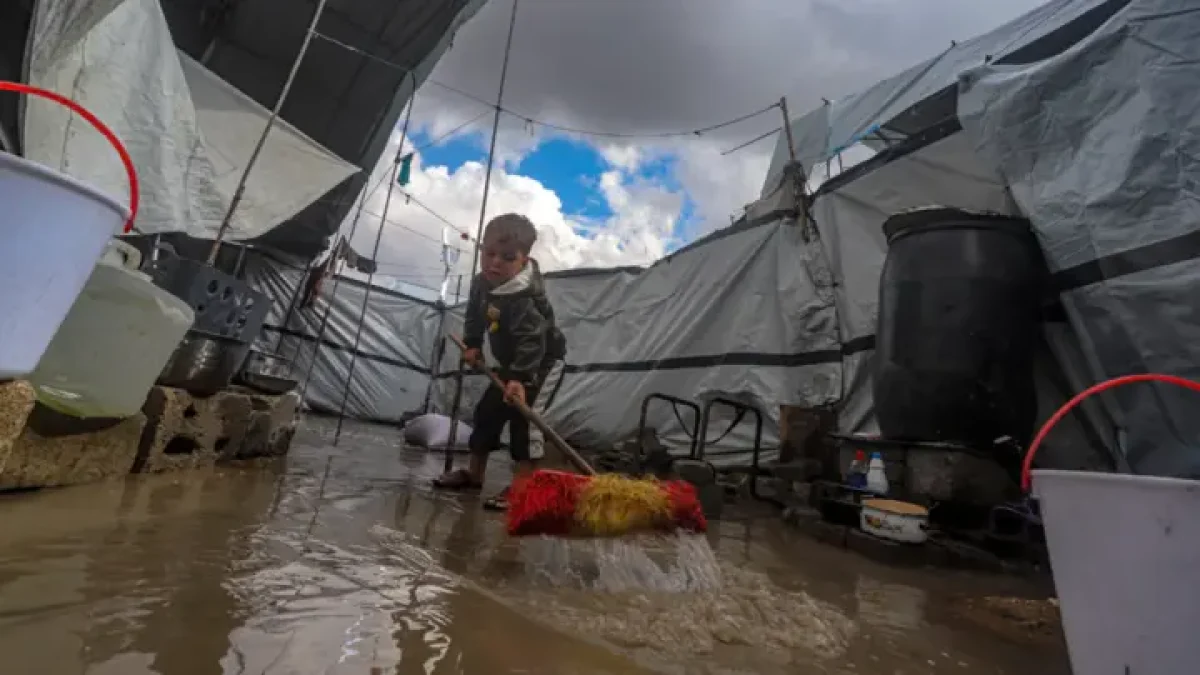
GAZA — Winter has brought a new disaster for displaced people living amid the ruins of war in Gaza, Palestine. Heavy rains, flooding and landslides have made life even more unbearable for hundreds of thousands residing in tents, submerging shelters and ruining their meager belongings as aid workers warn conditions could worsen in the coming winter months.
Early this month, four people were killed when a sand embankment collapsed during a stormy, rain-soaked night in the southern coastal area of Al-Mawasi. Eyewitness Abdul Karim Al-Sahar, 30, said his mother was buried beneath the collapsed sand and pulled out alive, while there was no sign of life from others buried nearby as an adjacent tent completely vanished underground.
Al-Sahar's home was in Beit Hanoun in northern Gaza, which was almost entirely destroyed early in the two-year war and whose ruins now lie beside the Israeli-controlled Yellow Line. Displaced by the fighting, he now lives with his family in a tent in Al-Mawasi.
Al-Sahar said his family lives in constant fear but has nowhere else to go, adding that renting an apartment is beyond their means as war injuries have left him unable to work, with no income or savings.
More than 40,000 shelters damaged by rain
According to the United Nations, recent rains have affected more than 220,000 people in Gaza and damaged over 40,000 shelters. A large portion of the roughly 2 million displaced residents now live in densely populated tent camps like Al-Mawasi, which lack adequate sanitation, clean water and other basic facilities.
Waddah Hubaishi, regional director at World Central Kitchen, said such disasters hit Gaza every winter, calling the season an extremely harsh period that returns like an annual natural calamity.
Aid officials said poor families, people with disabilities, the elderly and the sick face the greatest danger, though few displaced residents will escape the hardships of the approaching winter.
Killings continue despite ceasefire
Although a ceasefire that took effect in October 2025 reduced large-scale fighting, violence in Gaza has not completely stopped. The United States-backed Board of Peace accused both Israel and Hamas last week of failing to meet ceasefire terms, warning the truce cannot hold for long without visible progress.
The broader ceasefire plan outlines Hamas disarmament, Israeli troop withdrawal and Gaza's reconstruction, but progress has stalled. Hamas agreed in July to a framework to hand over weapons and transfer Gaza's governance to a civilian interim authority, while Israel maintains it will not withdraw troops until Hamas disarms.
Currently, about 70 percent of Gaza remains under Israeli military control. Last week, Israeli forces launched a major ground operation beyond the Yellow Line targeting a suspected Hamas tunnel, forcing dozens of displaced Palestinians to flee their tents. According to Gaza's Health Ministry, more than 1,600 Palestinians have been killed in Israeli attacks since the 2025 ceasefire took effect.
Fewer aid trucks entering Gaza than pledged
Under the ceasefire deal, 18,000 trucks of goods were meant to enter Gaza each month. However, data obtained by Israeli newspaper Haaretz shows the monthly count has not exceeded 13,000 since March and dropped below 5,000 in some months. Aid groups also say many trucks entering Gaza are not carrying full loads.
The United Nations said Israeli policies are obstructing the entry of essential supplies and their delivery to less flood-prone areas inland, citing multiple approval steps, limited border-crossing capacity and unpredictable schedules.
Aid workers said restrictions imposed by Israeli authorities also prevent regular deliveries of vital spare parts and equipment, leaving their ability to repair and keep heavily worn emergency gear running nearly exhausted.
Last week, Australia, Canada, the United Kingdom and Italy urged Israel to allow 150,000 tents and other emergency equipment stuck at the border into Gaza before winter sets in.
Meanwhile, Israeli officials say more than 93,000 tents and over 8,600 trucks carrying winter supplies and essential goods—including laboratory materials, engine oil and incubator parts for newborns—have already entered Gaza.
Food available, but residents lack means to buy it
Even as supplies enter Gaza, a large majority of ordinary residents cannot afford them. Because most goods arrive through a small number of commercial importers, fresh meat, vegetables, chocolate and other food items are available in markets but remain beyond most Palestinians' reach.
United Nations projections indicate roughly two-thirds of Gaza's population will face severe food insecurity through the end of 2026, down from 77 percent in late 2025, signaling only modest relief in an otherwise severe crisis.
Mohammad Shafut, owner of one of Gaza's oldest eateries, Shafut Restaurant, said business briefly picked up right after the ceasefire, but customers are now mostly international and local agency staff, traders and their families. The issue is no longer just market availability, he said, as many people lack the money to buy basic food or eat at restaurants.
Northern Gaza Chamber of Commerce Secretary General Imad Al-Ghoul said trade and economic conditions have seen no meaningful improvement since the ceasefire. He estimated that nearly 95 percent of local industrial facilities have shut down, while business concentration in the hands of a few traders has curbed competition and driven up prices—a burden borne by ordinary residents.
According to an August United Nations geospatial assessment, just 3 percent of Gaza's farmland remains usable and intact, with most of the rest located inside Israeli-occupied zones.
Salvaged food sacks and broken wood used to protect tents
Aid groups are also working within tight constraints to battle the severe weather. World Central Kitchen workers are breaking down wooden food crates to make tent poles, turning old food sacks into sandbags and repurposing worn-out metal pots into makeshift flood barriers.
While these efforts offer temporary protection, concerns remain over how well they will hold up against heavy rain and storm surges.
Sitting near rubble in the Nuseirat refugee camp, 44-year-old Abd Alioua said residents can no longer bear the suffering and want someone to find a solution, saying people in tents are flooding, people on the streets are getting injured and even those in shelters are not safe.
Third winter spent in torn tents
Khan Younis resident Mohammad Abu Daqqa, 39, lives with his wife and seven children in a battered tent along the coast in Al-Qarara. The former farm worker has earned no income since the war began. His father, brother and two nephews were killed in the war, and his daughter suffered shrapnel wounds to her leg.
Abu Daqqa said winter is an exhausting battle that returns every year, marking their third winter in the same spot facing cold, rain and strong winds. Their tent is so tattered it can no longer withstand the weather, forcing his children to hold down the edges so it does not tear or blow away.
The family dug shallow trenches around the tent to channel away rainwater, though they know the ditches will fail if sea levels surge. While they receive some meals from community kitchens and World Central Kitchen, they cannot afford soap or laundry detergent, forcing his wife to ask other displaced families for basic supplies.
Abu Daqqa said his sole wish is an end to the misery and a permanent shelter where his family can live with safety and human dignity.
Death toll surpasses 74,000
Israel launched its military campaign in Gaza after Hamas's surprise attack in October 2023 killed around 1,200 people in Israel. According to Gaza's Health Ministry, the Palestinian death toll in the enclave since the war began has reached 74,000, most of them civilians.
In June, an independent United Nations commission of inquiry said Israel has continued committing genocide by deliberately targeting Palestinian children.
Despite the ceasefire, Gaza residents remain without security, food, medical care or adequate housing, as winter rain and flooding add new dangers while aid restrictions, joblessness and ruined infrastructure leave them with little ability to cope.
Displaced Palestinians in Gaza fear the harsh winter weather will bring an even greater catastrophe on top of the war's destruction.