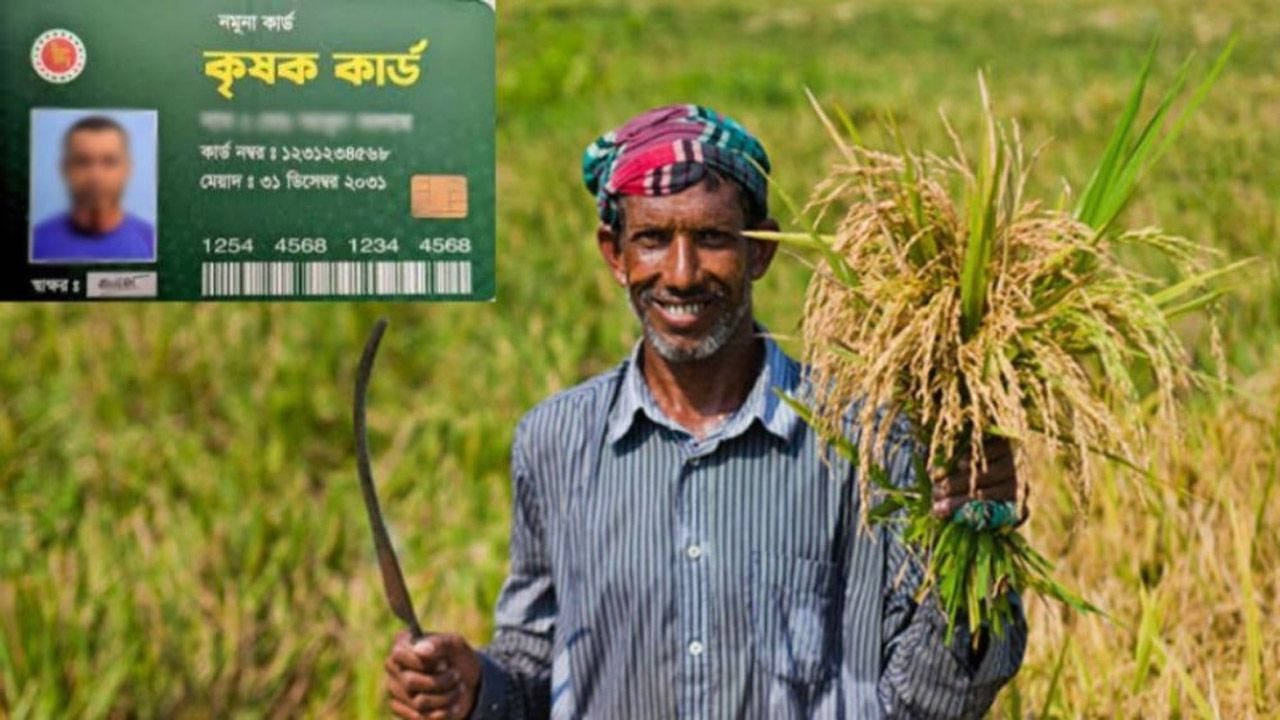
The farmer card program has opened a new chapter in protecting farmers financially, raising agricultural productivity and strengthening social safety nets in Bangladesh's farm sector.
Under the program, nearly 5 lakh farmers in Kushtia on December 2 and Gaibandha on December 5 will receive agricultural input assistance. Records for 4 lakh 43 thousand 484 farmers have already been updated, while data for the remaining 56 thousand 516 is being verified and is expected to be finalized before the end of November, the Ministry of Agriculture said.
Across the two launches, 4 lakh 6 thousand 591 farmers with bank accounts verified through iBAS++ will receive direct financial support, with Prime Minister Tarique Rahman scheduled to hand over farmer cards to growers at the designated ceremonies.
Designed to deliver direct financial aid to landless, marginal and small farmers, support farm-input purchases and guarantee data-driven registration and transparent state disbursements, the two-district rollout is expected to raise output, inject liquidity into rural markets and improve village livelihoods.
Agriculture remains a pillar of Bangladesh's economy, employment and food security. While large shares of the population depend on farming, rising input costs, price volatility, climate shocks and natural disasters pose constant challenges, forcing small and marginal growers to contend with seasonal cash crunches and cost pressures.
To ease those pressures and make farm services simpler and more effective, the government launched the farmer card initiative, setting a target to cover roughly 2 crore 40 lakh farmers nationwide within four years.
The Agriculture Ministry said initial plans are underway to grant landless, marginal and small farmers 2,500 taka annually via farmer cards to purchase seeds, fertilizer and essential inputs, strengthening production capacity while streamlining state aid delivery.
According to the latest official summary of the program, agricultural input disbursements will be implemented on December 2 in Kushtia and December 5 in Gaibandha.
In the December 2 Kushtia program covering designated areas of Khulna and Dhaka divisions, 2 lakh 89 thousand 253 farmers fall under the scheme, of whom 2 lakh 68 thousand 836 hold iBAS++-verified bank accounts, with total aid set at 67 crore 20 lakh 90 thousand taka at 2,500 taka per farmer. Of those totals, 1 lakh 40 thousand 597 farmers sit across 110 agricultural blocks in 10 upazilas of Khulna division, and 1 lakh 52 thousand 220 across 147 agricultural blocks in 13 upazilas of Dhaka division.
Under the December 5 Gaibandha program across 50 agricultural blocks in eight upazilas of Rangpur division, 1 lakh 54 thousand 231 farmers are covered, including 1 lakh 37 thousand 755 with iBAS++-verified accounts, with allocations totaling 34 crore 43 lakh 87 thousand 500 taka.
Combined across both rollouts, five lakh farmers fall under input assistance, including 4 lakh 6 thousand 591 verified accounts, with aggregate disbursements of 101 crore 64 lakh 77 thousand 500 taka—rising further as remaining farmer enrollments clear verification, ministry officials said.
Cards will also be handed directly to 2,850 farmers in an agricultural block in Kushtia Sadar upazila and 1,990 farmers in an agricultural block in Gaibandha's Gobindaganj upazila, with Sonali Bank PLC partnering in card distribution.
Per the latest November 26 status report, nationwide data collection has covered 26.98 lakh farmers, with 19.02 lakh approved by committees, 16.52 lakh bank accounts linked and 15.32 lakh verified through iBAS++.
Officials said integrated storage of farmer identities and farming records will allow future subsidies, incentives and state services to be delivered more accurately, marking a major step toward digitizing Bangladesh's farm administration and eliminating duplication through iBAS++ checks.
Northern districts, particularly the Rangpur region once haunted by seasonal "monga" food scarcity and unemployment, have seen major improvements through higher crop yields, expanded irrigation, improved seed varieties, farm mechanization and agro-based jobs. Direct aid via farmer cards is expected to further ease seasonal credit strain for smallholders and boost local circulation while supporting agro-economic zones, processing industries, cold storage and market infrastructure.
Alongside financial transfers, government supplies of fertilizer and seed, agricultural mechanization and weather forecasts sent to farmers' mobile phones are widening tech adoption across the countryside, with the farmer card system set to expand gradually across all 64 districts.
Department of Agricultural Extension (DAE) Director General Md Abdur Rahim told state news agency BSS that the farmer card program will reinforce field-level contact and extension services, matching farmers with balanced fertilizer management, improved seeds, modern farm technology, mechanization and weather-based advice.
Agriculture Secretary Md Selim Khan told BSS that Prime Minister Tarique Rahman has placed special emphasis on farmers' welfare, agricultural output and strengthening the rural economy, adding that verified registration and transparent banking transfers will make farm support simpler and more farmer-friendly in Kushtia, Gaibandha and beyond.