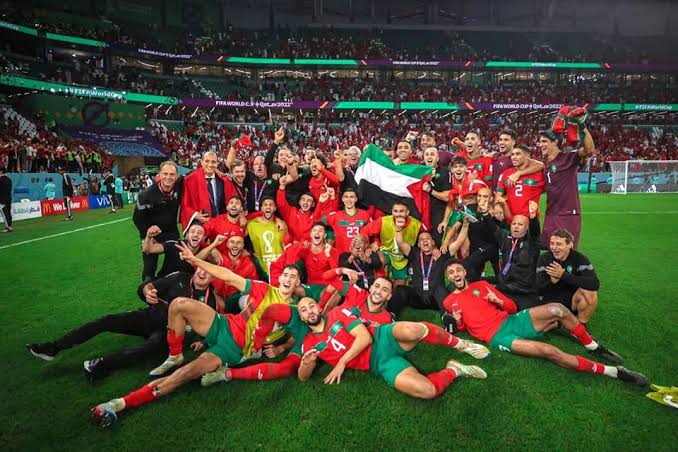
Every World Cup produces a new fairy tale. An unfamiliar nation rises suddenly, like Halley’s Comet, or another climbs steadily into the light, and we call it a Cinderella story. Many want to add Morocco’s name to that list. But truthfully, Morocco’s journey is no fairy tale. The fight forged at the foot of the Atlas Mountains has become an astonishing reality on “the greatest show on Earth.” It is the story of a banyan tree that has spent years spreading its roots underground before growing tall.
The 3-0 win over Canada in the World Cup round of 16 could mislead many into thinking it was an easy afternoon. In fact, for the first 15 minutes, the ball seemed to belong to Canada alone. Morocco’s defense was tested repeatedly, and goalkeeper Yassine Bounou had to make two life-saving saves. But that is normal, at least for Morocco. The mark of a big team is that they do not fear the storm — they know how to wait it out. This Morocco side is no worshipper of beautiful football. They know the World Cup does not award trophies for beauty; it awards them to winners. So whether as artists or as soldiers, the Lions of the Atlas are equally at ease in either role.
With the win over Canada, Morocco extended their unbeaten run to 34 matches. The number is not just a statistic — it is another name for consistency. Since a loss to Kenya in August 2025, no team has been able to bring them to their knees. World Cup, African qualifiers, international friendlies: everywhere, they have established themselves with a strange steadiness.
African teams were once “guests” at the World Cup. They would come, leave behind a few memories, and depart. Morocco has changed that perception. In 2022, they wrote history as the first African nation to reach the semifinals. This time, on North American soil, they are back in the quarterfinals. Their success can no longer be called a surprise — failure would be the surprise now.
Morocco coach Mohammed Ouahbi said after the match: “The most important thing is that we haven’t changed our identity. Difficult moments came, but we never forgot who we are playing for.” The remark was not just a comment at a press conference — it reflects the whole philosophy of Moroccan football. Because this team is not simply eleven footballers. They are a symbol of a nation’s self-belief.
That self-belief was not born overnight. Today’s Morocco is the product of a football academy whose foundation was laid in 2009 and a modern training complex built in 2019. Investments worth hundreds of millions of dollars, long-term planning, and the return of Moroccan-descent footballers raised in Europe to the national team have gradually built this new force. Many players, including Achraf Hakimi and Brahim Diaz, were born in Spain and grew up in European football. But in the end, their hearts pulled them back to the red-and-green jersey. They are not just talent — they are a bridge between two cultures.
Against Canada, Hakimi was a symbol of leadership, much like a captain. Brahim Diaz provided two assists. And Azzedine Ounahi showed how a midfielder can change the entire course of a big match. Substitute Soufiane Rahimi came off the bench to score again, as if the bench itself were another weapon for this team. Morocco’s greatest strength may not be any single player. Their greatest strength is knowing when to attack, when to wait, and when to break the opponent’s patience.
France awaits next — a tougher test, a bigger stage. If Morocco plays the way they did in the first half against Canada, France will show no mercy. That is true. But it is equally true that this Morocco team grows stronger with every match. Four years ago in Qatar, the world watched their success with astonishment. This time there is no astonishment — only expectation. That is the biggest change of all.
Morocco is no longer a fairy-tale character. They are now a team that world champions have to reckon with. African football has waited a long time for its sunrise. That sun may not have fully risen yet. But the horizon turned red long ago. And the name of that red glow is Morocco, “the Atlas Lions.”
বাংলায় মূল প্রতিবেদন পড়ুন · Read the original Bengali report