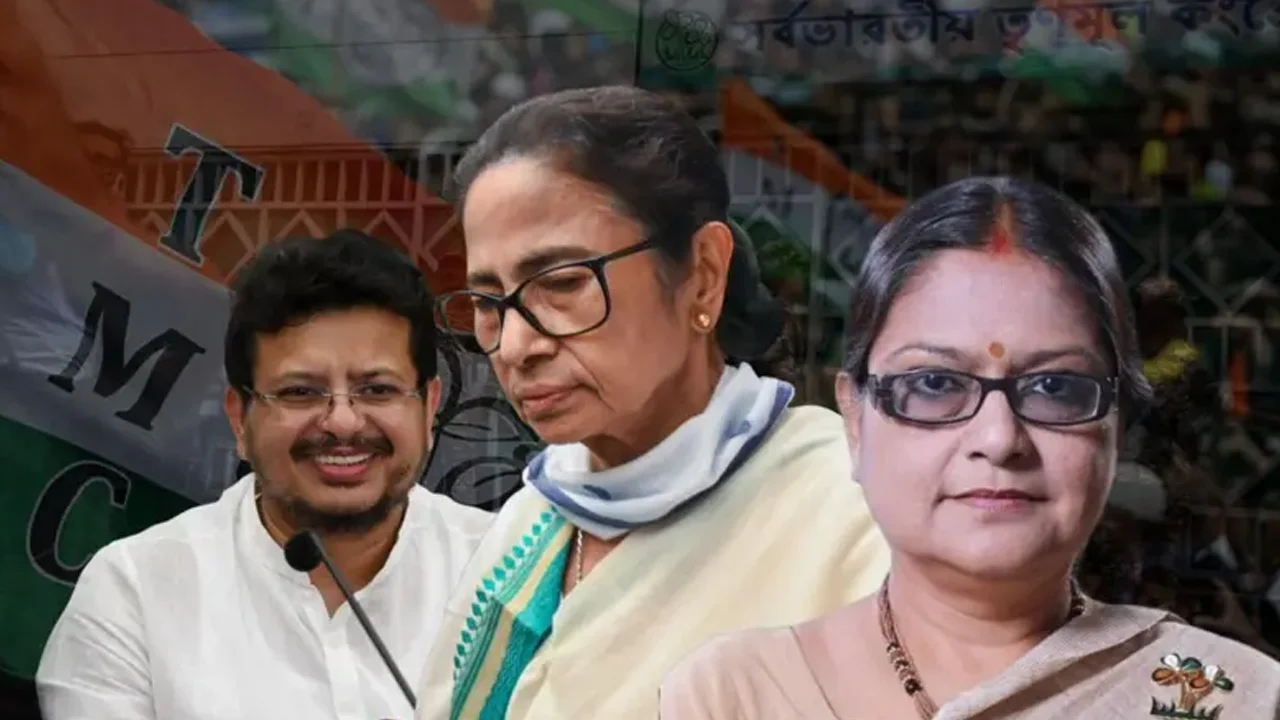
The Trinamool Congress, Mamata Banerjee’s party that held power in West Bengal for 15 consecutive years, has shattered just weeks after the election results were announced. While many political analysts had made predictions about the party’s future, none had foreseen a collapse so swift. The party, more than 28 years old, has broken into three pieces in just 28 days.
Most of the party’s MLAs have now formed a separate bloc under Ritabrata Banerjee, claiming to be the ‘real Trinamool.’ They are serving as the main opposition in the state assembly in Kolkata.
In Delhi, meanwhile, at least 20 of the Trinamool’s Lok Sabha MPs have written to the speaker announcing they are leaving the old party. They have joined a party called ‘NCPI’ and are backing the ruling NDA coalition at the centre.
The original party remains, on paper, under the control of Mamata and her nephew Abhishek Banerjee, and has come to be known as the ‘Kalighat Trinamool.’
The three main reasons behind the Trinamool Congress’s rapid disintegration are set out below.
1. Election-obsessed, ideology-free politics
The Trinamool Congress had no political philosophy or ideology of its own, the analysis goes. Mamata Banerjee’s politics rested largely on populism. From the party’s founding in 1998 until it came to power in 2011, its sole aim was to dislodge the CPI(M). A politics dependent purely on winning elections ultimately came at a heavy price.
After losing the May 4 election, the party’s leaders realised they had no ideological foundation to fall back on once they were out of power. In India, the Congress, the BJP and the left parties have defined ideologies and organisations that let them survive electoral defeat. Even Jamaat-e-Islami, when it was banned in Bangladesh, kept itself alive on an ideological base. That did not happen with the Trinamool. As a result, despite winning 41 percent of the vote, the party — unable to build itself beyond election-centred politics — fractured easily.
2. The BJP as catalyst
After the electoral debacle, the BJP let slip no chance to strike at Mamata Banerjee in her weakest moment. The split was actively backed by the BJP, according to the analysis. Before breaking away, rebel MLA leader Ritabrata Banerjee met Suvendu Adhikari, and the rebel MPs held talks at the residence of BJP leader Bhupender Yadav. The entire affair was overseen from behind the scenes by Home Minister Amit Shah, it is reported.
The BJP wanted West Bengal’s opposition — instead of the street-agitating Mamata — to be a ‘friendly’ one that would offer only constructive criticism.
In Delhi, the BJP had been dependent on its allies after failing to win a single-party majority (240 seats) in the 2024 general election. Peeling away two-thirds of the Trinamool’s MPs to push the NDA’s strength past 300 was the BJP’s aim. The BJP did not, however, take the rebels directly into its own ranks.
3. The Abhishek Banerjee factor
Almost all the Trinamool’s rebel leaders blamed Mamata’s nephew and unofficial heir, Abhishek Banerjee, for the suffocating atmosphere inside the party. Abhishek ran the party ‘in a corporate style’ and maintained a tight inner circle of his own, they said, opening a wide gap between the Trinamool’s grassroots and its top leadership.
In trying to impose corporate discipline, Abhishek widened the distance from ordinary people. A few years ago he brought in an election consultancy called I-PAC. Its paid staff effectively hijacked the party, deciding who would get tickets and who would say what, the rebels alleged. Various allegations of financial impropriety against Abhishek further damaged the party’s image. Angry leaders are now pointing the finger at Abhishek to justify their own defections.
বাংলায় মূল প্রতিবেদন পড়ুন · Read the original Bengali report