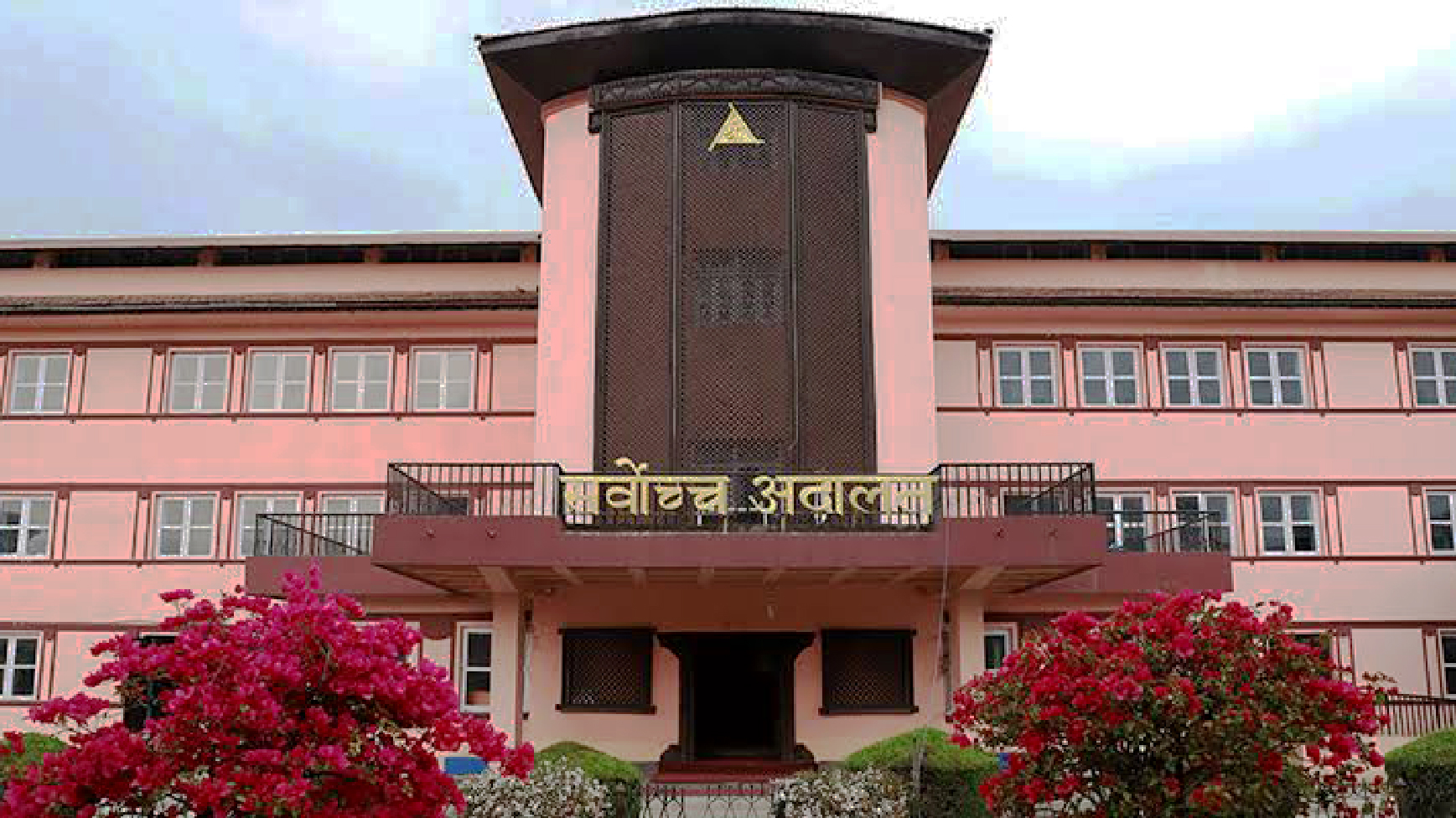
Nepal’s Supreme Court has issued an interim stay on the work of a high-level commission set up to investigate the source of assets of former and current government officials. On Friday, the court ordered that, until the case is finally settled, the commission cannot compel any citizen or official to submit details of their assets, nor recommend legal or punitive action against anyone based on information already submitted.
The commission, formed by the government led by Balendra Shah, will now have its constitutional validity examined by a full bench of the Supreme Court, and the order has effectively brought its main work to a halt. A division bench of Justices Tek Prasad Dhungana and Srikanta Poudel issued the order after two days of hearings and, citing the constitutional importance of the matter, directed that the case be transferred to a three-member full bench.
The interim order came in response to two writ petitions filed by advocates Prem Raj Silwal and Man Bahadur Lamichhane, who argued that the government had violated its constitutional authority by forming the commission through an executive order alone, bypassing parliament. The court said that if the investigation proceeded according to the scope of the gazette notification forming the commission, it could clearly violate Nepal’s constitution and prevailing laws and cause irreparable legal harm to those concerned. The petitioners contend that the commission’s formation runs counter to the right to privacy under Article 28 of the constitution and to the jurisdiction of the anti-corruption body, the Commission for the Investigation of Abuse of Authority (CIAA), under Article 239.
The five-member commission was formed on April 15 this year under retired Supreme Court Justice Rajendra Kumar Bhandari and tasked with tracing the sources of illegal wealth of politicians, bureaucrats and security officials who held office over the past 20 years – from the mass movement of 2005-06 to 2025-26. Its other members are retired justices Purushottam Paranjuli and Chandi Raj Dhakal, former Nepal Police DIG Ganesh KC and chartered accountant Prakash Lamsal. From the outset, part of the legal community had questioned the commission’s validity, and some retired judges had publicly announced they would boycott it and not submit their asset details.
The commission’s work had been in full swing until the stay. Its spokesperson, Ganesh KC, said it had already received 13,660 asset declarations and more than 1,500 general complaints, and that about 25,000 current and former officials were due to submit declarations by July 16. “We began opening the submitted declarations on Friday morning,” he said. “Over the past four days we had completed a preliminary review of about 300 files, and where we found suspicious assets we were preparing to send the cases to the CIAA.” Several influential political and administrative figures had already submitted their declarations, including former prime ministers Madhav Kumar Nepal and Sushila Karki, former cabinet chairman Khil Raj Regmi and former deputy prime minister Ishwar Pokhrel, as well as several former chief justices, army chiefs and secretaries. The commission had sought declarations from 52 retired Supreme Court justices and more than 220 former high-court judges.
Prominent Nepali constitutional expert Bipin Adhikari welcomed the court’s decision. “Preventing corruption and ensuring accountability is extremely important, but the government cannot create such a mechanism or commission through an executive order alone, bypassing parliament,” he said. “Even a government that wants to ensure good governance cannot bypass parliamentary scrutiny.” Pushkar Sapkota, law secretary at the Nepali prime minister’s office, said the government was assessing the legal aspects of the order. “So that the fight against corruption does not stop entirely, the government will examine all possible legal options and take the necessary steps,” he said. For now, the thousands of asset declarations and complaint files submitted to the commission will remain in sealed envelopes, awaiting the Supreme Court’s final verdict.
বাংলায় মূল প্রতিবেদন পড়ুন · Read the original Bengali report