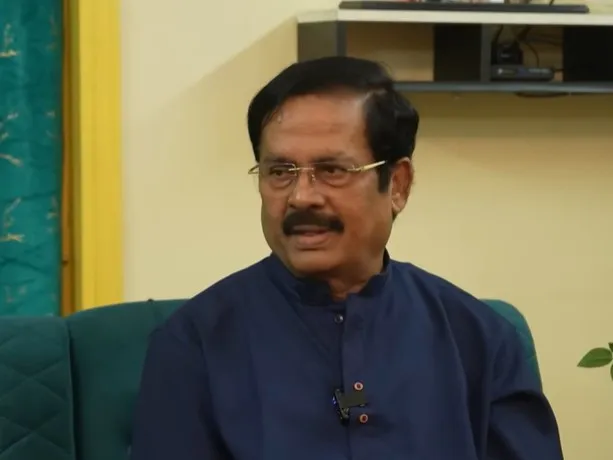
Jahangir Kabir Nanak is a three-time former member of parliament, a two-time former minister and a presidium member of the banned Awami League. He has been living in hiding in India since the Awami League government fell on August 5, 2024. He recently spoke to India’s Anandabazar about the party’s future politics and openly discussed the uprising and other issues.
Question: How are you, Jahangir Kabir Nanak?
Nanak: We do politics and are a family. When this family is not well, none of us is mentally well.
Question: You have been in hiding since the fall of the Awami League government. Is this the first time in your life?
Nanak: I have a long history of hiding. I began politics at school, during the anti-Ayub movement in 1969. I came to India in 1971, received training, returned with weapons, fought as a member of the Mujib Bahini and helped liberate the country. After Bangabandhu Sheikh Mujibur Rahman and his family were assassinated on August 15, 1975, the anti-Bangladesh and anti-democracy forces that opposed independence began their journey, and we had to live in hiding. We had to hide for a long period during Khaleda Zia’s rule, the BNP-Jamaat period. We worked, organised and held meetings, then had to hide again.
Question: After being away from home for so long, do you miss the country and your friends and family?
Nanak: We are people devoted to our workers. Sometimes my heart breaks. In 1971 I fought on the front against the Pakistani Punjabi forces. We fought an ideological war. Since August 5, 2024, as a freedom fighter I have watched them disgracefully smash Bangabandhu’s statue and demolish Dhanmondi 32 with bulldozers. I ask why I survived and why I did not die before seeing it. If I had died before this, it would have been a peaceful death. We achieved independence under Bangabandhu’s leadership through the Liberation War, and the defeated forces took revenge. We had to see freedom fighters humiliated and beaten. I have not slept at night for the past two years; after the dawn prayer, I sleep only when exhaustion takes over. I also remember visiting my son’s grave, which I have not been able to do for two years, and my parents’ graves, which I have not visited for a long time. I have no sorrow about those things; my sorrow is that those who seized power on August 5 are anti-Bangladesh, anti-independence, anti-democratic and defeated forces of the Liberation War. They are agents of Pakistan and Pakistan-oriented, and still cannot accept Bangladesh. They want to turn it into Pakistan again.
Question: How did you survive and come to India, and who helped you?
Nanak: I was at Ganabhaban until 12:30am on the night of August 4. I left the next day, August 5, when the leader left. I had almost collapsed in my sleeping place. When I regained consciousness, a close Air Force contact called and said someone was calling me. He said not to worry—the person had crossed the border safely. I left home and changed shelters repeatedly, discarding the telephones I used. At one point I realised they would become desperate to arrest me and decided I had to leave the country. My son-in-law, a doctor, called and told me to leave and follow his instructions. He guided me out. August 5 had passed, and I crossed the border on August 16.
Question: Did you reach Kolkata on August 16?
Nanak: No, I reached Shillong on August 16. From Shillong I went to Malda, where my grandchildren and daughters had taken shelter, and the next day I went to Kolkata.
Question: Many people criticise Sheikh Hasina for leaving party leaders and activists amid the disaster. How do you view the decision?
Nanak: If our leader had delayed by 30 minutes on August 5, they would not merely have killed Prime Minister Sheikh Hasina and her younger sister Sheikh Rehana, who was at Ganabhaban that day—they would have killed them brutally. Because she is alive, the conscience of the world and of 180 million people is saying that no one else is capable of leading this country as Sheikh Hasina is.
Question: Did the Indian government give you a specific protection or status, and what would you do if Bangladesh put pressure on it?
Nanak: We believe the government here is like water trembling on a colocasia leaf, so how much capacity does it have to exert pressure? Whatever the pressure, the Indian government can handle it.
Question: What caused the collapse of the government and the party, and what mistakes will you avoid?
Nanak: We fell into a deep conspiracy, a deep-state conspiracy.
Question: You were in power for 16 consecutive years. Did you not realise where the leak was?
Nanak: I will not admit that we failed to understand. If I sensed something, my leader also understood. Six months earlier she began saying that attempts and conspiracies were being made to remove her. She warned that “white-skinned people” wanted to remove her and alleged that Dr Yunus was conspiring to topple her government. She informed and warned the people and the party. You may ask about our party’s failures or weaknesses, but deep-state conspiracies have occurred around the world, sometimes succeeding and sometimes failing. On the day the so-called quota activists—essentially Shibir—occupied Dhaka University with weapons, the Chhatra League president and secretary called the leader, and I called the prime minister. She told us to leave the halls and campus and not to enter any conflict because she did not want anyone killed. We could have surrounded Ganabhaban with 50,000 people; our mobilisation would have overwhelmed them. With a signal, we could have brought 500,000 to 1 million people into Dhaka. Our strongholds stretch from Dhaka to Mawa, Shariatpur, Madaripur, Faridpur, Gopalganj and Bagerhat; Gazipur is another Gopalganj, and 100,000 people could have entered from there. Keraniganj, Narayanganj and Narsingdi are also strongholds. We could have closed every gap and taken control, although we knew they had weapons.
Question: Could the collateral damage have been much greater?
Nanak: Much greater. Would we have held back? No. Even at my age I would have stood with a stick. She did not want bloodshed. We could have done it; this is the Awami League, whose roots cannot be uprooted. Hold a fair election under an interim government—if we fail to win a two-thirds majority, let a UN force come and conduct the election. If we do not win two-thirds, we will all bow our heads and leave politics.
Question: Why India? Sheikh Hasina’s son is in Washington and she was reportedly considering London.
Nanak: It is wrong to place the responsibility on India. For the prime minister’s security, SSF and Air Force officers took Sheikh Hasina safely to Delhi. What role did India have beyond that?
Question: Who led the operation from India’s side?
Nanak: I cannot say that now.
Question: Have you met Sheikh Hasina?
Nanak: Yes.
Question: How is she?
Nanak: Alhamdulillah, she is very well. I am grateful to the Indian government. She receives the prime minister’s protocol and security. When we ask her on the telephone how she is, she says, “I am well; tell me whether you are well. Do not worry about me.” I recently asked her, and she said that in two years she had caught a cold only twice and had not needed a single medicine apart from those two colds. Inshallah. Pray for all of us.
Question: Is there an Awami League office in Kolkata where senior leaders meet?
Nanak: Various reports appear; they are sensational.
Question: What about reports in the international media?
Nanak: They have no basis. If someone gives us a place to sit, we may visit to spend time and get some oxygen, but there is no office here.
Question: How are you running the organisation in Dhaka North’s Mohammadpur area?
Nanak: From the day I came to Kolkata I have stayed in touch with leaders and activists in my area and tried to share their joys, sorrows and hardships. I check on those in jail and those who have been arrested and share their families’ difficulties. My daughter, who is the Bangladesh Mahila Awami League secretary for women and children, spends much time in my constituency and looks after the families of detained workers. On my leader’s instructions, we started processions and other activities in Dhaka-13. Many were arrested in marches and torch processions.
Question: You are accused in the July movement killings in Mohammadpur and the International Crimes Tribunal has issued an arrest warrant. As a lawyer, will you surrender or fight?
Nanak: I am fighting strategically and legally.
Question: Is it true that you are accused in the killing of nine people?
Nanak: They are trying to put the blame on the wrong person. I have all the case documents. They repeatedly say “on his instructions”, but no witness says they saw him. Who gave an order from the seventh heaven? How people died and whose bullets killed them is not for me to know. Did I go there with a weapon and shoot? Can they show such evidence? If the law and courts proceed according to law, I can say that none of the murder cases filed, including those against my leader Prime Minister Sheikh Hasina in the ICT, will stand.
Question: Sheikh Hasina is reportedly returning in December. Will you return?
Nanak: Of course. We will go and arrive before her.
Question: Will Jahangir Kabir Nanak be seen again in Bangladesh politics?
Nanak: If I remain alive, you will see me. Pray that I do not die.
বাংলায় মূল প্রতিবেদন পড়ুন · Read the original Bengali report