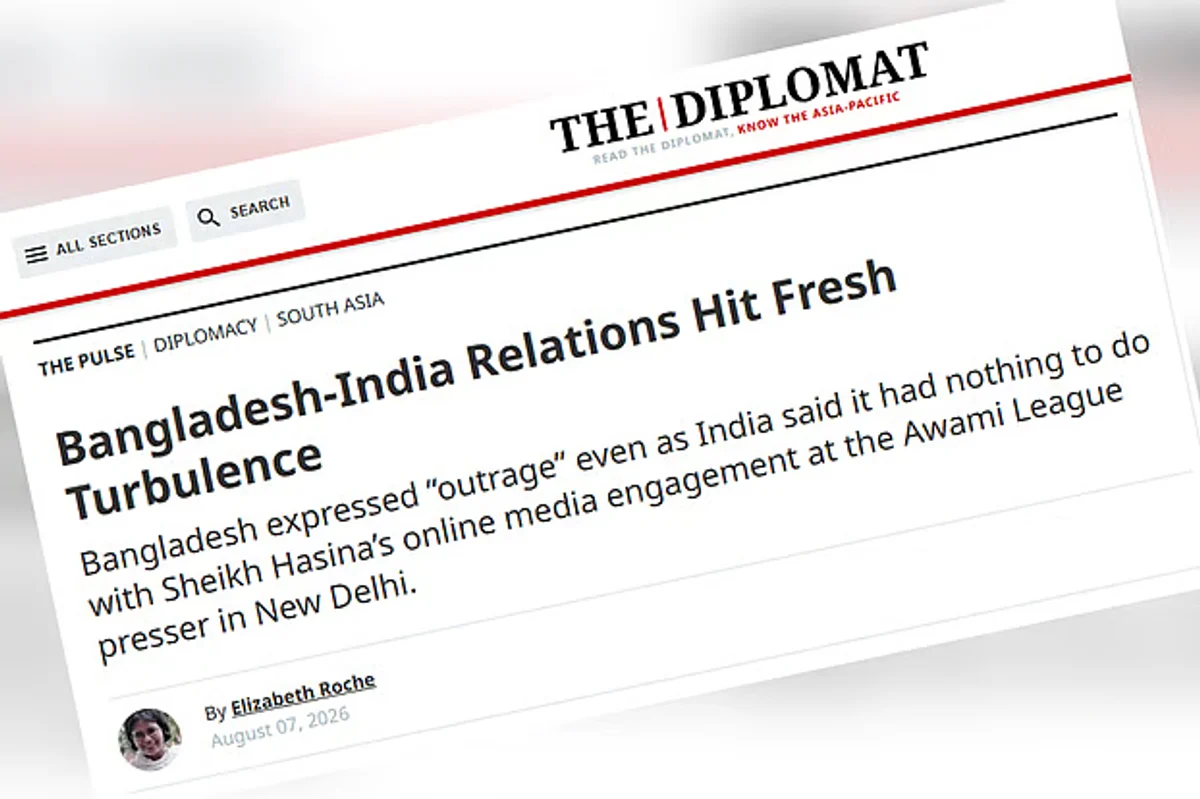
Ousted prime minister Sheikh Hasina, toppled in the student-people uprising, held a virtual press conference from New Delhi, India, last Wednesday. Bangladesh’s government has lodged a strong reaction with the Indian government for allowing her to hold it in New Delhi.
The 78-year-old Sheikh Hasina has been convicted of crimes against humanity over the attempt to suppress the 2024 student-people uprising. She is a fugitive convict under a death sentence, and her party, the Awami League, has been banned from operating in the country.
Staying in Delhi for two years, Sheikh Hasina has issued audio messages on social media at various times and given interviews to various outlets by email. This is the first time she has joined an event in Delhi online and spoken directly.
Analysts’ views on Sheikh Hasina’s announcement
At the press conference, Sheikh Hasina said she would return home this December — an announcement made two years after she left the country for India.
According to analysts, she is saying this in a desperate bid to maintain her political relevance, hold on to supporters and reactivate the banned Awami League.
In a report on Thursday, Japan’s influential outlet Nikkei Asia said Michael Kugelman had put forward three possible reasons behind Sheikh Hasina’s announcement of a return. He is a South Asia analyst at the US think tank the Atlantic Council. His reasons are as follows.
First, she may believe the current political environment under the BNP-led government is more favourable to her than during the interim government — which banned the Awami League’s political activities, and under which the judicial process that sentenced her to death took place.
Second, Sheikh Hasina has claimed the charges against her in court are politically motivated, so she may want to present her position in court and clear her name.
According to Kugelman, the simplest explanation is that she wants to leave politics and simply return to Bangladesh to spend her retirement and die there.
On condition of anonymity, a senior Awami League leader said he believed Sheikh Hasina genuinely wanted to return home. According to him, one way to reward leaders and workers for their loyalty to the party would be for her to return.
Mahmudur Rahman Manna, a former senior Awami League leader and now a sharp critic of Sheikh Hasina, described her announcement as self-interested. “There are some leaders within the Awami League who have public support and acceptance,” he said. “After the party was banned, Sheikh Hasina could have given them some scope to help it recover, but she did not.” He added: “The idea that she will return home for the party’s sake is baseless.”
According to Mohammad Jalal Uddin Sikder, a professor of political science at North South University in Dhaka, by threatening to return home Sheikh Hasina also wants to create political pressure on Prime Minister Tareque Rahman.
What could happen if Hasina returns
According to analysts, even if Sheikh Hasina returns, her scope for immediate political activity will be very limited. But her presence could have a significant impact on Bangladesh’s current political situation.
Kugelman told Nikkei Asia that if she returned she would almost certainly be arrested at the airport. Her return could energise both supporters and opponents, increasing the risk of violent clashes and creating pressure on the government over how her trial would be conducted. “Her mere return home would be enough to create political instability,” he said.
Professor Mohammad Jalal Uddin Sikder told AFP: “Even if she is taken straight to jail after returning from India, the Bangladesh government is not ready to receive Sheikh Hasina. Her return would create political instability.”
Prime Minister’s adviser Zahed Ur Rahman said the Bangladesh government had written to the Indian government seeking Sheikh Hasina’s return, and was ready to ensure her fair trial. “The person we are trying to bring back is herself talking about returning home. We are ready. Let her come, we will ensure justice,” he said.
Sheikh Hasina has announced her return at a time when Bangladesh and India are trying to normalise their strained relationship. But the matter of Sheikh Hasina remains a major point of contention between them.
The Bangladesh government has repeatedly requested India to extradite her. India, for its part, has said the request is being considered through the legal process. But relations have improved since BNP leader Tareque Rahman was elected prime minister of Bangladesh, and India has invited him to attend the BRICS summit to be held in September.
Before Hasina’s press conference, Indian foreign ministry spokesperson Randhir Jaiswal told journalists New Delhi had no involvement in the event. “The government has no involvement in this. The government does not endorse any views expressed at the event,” he said.
Bangladesh’s strong reaction
On 3 August, the Prime Minister’s foreign affairs adviser Humayun Kabir had sought the Indian government’s cooperation to ensure that Sheikh Hasina and others from the banned Awami League could not use Indian territory to make political statements. He warned that such activities could damage the positive progress in bilateral relations. The adviser made the remarks that day when Indian High Commissioner Dinesh Trivedi paid him a courtesy call in Dhaka.
After Sheikh Hasina spoke, a Bangladesh foreign ministry statement on Wednesday night lodged a strong reaction with the Indian government. “Bangladesh is angry that fugitive convicted mass-murderer Sheikh Hasina was allowed to speak directly to the media in New Delhi,” it said. “There, she and her associates spewed venom against the Bangladesh state and its people. Bangladesh is outraged.”
The government said India had been informed in advance of concerns about the possible negative impact such an event could have on efforts to launch a new chapter in bilateral relations. Even so, Dhaka expressed deep disappointment that it was allowed on Indian soil.
The statement said that on a day when the people of Bangladesh were marking the second anniversary of the July revolution, Sheikh Hasina’s exchange on Indian soil was an affront to Bangladesh’s sovereignty and a grave insult to the martyrs of that revolution.
‘India could have stopped the press conference’
Kugelman told Nikkei Asia: “India tried to take a middle position on this press conference. But I don’t think this explanation will be acceptable to Dhaka.” India could have stopped it if it wanted to, he said, so Bangladesh would probably see the event as another example of New Delhi sheltering its long-time political ally.
Sreeradha Datta, a professor of international relations at OP Jindal Global University, told Nikkei Asia the event came at a time when, after nearly two years of strain, Bangladesh and India were slowly trying to normalise relations. “Even though tourist visas have resumed, the two countries’ relationship is not yet fully normal. The improvement is moving very slowly,” she said. But she advised against seeing it as a long-term setback: “Both India and Bangladesh can benefit through mutual cooperation.”
Where Bangladesh-India relations are heading
A report in The Diplomat said forcibly sending Sheikh Hasina back to Bangladesh was not a realistic option for India. But if she returned of her own will, the current tension could ease somewhat. There is even speculation that India is quietly in contact with several European countries to ensure her security if she returns; India’s foreign ministry has not commented.
The Diplomat report said Bangladesh-India relations were warm while Sheikh Hasina was in power but changed after she was ousted. In particular, New Delhi claims the interim government led by Professor Muhammad Yunus leaned more towards China and did not give sufficient weight to India’s concerns.
After the BNP-led government came to power last February, hopes arose for rebuilding relations. In this context, Foreign Minister Khalilur Rahman’s visit to New Delhi last April was seen as an initiative to rebuild mutual trust.
Maintaining a stable relationship with Bangladesh is vital for India, which shares a border of about 4,100 kilometres. India also wants to strengthen connectivity with its landlocked north-east and seeks Dhaka’s cooperation in suppressing insurgency there.
Considering these strategic needs, India has taken several positive steps towards Bangladesh in recent months. In February it sent Foreign Secretary Bikram Misri and Lok Sabha Speaker Om Birla to Prime Minister Tareque Rahman’s swearing-in ceremony.
In April, during an energy crisis, India supplied more than 45,000 tonnes of diesel to Bangladesh. It also appointed Dinesh Trivedi as the new High Commissioner in Dhaka to rebuild bilateral relations, giving him ministerial rank to ease communication with Bangladesh’s prime minister.
In addition, India’s prime minister has invited Prime Minister Tareque Rahman — as BIMSTEC chairman — to the BRICS summit to be held in Delhi in September. Bangladesh’s prime minister has not yet accepted.
The Diplomat report said the Ganges water-sharing treaty could play an important role in shaping the future of bilateral relations. The 30-year treaty expires this December, and any renewal must take into account the current volume of water flow in the Ganges and the impact of climate change on both countries. According to analysts, a quick renewal could put Dhaka-New Delhi relations on a firmer footing.
With the Bharatiya Janata Party (BJP) now in power both at India’s centre and in West Bengal, the report noted, a favourable environment had been created for a Teesta water-sharing treaty. West Bengal Chief Minister Mamata Banerjee had earlier opposed it.
The report said normalising Bangladesh-India relations afresh was now urgent, but that first New Delhi must take steps to manage the diplomatic damage caused by Sheikh Hasina’s online press conference.
বাংলায় মূল প্রতিবেদন পড়ুন · Read the original Bengali report