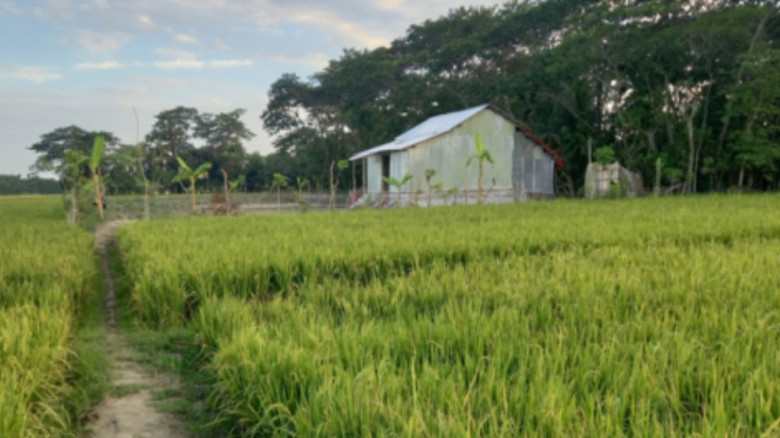
Agricultural land is shrinking at an alarming rate in Charfasson, Bhola, due to unplanned house-building. Cropland is being filled in to build homes and commercial premises, and crop production is falling worryingly as the amount of cropland decreases. Continued erosion by the Meghna river is also eating away at the land, displaced residents say.
Local farmers said that the building of homes and commercial premises and the operation of brick kilns near cropland were reducing the amount of land and cultivation. Unplanned filling-in of farmland was cutting the output of aus, aman, iri, boro and rabi crops, they said.
According to the Charfasson upazila agriculture office, the upazila has 85,192 hectares of arable land and 3,337 hectares of non-arable land. Each year about 1 percent of this agricultural land is lost to unplanned house-building. Of the arable land, boro paddy was grown on 27,008 hectares this season, while vegetables and other seasonal crops were grown on 75,072 hectares.
Bashir Chokidar, 65, a resident displaced from the Meghna riverbank, built a new home in the Kashemganj area of Jinnagar union in the upazila after losing everything to erosion five times. Describing a hundred memories of Meghna erosion, he said: “People on the riverbank live with their thatched homes, livestock, cropland — even their families and lives — under constant threat. Storms, floods and erosion are our daily companions. We are poor as it is, and on top of that our homesteads, cropland and houses have been lost to erosion. So people from eroded villages have to move again and again. That is why I bought 8 decimals of land here and built a home.”
Shah Alam Majhi, 57, from the same area, runs a six-member household by fishing on others’ boats. He once had a fairly large home and his own cropland to live on; after losing everything to river erosion, he now shelters in a tin-roofed hut on 4 decimals of land.
Locals said agriculture was the main source of income for most people in Charfasson upazila, and that the falling amount of cropland was a key reason for declining crop output. The amount of cropland of a few years ago had fallen sharply due to housing demand and river erosion, with unplanned homes, commercial premises, brick kilns and pond-digging springing up everywhere and farmland disappearing. As a result, crop production could fall sharply within a few years, they said, adding that a national land-use plan and policy were urgently needed to ensure proper use of land.
A Charfasson upazila sub-assistant agriculture officer said the upazila had no food shortage at present because multiple crops were now grown on the same arable land, but that a food shortage could one day arise given the rate at which arable land was shrinking. The upazila has 2,60,000 farmers. As farmland was filled in in unplanned ways, farmers were changing professions, the officer said, adding that unplanned filling-in and construction could not be prevented because the farmland-protection law was not being properly enforced, and that public awareness was needed.
Upazila Nirbahi Officer Romana Afroz said: “Protecting farmland has now become the biggest challenge. If the Agricultural Land (Proper Use and Conservation) Act 2022 is enforced, perhaps there could be some change.”
বাংলায় মূল প্রতিবেদন পড়ুন · Read the original Bengali report