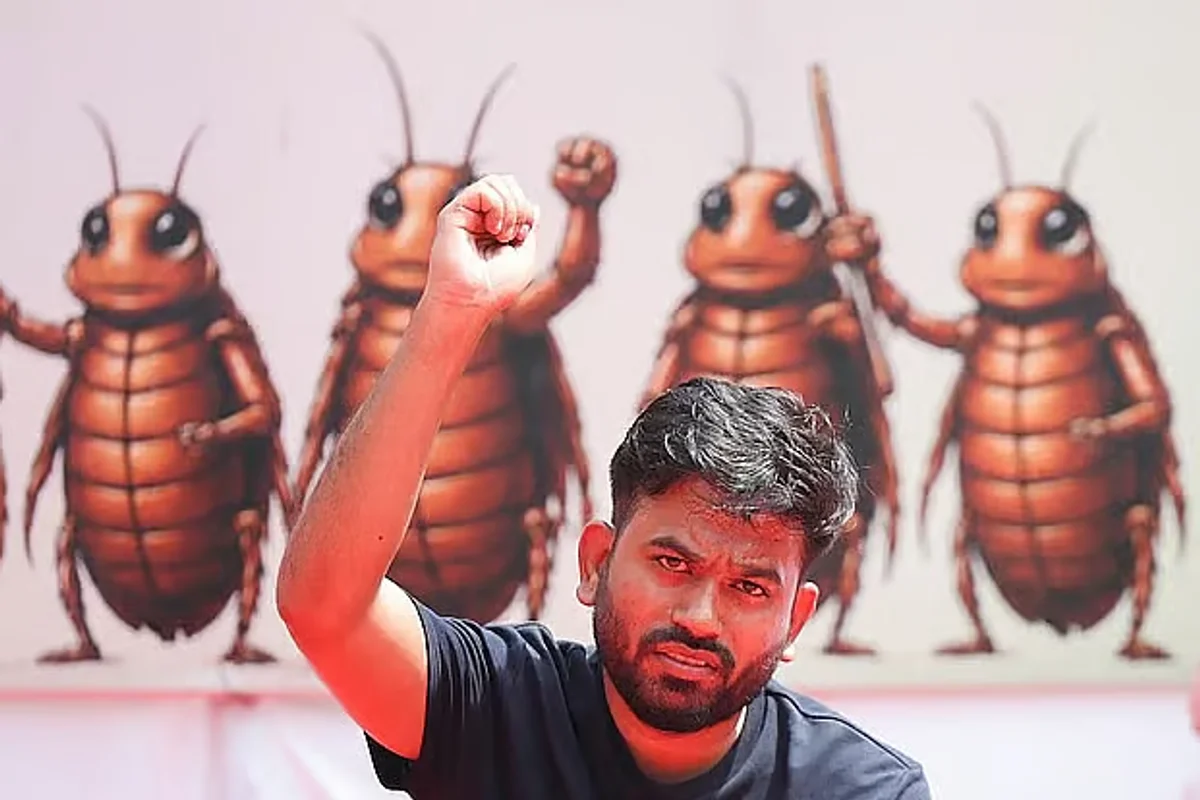
Rather than forming a political party right now, the “cockroaches” will listen to ordinary people by building organisations state by state. Leaders of the Cockroach Janata Party (CJP) devised this strategy after two days of internal discussions. From next month they will spread across the country to hear from the public — to learn and understand people’s minds. The programme has been named “Kya Bolti Public” — that is, what the people are saying.
Announcing this after the two-day meeting, CJP national convener Abhijit Dipke said the programme’s aim was to find out people’s problems and to prepare themselves to remedy them. He made clear that reforming education was their main goal, because education had steadily become expensive — easily accessible to the rich, beyond the reach of ordinary people.
The CJP core-committee meeting decided not to move towards forming a political party for now. Party leader Saurav Das said: “Many want the CJP to emerge as a political party. But we do not want to go that way. There is no shortage of political parties in the country. Everyone knows how the ED, CBI and income-tax department are set loose to break political parties.”
Das said the CJP did not want to go that way, because forming yet another political party would achieve nothing. So instead it had decided to work at the grassroots. From 1 September, moving state by state, it would understand what the public was saying and what the younger generation was thinking, and work accordingly to find solutions.
Abhijit explained in detail why they did not want to form a party. For now, he said, they wanted to remain a pressure group. Education minister Dharmendra Pradhan’s resignation was their success; they had largely removed fear from people’s minds, and the government was being forced to listen. In this situation, their goal was to ensure the ideals of the constitution, democracy, social justice and the accountability of public institutions.
On institutional accountability, Abhijit mentioned the Election Commission (EC) and the judiciary. People had no trust in the EC, he said: in the morning people voted someone to victory, and by evening he had joined another party. People vote one party to victory, yet another party forms the government, with the ED and CBI used freely to break parties.
It was no longer voters who decided who would form the government, Abhijit said; now the government was deciding who would vote. Just as there was not the slightest trust in the EC, ordinary people also did not get justice — a lifetime passed waiting for a court date, yet the influential did not have to wait, with hearings held even at midnight.
A CJP co-founder said that during the Jantar Mantar movement they had seen people were angry about these things and wanted redress. To that end, understanding people’s minds in more detail was essential, so the “Kya Bolti Public” programme had been taken up.
Over the two-day meeting, the CJP built its organisational structure, forming an 11-member national working committee. Abhijit Dipke is its all-India convener, and the two spokespersons, Saurav Das and Ashutosh Ranka, were made co-conveners. Notably, every member of the working committee is aged between 26 and 35.
As the reason, CJP leaders said 65% of the country’s people were of this age. The country has been divided into four parts, each assigned to specific leaders who will work to build organisations there. A membership drive will be conducted, and a website has been created for it.
CJP leaders said no money was being taken from anyone now to build funds, and this had been stated in the interest of transparency. But in future, money would be raised from the public through crowdfunding.
There is no doubt the BJP and the central government are taking the “cockroaches” seriously. It was because it takes the new “Gen-Z” generation seriously that it accepted the demand for the education minister’s resignation. Prime Minister Narendra Modi has been posting on Instagram on various topics almost as a rule, wanting to connect with the new generation, and party programmes are being adopted for this too.
The Rashtriya Swayamsevak Sangh (RSS) has also stirred at this. While one section of the BJP favours branding Gen-Z “anti-national” and cracking down, RSS chief Mohan Bhagwat has said someone is not a traitor merely for protesting; if the younger generation protests over an issue, it needs to be resolved.
The Hindutva RSS chief said: “Gen-Z are our own people. They are our next generation. We must understand their language.”
Mohan Bhagwat faced 2,000 school students from a hundred cities at an event in Mumbai on Thursday. Comparing them with his own time, he said: “In our day, we accepted what our elders said. Today’s Gen-Z asks questions. They look for logic. They do not accept everything without argument. That does not mean protesting over an issue makes them traitors. Establishing a bond with them is essential.”
The RSS chief said: “Today’s Gen-Z, or Gen Alpha, are far more honest than us. They have a spirit of patriotism and service to the country. I can trust them with my eyes closed.”
The RSS chief, however, carefully avoided the matter of the Delhi police’s “atrocities,” baton charges and use of pellet guns in dealing with the student movement at Jantar Mantar. “I do not know exactly what happened that day, why it happened, how it happened, what was right or what was wrong,” he said.
Yet it is on this very question that the opposition remains firm. Parliament is deadlocked. Like the students, the opposition demands that the prime minister apologise for the police atrocities and that the home minister take responsibility and make a statement in parliament. It was because of that demand that Mohan Bhagwat carefully avoided the subject.
The government has not yet found a way to end the parliamentary deadlock. Although parliamentary affairs minister Kiren Rijiju met Lok Sabha opposition leader Rahul Gandhi, the opposition did not want to back away from its demands.
বাংলায় মূল প্রতিবেদন পড়ুন · Read the original Bengali report