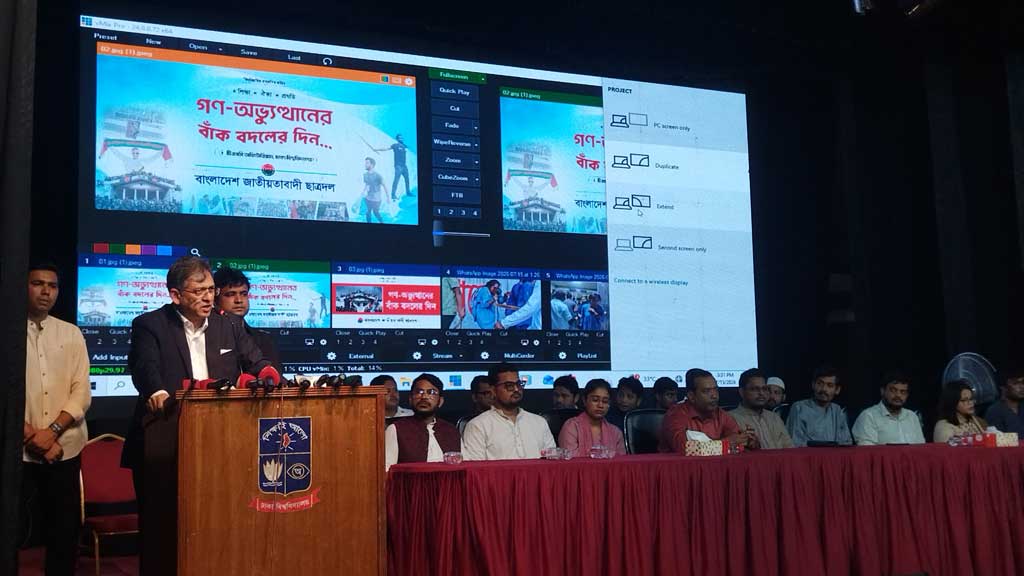
BNP standing committee member and Home Minister Salahuddin Ahmed has said the Awami League will be put on trial as a party over allegations of genocide and crimes against humanity. To that end, he said, necessary changes had been made to the International Crimes Tribunal (ICT) Act and the anti-terrorism law, and an investigation was now under way.
He made the remarks as chief guest on Wednesday at an event titled “The Day the Mass Uprising Turned,” organised by the Bangladesh Jatiyatabadi Chhatra Dal at the TSC auditorium of Dhaka University.
Under Article 47 of the constitution, the home minister said, both individuals and organisations could be tried for genocide and crimes against humanity. “We want the political fate of this fascist organisation decided through a lawful judicial process,” he said. “We do not consider it right to ban any party by administrative order.”
Salahuddin alleged that the Awami League’s top leadership had run the government illegally and that genocide had been committed through the party’s leaders and activists, so the Awami League must also bear responsibility as an organisation.
Drawing on the Nuremberg trials, Salahuddin Ahmed said that just as action had been taken against Hitler’s organisation after the Second World War, a similar legal process was needed in Bangladesh.
The home minister further alleged that state forces had been used to kill ordinary people and children, which he described as a rare occurrence in the world.
It was deeply shameful, he said, that the Awami League and Sheikh Hasina showed no remorse for this genocide, and were instead branding the fighters of July as “militants.”
Salahuddin also said the Awami League’s history was one of killing democracy, killing freedom fighters through the Rakkhi Bahini and establishing one-party BAKSAL rule. He pledged that no fascism would be allowed to rise again in Bangladesh.
Stressing reform of the structures of the state, the home minister said these would be rebuilt so that no autocracy could rise in future.
Salahuddin said the July 2024 mass uprising had not belonged to any single organisation but had been a movement of the country’s people at large. Holding on to this anti-fascist unity, he said, the democratic Bangladesh the martyrs had hoped for would be built; and, so that no future government could behave in a fascist manner, Ganabhaban would be turned into a “July Memory Museum.”
Closing his speech, the home minister said: “We are leaving in the hands of the young generation the responsibility of building the Bangladesh that the martyrs of 1971 and the martyrs of July dreamed of. Long live the student-people uprising of 2024; may the memory of July be a source of our strength.”
বাংলায় মূল প্রতিবেদন পড়ুন · Read the original Bengali report