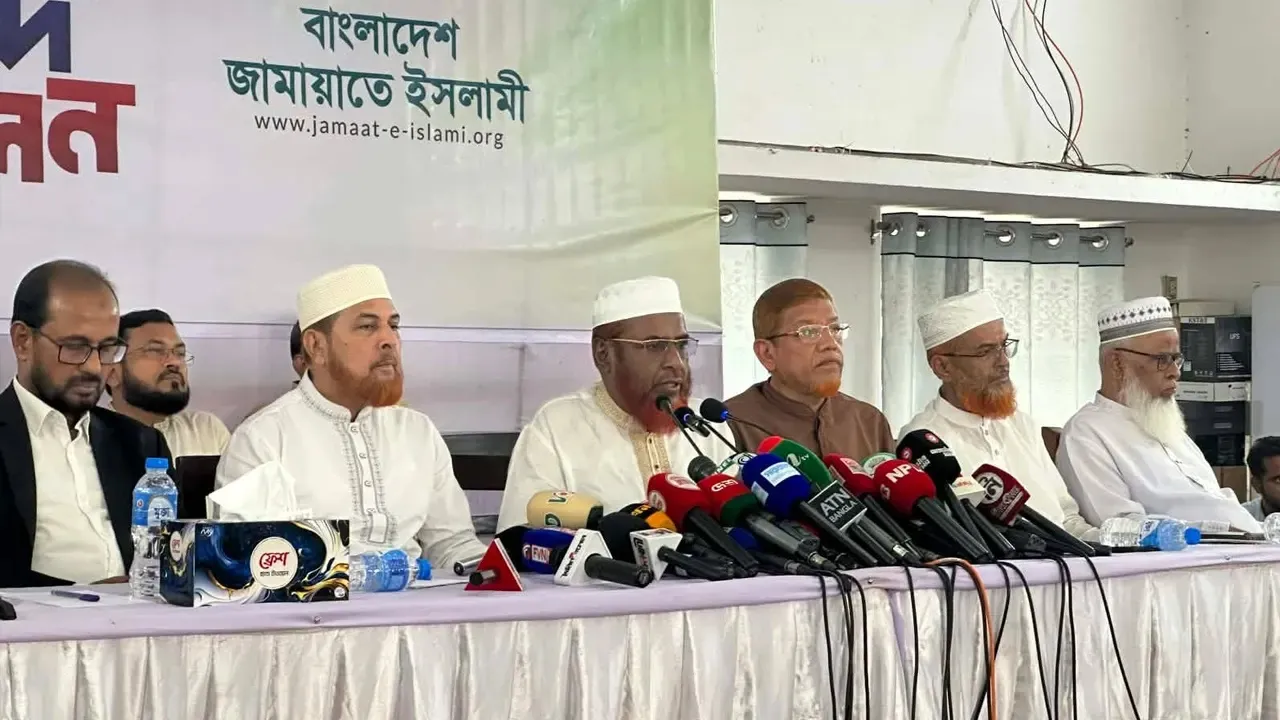
Bangladesh Jamaat-e-Islami has claimed that the BNP-led government has shown no clear success matching public expectations in its first six months in office. The party alleges the government’s failures have become evident across matters of major public importance.
Jamaat-e-Islami Secretary General Mia Golam Parwar made the remarks at a press conference titled “A Six-Month Assessment of the BNP Government,” held Tuesday, August 18, at Al-Falah Auditorium in Moghbazar, the capital.
The party alleges the government has failed across eight important areas: reluctance to implement the referendum verdict and the July charter, failure to improve the law-and-order situation, energy security, failure to control rising prices, a crisis of confidence in the banking sector, and politicization of government institutions.
Mia Golam Parwar said the government had failed to show the desired progress in areas beneficial to the public, including leaving concerning gaps in the anti-enforced-disappearance law, keeping MPO-listed teachers out of local government elections, and strategic weaknesses in foreign policy, along with reforms generally.
Also present at the press conference were Jamaat Executive Council members Professor Mujibur Rahman MP, Rafiqul Islam Khan MP, Hamidur Rahman Azad, and other senior party leaders.
He further said the government’s first six months had shown clear delays, policy indecision, hesitation, and a shortage of concrete results across various areas. In the February 12 referendum, he said, the public delivered a clear verdict in favor of constitutional reform based on the July national charter. According to the Election Commission’s revised gazette, “yes” votes totaled 47,225,980, and “no” votes totaled 21,960,231, meaning the “yes” vote won by a margin of more than 25 million.
He said that had “yes” prevailed, elected MPs were meant to form a constitutional reform council, which was to complete constitutional reform within 180 working days of its first session. But although MPs took their oaths, the reform council’s structure was never made operational. He alleged the government subsequently moved toward an alternative method of amending the constitution through parliament instead.
Referring to the July charter’s 30 key reforms, the Jamaat leader said that although the charter included provisions such as limiting the prime minister’s term, a bicameral parliament, a balance of presidential powers, giving the opposition the deputy speaker’s post and leadership of parliamentary committees, judicial independence, fundamental rights, and establishing strong local government, not one of these had been implemented over the past six months.
Criticizing the government over the energy crisis, Mia Golam Parwar said the country’s daily gas demand is roughly 3,800 million cubic feet, against a combined domestic production and import supply of only 2,700 to 2,800 million cubic feet, leaving a structural shortfall of roughly 1,000 million cubic feet a day. He said this is affecting industrial plants, power stations, CNG stations, and other sectors.
He claimed the energy and electricity crisis has cut industrial production by roughly 40 percent, saying around 20 factories have closed and 20,000 workers have lost their jobs as a result. He said the recent conflict in the Middle East has also exposed the vulnerability created by Bangladesh’s dependence on energy imports.
Alleging politicization of government institutions and the administration, the Jamaat secretary general said that although the government had promised to run the state based on merit, competence, and professionalism, allegations of appointments made on partisan grounds in the administration, universities, and key state institutions grew stronger within the first six months itself. He also alleged political influence over promotions, postings, officers-on-special-duty (OSD) assignments, and contract-based appointments, and giving priority to individuals close to the party for important posts.
He claimed that, during this same period, BNP leaders were given contract-based appointments to the top posts of 11 government institutions and organizations. He said information had also emerged of BNP leaders and activists being appointed to 12 institutions, including the Election Commission. He claimed similar questions had been raised at the university level as well.
Criticizing the law-and-order situation as well, Mia Golam Parwar said that although the government claims to prioritize law and order, data from government and independent observers gives sufficient cause for concern. Citing Transparency International Bangladesh’s assessment of the government’s first 100 days, he said 605 killings, 294 robberies, 196 kidnappings, and 3,496 incidents of violence against women and children were recorded during March-April. He also cited data showing 69 to 80 incidents of mob violence nationwide during the same period, killing 31 to 42 people.
Citing law-and-order research from police headquarters, Mia Golam Parwar said 915 murder cases, 461 robberies, 286 kidnappings, 3,277 thefts, and 5,448 incidents of violence against women and children were recorded over the three months of March through May. He claimed that 915 murder cases were registered in the March-May 2026 period alone, compared with 767 for the whole of 2025 and 794 for the whole of 2024.
On the assessment of prices, the party said that according to the Bangladesh Bureau of Statistics, overall inflation in June 2026 stood at 9.16 percent. Food inflation stood at 8.60 percent, and non-food inflation at 9.61 percent. Overall inflation in June of the previous year had stood at 8.48 percent.
Mia Golam Parwar said that although the inflation rate has eased somewhat, overall price levels remain high. As a result, he said, the pressure of spending on food, rent, transport, and other daily necessities is increasing on low- and middle-income families, while people’s real purchasing power is declining.
He also described the government as having failed on the banking sector. Citing Bangladesh Bank data, Mia Golam Parwar said defaulted loans stood at roughly Tk 5.887 trillion at the end of March, or 32.26 percent of total loans. He said defaulted loans had increased by roughly Tk 314.87 billion in just three months.
He alleged that even in the government’s first six months, there had been no visible progress in emerging from defaulted loans, the liquidity crisis at weak banks, depositors’ loss of confidence, and pressure from high interest rates. Citing data showing weak private-sector credit flow and a 20 to 30 percent year-on-year decline in letters of credit opened for capital machinery, he said this was concerning for new investment and employment.
The Jamaat leader also claimed there are strategic weaknesses in foreign policy. He alleged that although the government declared “Bangladesh First” as its core foreign-policy philosophy after taking office, it had not been possible, over six months, to turn this into a clear, coordinated foreign-policy framework. He claimed there had also been no visible progress on various unresolved issues, including Sheikh Hasina’s extradition.
On the Rohingya crisis, Mia Golam Parwar said that although roughly 309,000 Rohingya have been verified as former residents of Rakhine, repatriation still has not begun, citing the security situation as the reason. At the same time, he said, a shortfall in international humanitarian assistance for roughly 1.2 million Rohingya is creating additional pressure on Bangladesh.
Jamaat has also expressed concern over the anti-enforced-disappearance law. Mia Golam Parwar said ensuring that a horrific human-rights violation like enforced disappearance never recurs is one of post-July Bangladesh’s most fundamental expectations. He said that although the government has taken the initiative to draft the “Prevention and Remedy of Enforced Disappearance Act, 2026,” UN experts have formally raised concerns over several provisions in the draft.
At the press conference, Jamaat-e-Islami issued an eight-point call to the government. These include publishing a time-bound roadmap for implementing the referendum verdict and the July charter, formulating an integrated energy security strategy to address the gas and energy crisis, freeing the administration and state institutions from partisan influence, and ensuring visible improvement in the law-and-order situation.
Mia Golam Parwar said the BNP government had been unable to present the nation with any strong achievement matching public expectations in its first six months. The public gave the government its mandate to provide solutions, not explanations for problems, he said. If the government cannot overcome the failures and limitations of its first six months and show visible change going forward, he said, public disappointment and the crisis of confidence will only deepen further.
বাংলায় মূল প্রতিবেদন পড়ুন · Read the original Bengali report