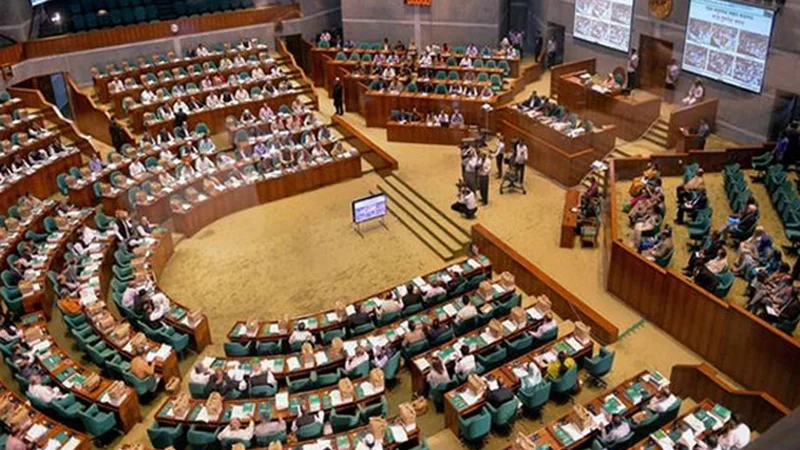
Parliament has passed an amendment to the property transfer law that allows a donor to continue enjoying donated property for as long as they live. The “Transfer of Property (Amendment) Bill, 1882,” was passed in parliament Sunday. Law Minister Asaduzzaman tabled the bill for passage. Opposition members’ motions to send the bill to a select committee for public consultation were settled by voice vote, along with proposed amendments.
Under the passed bill, when a parent or grandparent gifts property to their child or grandchild (or vice versa), or between spouses, the donor may continue to enjoy that property for as long as they live. If the recipient dies while the donor is still alive, the right to enjoy the property will pass to the recipient’s heirs under the law once the transfer takes effect.
In a statement of objects and reasons for the bill, the law minister said that while the existing law provides for the method of property transfer, it contains no specific provision for a gift that reserves the donor’s right to enjoy the property for their lifetime. The proposed lifetime-usufruct-reserving gift would be a distinct method of property transfer, applicable equally to people of all faiths. He said it would not affect, or create any conflict with, conventional gifts, heba under Muslim law, or any other form of property transfer recognized by law.
Taking part in the debate on the bill’s passage, opposition leader Dr. Shafiqur Rahman said, “This law clearly contradicts Shariah. My question here is whether we will uphold the core principles of the Quran or set them aside. I consider this a very sensitive matter. It concerns the core principles and application of the Quran and Sunnah. Presenting this law in this way risks creating widespread disorder and unrest in society. There is also a risk that this law will undermine the rightful claims of rightful heirs.”
Calling the law contrary to the Quran and Sunnah, Jamaat’s Najibur Rahman said BNP had promised before the election that it would not enact any law contrary to the Quran and Sunnah. Yet, he said, it is now moving to pass a law that clearly contradicts them. He said Islamic scholars also strongly object to this law.
Ali Asgar, lawmaker for Pabna-3, described the bill as being in conflict with the Quran and Sunnah.
Masud Parvez, lawmaker for Chuadanga-1, said, “Not all children treat their parents this way. We cannot pass a law that conflicts with our core beliefs and convictions because of a handful of offenders.”
Abdul Alim, lawmaker for Bagerhat-4, said that instead of this law, the Quranic provision that no one may gift more than one-third of their property should be enacted into law. He said Islamic scholars’ opinions are needed on this law, which conflicts with Islamic principles.
Rashedul Islam, lawmaker for Sherpur-1, said, “Even though Article 70 of the constitution exists, I believe most lawmakers will either oppose this law when it’s passed or stay silent. We cannot accept a framework that conflicts with Islamic inheritance law.”
Kamrul Hasan, lawmaker for Mymensingh-6, said, “In amending this law, they have reached into Muslim family law. This law is being passed under the guise of human rights, through a kind of maneuver. We strongly object to the provision stating this law will apply to people of all faiths. If this law is not reviewed, there is a risk of public unrest.”
Sheikh Mujibur Rahman Iqbal, independent lawmaker for Kishoreganj-5, said, “I am demanding effective measures to pass this law quickly, so that no parent is disgraced by an unworthy child.”
Independent lawmaker Rumin Farhana thanked the government for bringing this bill in consideration of parents’ interests.
Law Minister Asaduzzaman said, “This law will not affect heba or any other method of property transfer. We have not touched Muslim law here. The gift, or property transfer, referred to in this law is not heba. It is not related to heba. This law will not obstruct heba or any other form of property transfer.”
Referring to Muslim family law, the law minister said, “We have brought this bill in consideration of social reality.”
Citing Islamic banking, he said Islamic law takes profit, not interest. Banks take profit but do not share in losses. Without sharing in losses, this Islamic banking system would not technically be permissible, yet it operates anyway.
Citing examples from several Muslim-majority countries, Asaduzzaman said, “We believe this law will help countless parents take their last breath in peace. This law will meet a need in society. Compared with the Muslim Family Laws Ordinance of 1961, it is not in conflict with Islam.”