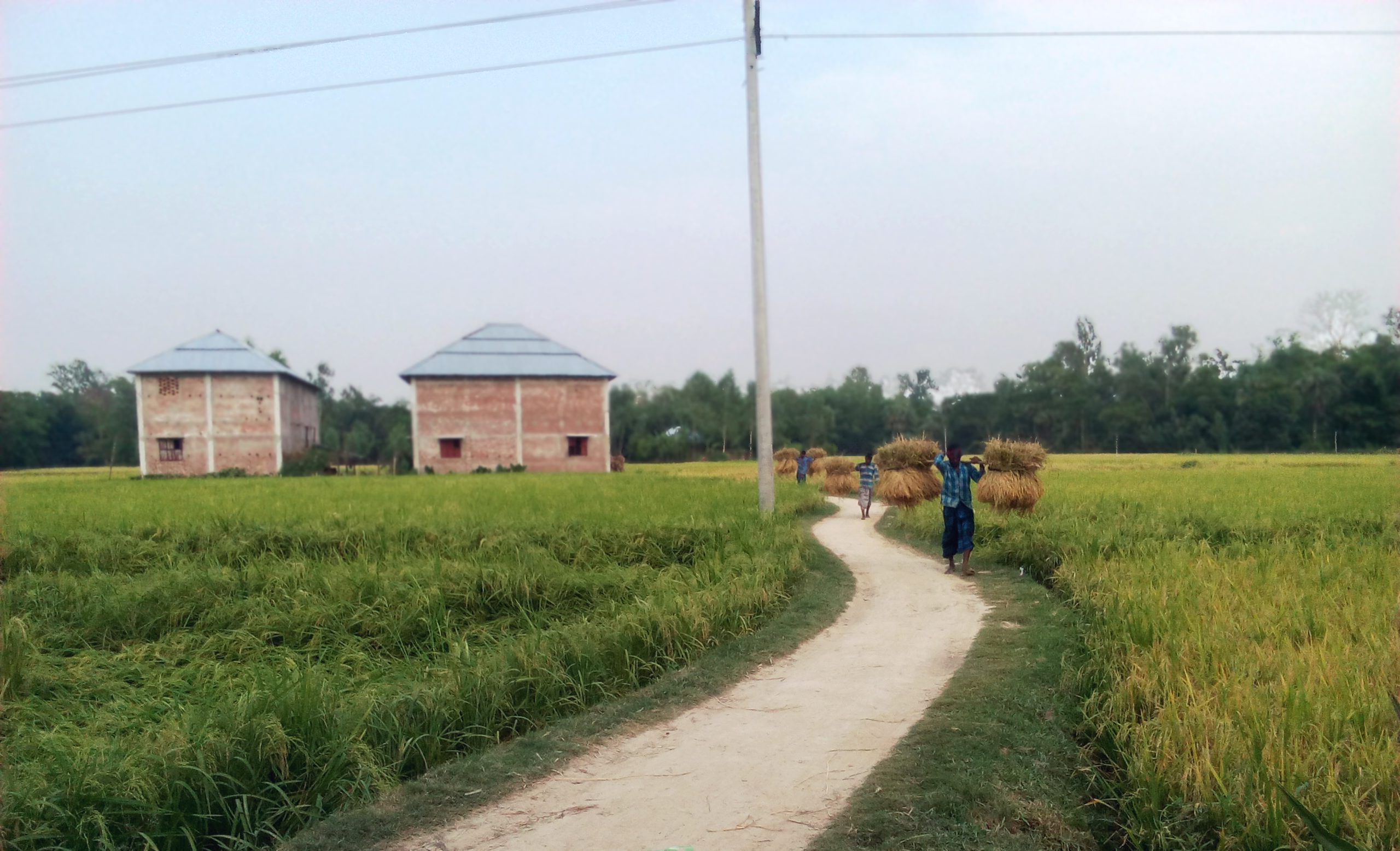
Boro paddy is selling at Tk 800 to Tk 850 per maund (about 37 kg) in Rangpur division markets — against a production cost of Tk 920 to Tk 950 — as a bumper harvest peaks and cash-strapped farmers rush to sell, the Daily Star reported on May 26. With Eid near, the slump has muted the festive mood across northern Bangladesh’s grain belt.
Farmer Monsur Ali, 65, brought eight maunds of paddy to Durakuti Haat in Lalmonirhat hoping to sell at Tk 1,000 to Tk 1,050 per maund. After waiting nearly two hours, he accepted Tk 810. He sold at Tk 1,050 in the same market last year.
“My heart fills with happiness seeing the crop in the field, but in the market there is only disappointment because of low prices,” Monsur said. He cultivated Boro on 10 bighas (one bigha is about 0.13 hectares) this year and has harvested seven so far, with a yield of 22 maunds per bigha — about one maund more per bigha than last season.
Nabin Chandra Barman, 60, of Shalmara village in Aditmari upazila, sold at Tk 800 to Tk 850 per maund against a production cost he puts near Tk 950, on 16 bighas this season. A year ago the same paddy fetched Tk 1,050; costs have risen since, even as prices fell. “Had I known this earlier, I would not have brought my paddy to the market,” he said.
The gap between cost and market price was echoed by Atoar Rahman, 55, of Gopinathpur village in Rangpur Sadar, who sold 30 maunds at Tk 800 per maund against a production cost of Tk 920 per maund. He cultivated 20 bighas and has harvested 15.
Wholesalers told the Daily Star they are buying in smaller quantities because warehouses still hold last year’s stock. “Once the old stock finishes, I will start purchasing paddy fully,” Soleman Ali, a wholesaler in Lalmonirhat, said. Another wholesaler in Rangpur, Sunil Chandra Sen, who also farms, said low prices were forced by storage constraints.
The Department of Agricultural Extension has put Boro cultivation across the eight districts of Rangpur division — Lalmonirhat, Kurigram, Rangpur, Gaibandha, Dinajpur, Panchagarh, Nilphamari and Thakurgaon — at 683,795 hectares this season, with a production target of 4.1 million tonnes. The government plans to procure 71,483 tonnes of paddy directly from farmers and 246,246 tonnes of rice from millers, according to the Rangpur Divisional Food Department. The state rate is Tk 36 a kilogram — above the open-market price — but the volume is small and limited to farmers on agriculture-office lists, so most growers cannot sell into it.
The squeeze is not unique to Rangpur. Across the country this Boro season, farm wages have climbed while paddy prices have slid, leaving many growers unable to recover the Tk 25,000 to Tk 26,000 it costs to farm a bigha, The Business Standard reported. The government’s nationwide procurement — 5 lakh tonnes at Tk 36 a kilogram — reaches only a fraction of the harvest.
For Akkel Ali, 65, of Chowdhurani village in Pirgachha upazila, the gap between yield and price has reordered the holiday. “There is no Eid in our homes this year,” he said, speaking to the Daily Star. “We are not getting fair prices for our crops, and because of that we are all deeply upset.”
বাংলায় মূল প্রতিবেদন পড়ুন · Read the original Bengali report