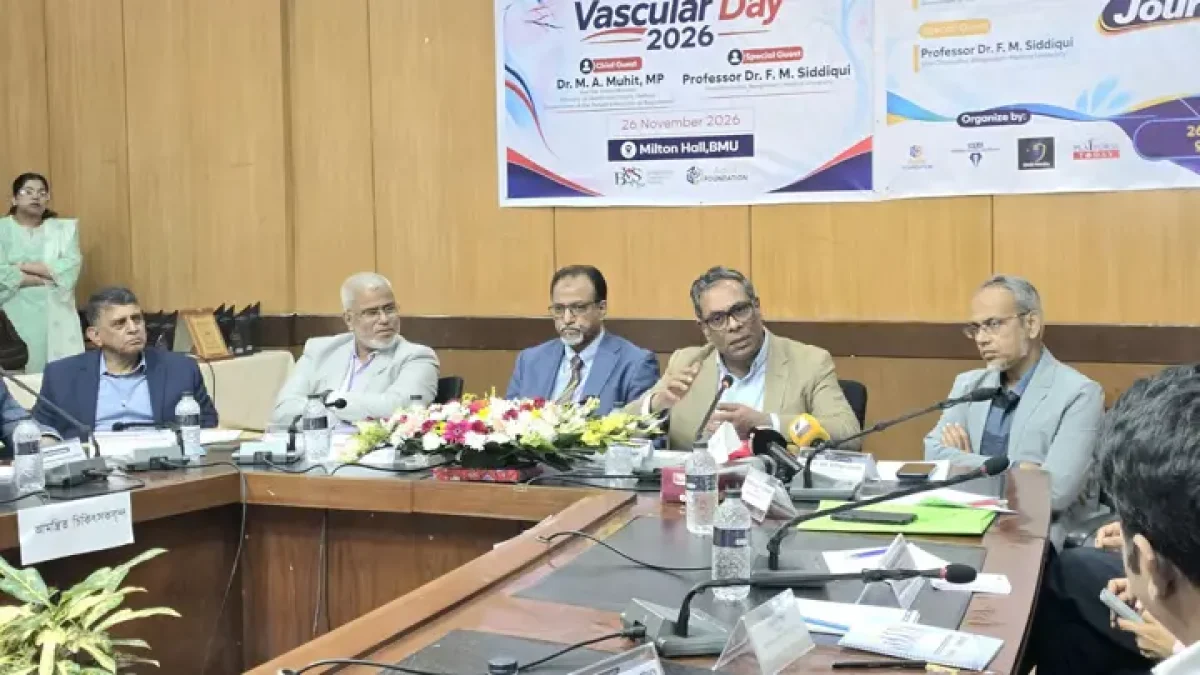
The change the health sector needs is not possible without mutual trust and coordination between doctors, the media and the administration, State Minister for Health and Family Welfare Dr MA Muhit has said. He said the government is working to recruit 10,000 doctors to ease the staff shortage and to draft a balanced law to protect both doctors and patients.
He said this as chief guest at a roundtable held on Thursday afternoon at Milton Hall of Bangladesh Medical University in the capital to mark "National Vascular Day 2026" and a "Health Journalism Workshop".
The state minister said long-accumulated grievances and mismanagement have opened a kind of distance between doctors, journalists and the administration. "We have to overcome this crisis of trust," he said. Sensational or negative headlines in the media before an allegation is proven damage professionals' standing, he said, while meetings and constructive discussion are the most effective way to solve problems inside hospitals.
Setting out the health sector's current steps and future plans, Dr Muhit said the process of recruiting 5,000 doctors has already begun, and 5,000 more will be recruited straight after. Moves have also been made to recruit nurses, medical technologists and health workers.
On digital systems to ease patients' hardship in hospital outpatient departments, the state minister said online tickets and appointment slots have been introduced on a trial basis at the National Institute of Ophthalmology. Within the next one to two weeks the digital service will be fully launched at five or six more specialised hospitals in Agargaon, so patients will no longer have to queue from before dawn and the grip of touts will weaken.
Dr Muhit said steps have also been taken to open trauma centres and children's hospitals that were built in the past and left unused.
Within the next month, five idle children's hospitals in various divisions will be opened with the staff and equipment they need, he said. A new nationwide family planning campaign will also begin on the 13th, and the medical education curriculum is being updated to tackle the risk of antimicrobial resistance.
Other speakers included Bangladesh Medical University Vice-Chancellor Professor Dr FM Siddiqui, Pro-Vice-Chancellor Professor Nazrul Islam and Professor Dr Md Rafiqul Islam of the urology department. The event was moderated by Dr Saklayen Russel, head of department at Ibrahim Cardiac Hospital.
Earlier on Thursday morning, speaking as chief guest at the opening of the fourth biennial conference of the Bangladesh Cornea and Refractive Society at a hotel in the capital, Dr MA Muhit said the country's eye banks will be revived and reorganised to prevent corneal blindness and restore sight. At the same time, awareness must be raised to encourage people to donate their corneas after death, he said.
He said eye disease epidemiology and public health have always been the focus of his long research and teaching. Although cataract is the main cause of blindness in the country, corneal blindness has historically been another major cause. Twenty to 30 years ago, corneal blindness in children from vitamin A deficiency was very common. But since vitamin A capsules began to be given alongside the government's Expanded Programme on Immunisation (EPI), a large share of such blindness has been prevented. Today the main causes of corneal blindness are eye infections and injuries, he said.
Dr MA Muhit said that after taking office, the current government passed the "Transplantation of Human Organs Bill" in the very first session of parliament, and corneal transplantation is included in that legal framework. The country now has about 50 corneal specialist surgeons, 25 of whom perform corneal transplants regularly. But with a shortage of donor corneas, most transplants depend on corneas imported from abroad, which is costly and complicated for patients.