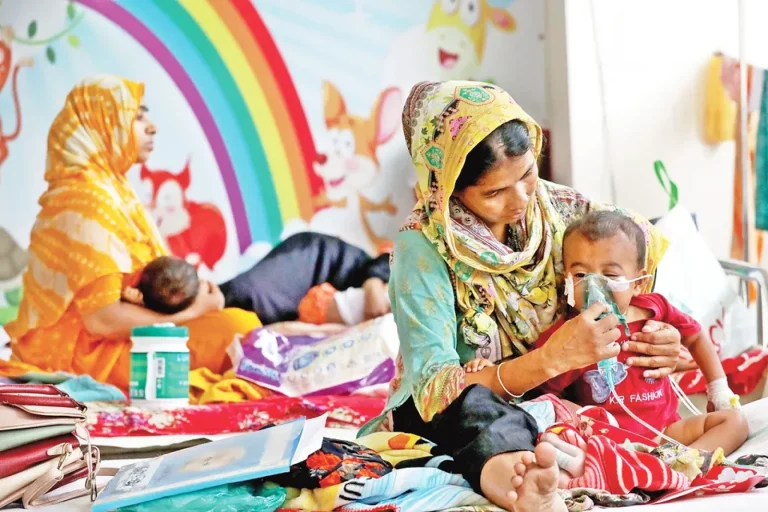
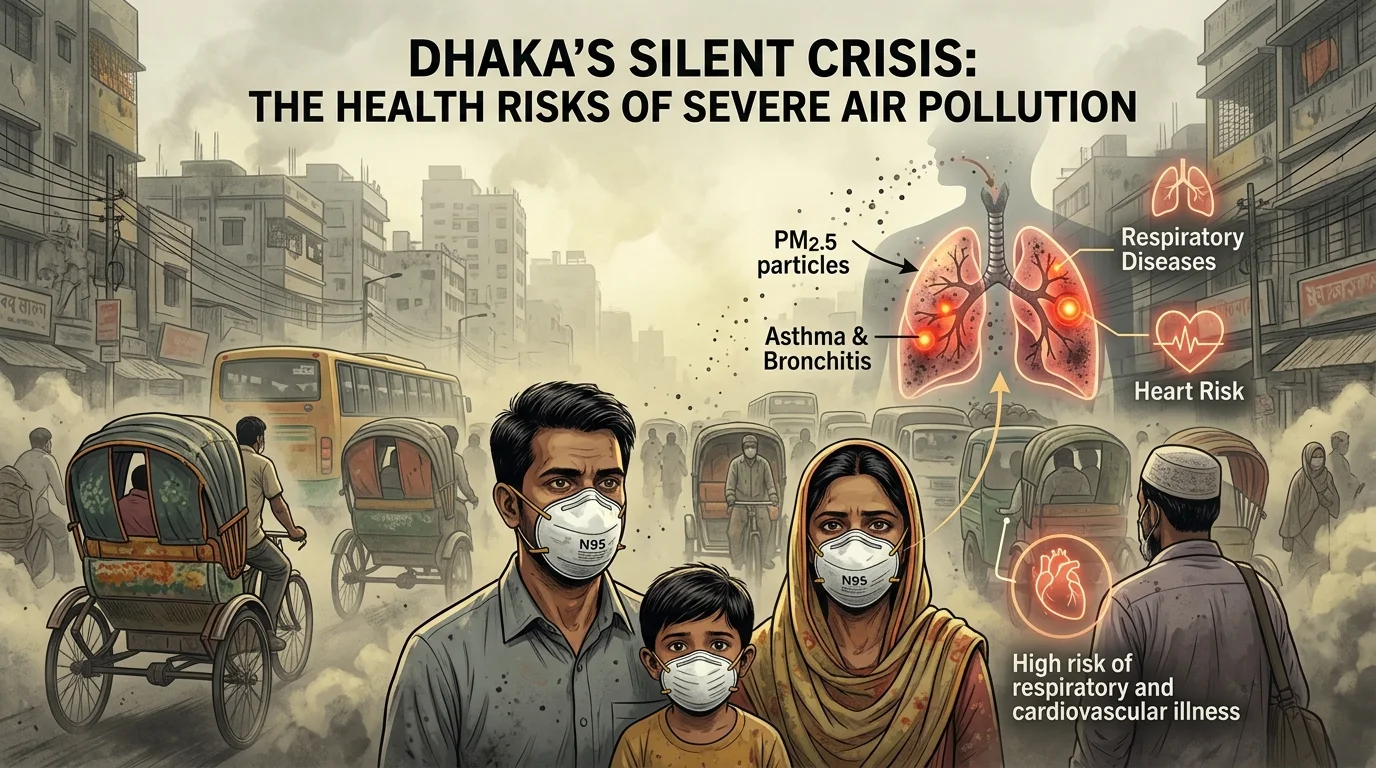
As winter sets in, air pollution in Dhaka is rising. Fine dust, vehicle exhaust, factory emissions and smoke from burning waste enter people's bodies with every breath.
Going to work, taking children to school or spending hours on the street to earn a living: these everyday routines of Dhaka's residents now carry an invisible health risk. Over the long term, this pollution can cause serious disease.
Winter makes it worse. Rain falls less, the weather stays dry and polluting particles linger in the air. Air pollution is therefore no longer only an environmental problem; it is a crisis of public health, city management and residents' quality of life.
What the research shows
Researchers at Dhaka University's Atmospheric and Environmental Chemistry Research Laboratory (AECRL) have published several studies on fine particles in the air, heavy metals and the sources of pollution.
One of them was published in June 2026 in the journal Next Sustainability. It assessed heavy metals in the fine and coarse particles in Dhaka's air and the health risk they pose to people. One of its co-authors is Dhaka University professor Abdus Salam.
The study showed that the risk from air pollution is not limited to dust or smoke. Some chemical elements mixed into the air are also a cause for health concern.
Another study published in 2026 analysed the chemical make-up and sources of Dhaka's PM2.5. Samples collected from November 2023 to March 2024 showed that in winter, PM2.5 levels in Dhaka were 11 to 15 times higher than the World Health Organization (WHO) 24-hour guideline.
The researchers also identified four distinct sources of pollution. Their findings indicate that controlling pollution requires knowing the chemical composition and sources of ultrafine particles, not only the smoke and dust that can be seen.
Why pollution rises in winter
In Bangladesh, air pollution is usually higher from November to February. With little rain in this period, dust suspended in the air does not easily clear. In some weather conditions, polluting particles are trapped in the lower layer of the air.
A major source of Dhaka's pollution is unplanned construction and road digging. At many building sites, sand, cement and soil are left uncovered, and their fine particles spread into the air.
Added to this are smoke from old and faulty vehicles, factory emissions, pollution from brick kilns and the open burning of waste.
The Department of Environment's National Air Quality Management Plan 2024-2030 analysed the sources of pollution in greater Dhaka. It named household solid fuel, waste, road dust, power plants, factories and vehicles as the main sources. In other words, no single sector is responsible for Dhaka's pollution.
Why PM2.5 is dangerous
PM2.5 is particulate matter 2.5 micrometres or less in diameter, far finer than a human hair. These particles reach deep into the lungs with normal breathing.
According to the World Health Organization, such particles can also enter the bloodstream. Long-term exposure raises the risk of respiratory infections, heart disease, stroke and lung cancer.
Those most at risk are children, older people and people who already have respiratory or heart disease. Polluted air can also harm the development of children's lungs.
Street workers at risk
People who spend much of the day working outdoors face a higher risk. Traffic police, rickshaw pullers, construction workers, delivery workers and small pavement traders spend long hours in polluted air every day.
Even when pollution is high, many low-income families cannot stop working or move somewhere safer. So while everyone bears the harm of pollution, not everyone has the same chance to protect themselves from it.
The government's target and delivery
To control air pollution, the government published the National Air Quality Management Plan 2024-2030 in 2024. It stresses controlling the main sources, strengthening air quality monitoring and enforcing existing environmental laws.
The plan aims to bring annual average PM2.5 down to 15 micrograms per cubic metre nationwide and to 30 micrograms in greater Dhaka by 2030.
Reaching that target will require controlling dust at building sites, stopping waste burning, curbing emissions from old vehicles and making sure factories follow environmental rules. Fines or occasional drives alone will not achieve it; it needs regular monitoring, effective enforcement of the law and coordination among government agencies.
A little over four years remain before the plan's term ends. If Dhaka's air is to come close to safe levels by then, the pace of delivery will be the real test.