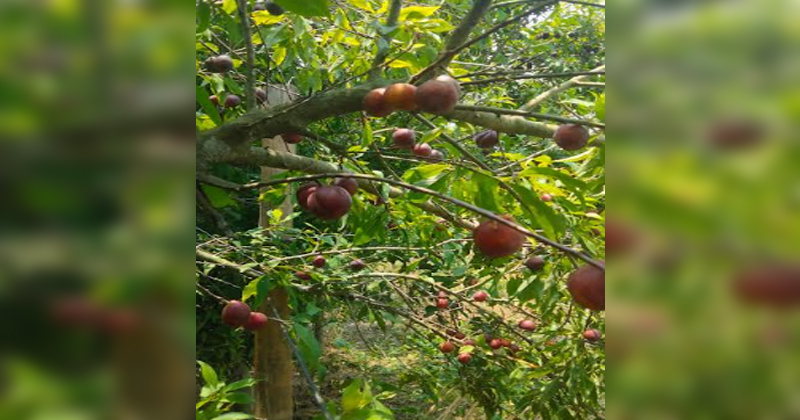
Agricultural entrepreneur Habibur Molla is successfully growing plum trees in Lokhnath village, Boalmari upazila, Faridpur. He received 25 alubukhara seedlings from a local NGO through a training programme three years ago and planted them on a plot of agricultural land next to his home.
He said that not fully understanding their value, he cut down 18 of the trees after one year, leaving seven. After two years, the remaining trees began producing fruit. He now sells the fruit at Tk 300 per kilogram in local markets, and says preserved alubukhara can fetch up to Tk 1,000 per kilogram.
The trees flower in January and February and fruit ripens fully in June. When unripe, the fruit is dark green; as it matures it turns bright brown, then red, and when fully ripe it becomes deep black or dark purple — resembling a jambul berry in appearance — and becomes soft and juicy. A mature tree can yield 10 to 15 kilograms of fruit per season; each fruit weighs approximately 10 to 12 grams, with about 90 per cent edible flesh and a very small stone.
Visitor Akash Saha said he had eaten alubukhara in biryani but had never seen the tree before coming to Habibur Molla’s home. He bought three kilograms at Tk 300 per kilogram to take away for making pickles.
বাংলায় মূল প্রতিবেদন পড়ুন · Read the original Bengali report