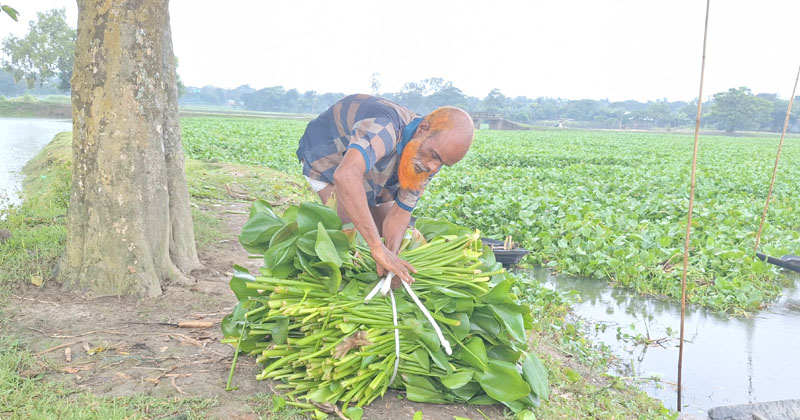
Water hyacinth in canals, ponds and other water bodies was once considered a mere weed by farmers — something pulled out and discarded while clearing waterways. That same water hyacinth has now become one of the main sources of cattle feed for many farmers and dairy operators in Kishoreganj. Every morning, they wade into the water with sickles in hand, carrying the plant home by van, rickshaw or on their heads.
Behind this shift lies this year’s crop damage. Continuous heavy rainfall and hill floods flowing down from upstream have damaged crops across various parts of the district, reducing the supply of straw. Meanwhile, prices for bran, grain feed and ready feed have risen. This has left farmers and dairy operators facing higher costs to raise cattle, pushing many to use water hyacinth — available free or at low cost — as an alternative feed.
To maintain feed supply, particularly for cows and cattle, farmers are also cutting banana trees around their homes into small pieces to feed livestock. Water hyacinth and banana stems are being mixed with straw, grass, bran or other feed and given to cattle.
Livestock rearing is one of the main sources of supplementary income for many families in Kishoreganj’s rural economy. Some sell milk to cover household expenses, while others fatten and sell cattle. For many, livestock also serves as an alternative form of savings — cattle are sold when funds are needed for children’s education, medical treatment, weddings or other family expenses. As a result, the cattle feed crisis affects not just farms but also farmers’ household finances. A survey of various markets in the district found straw currently selling at around 25 taka per kilogram, putting the price of one maund of straw at roughly 1,000 taka. A 37-kilogram sack of wheat bran is selling for 1,630 taka, and a 40-kilogram sack of ground maize for 1,440 taka.
Added to this are transport and labour costs. Fresh grass is also in short supply — while some can be found on higher land, roadsides or around homesteads, farmers in many cases must buy it at a premium. This has put the greatest pressure on marginal farmers and small-scale dairy operators.
Dairy operators say cattle feed prices have risen so much that selling cattle no longer fetches a proportionate return. This leaves them squeezed from both directions — rising feed costs on one side, and the risk of a loss if they sell cattle cheap on the other. As a result, rather than sell their cattle, many are relying on locally available alternative feed to keep raising them.
A visit to several upazilas in the district found farmers and dairy operators busy collecting water hyacinth from canals, ponds and other water bodies. Some gather it from water bodies near their homes, while others travel several kilometres by boat or other means to collect it. Some dairy operators have even hired labourers specifically to gather water hyacinth.
In the morning, farmers wade into the water, pull up the hyacinth and pile it up. It is then transported home by van, rickshaw or other vehicles, where it is cleaned, cut and mixed with straw, grass or other feed before being given to cattle.
Hossain Mohammad Riyad, manager of Jesse Agro Farm in Rauha village, Karimganj upazila, said: “It has become difficult to arrange the daily feed cattle need. Straw and grass used to be available from the fields — now there’s a shortage. So we’re forced to cut banana trees to feed the cows. On top of that, we have to give bran and other feed as well. It would help farmers a great deal if cattle feed prices came down or government support was available.”
Altaf Hossain, a farmer from Darbarpur village in Chowddoshoto union, Kishoreganj Sadar upazila, said: “This time, heavy rain and hill floods from upstream caused massive crop damage. We couldn’t even bring in the harvest properly. This has created a shortage of food for both people and cattle. If there had been no water hyacinth in the canals and wetlands, it would have been hard to keep the cattle alive.” He added: “Before, nobody paid much attention to water hyacinth. If it grew too much in a water body, it was considered a weed and thrown out. Now, with cattle feed prices rising, it has become something of a lifeline. But water hyacinth alone can’t meet a cow’s feed needs — it has to be given along with other feed.”
Bachu Mia of Batkila village, Sadar upazila, was seen collecting water hyacinth from Rauha wetland. He said: “The price of bran, grain feed and ready feed has gone up a lot. We can’t afford to feed cattle properly by buying these. So we’ve been forced to come nearly six kilometres to collect water hyacinth.”
Speaking about his own cattle, Bachu Mia said: “I bought a small calf for 46,000 taka and have been raising it for about four years. The cow now gives milk — about six litres a day. This cow is important to our family. So even with the feed shortage, we’re managing to keep raising it somehow.”
He added: “Raising cattle costs a lot of money. If we bought all the feed from the market, there would be little profit left from selling the milk. So we’re trying to cut costs by collecting water hyacinth, straw and other local feed.”
Rakib Mia, a farmer from Solpo Jashodal Noapara village in Jashodal union, Sadar upazila, said: “Before, we could raise cattle for several months just on straw produced at home. This time, crop damage means less straw, so we have to buy it from outside. On top of that, bran and other feed are also expensive. All told, raising cattle is now far more costly than before.” He added: “Water hyacinth is available for free. So we bring it from the wetlands and give it to the cattle along with other feed. That cuts costs somewhat. Now, to raise cattle, it’s hard to survive relying only on market feed.”
Farmer Rakib added: “Beef sells for 800 taka a kilogram in the market. But when we take cattle to sell, we often don’t get a price to match. Feed prices are also high. So dairy farmers are under pressure from both sides.”
Nazrul Islam, a dairy operator from Kajla (Bogarbaid) village in Damiha union, Tarail upazila, said: “I raise several cattle together. They need a lot of feed every day. If we bought all the feed from the market, forget about profit — even keeping our capital intact would be difficult.”
Marginal dairy operators say that even with rising feed costs, selling off their cattle is not an easy solution. That’s because their livestock are tied to family savings, loans, labour and hopes for the future. Many raise cattle for years, waiting to sell at a particular time for a large sum. Selling cattle because of a temporary feed shortage, they say, risks long-term losses.
According to the district Department of Livestock Services, Kishoreganj currently has about 930,000 head of livestock, including 922,449 cattle and 7,745 buffalo. The district produces 75.03 lakh metric tonnes of milk annually. A large share of the feed for this large livestock population depends on local agricultural production. But when crop output falls, the supply of straw and other agricultural byproducts falls with it, putting pressure on the cattle feed market and raising farmers’ production costs.
Dr Md Abdul Mannan, Kishoreganj district livestock officer, said: “Water hyacinth doesn’t have very high nutritional value. But it is used as a kind of bulk feed for cattle, similar to green grass. During feed shortages, many dairy operators are using water hyacinth.”
He added: “Feeding cattle water hyacinth in moderation generally causes no problems. But no single feed in excess is good for livestock. So alongside water hyacinth, we advise keeping straw, grass, bran and other nutritious feed in the cattle’s diet as well.”
Dr Sadiqur Rahman, deputy director of the district Department of Agricultural Extension, said: “In April this year, continuous heavy rainfall and hill floods from upstream damaged crops on 11,933 hectares of land in Kishoreganj. This affected 52,980 farmers. The loss in crop production stood at 53,580 metric tonnes. According to the agriculture department’s estimates, the financial loss amounts to about 272 crore 24 lakh taka.”
He added: “With straw also damaged alongside the crops, there is currently a temporary shortage of cattle feed. Once the situation returns to normal, this shortage will gradually ease as well.”