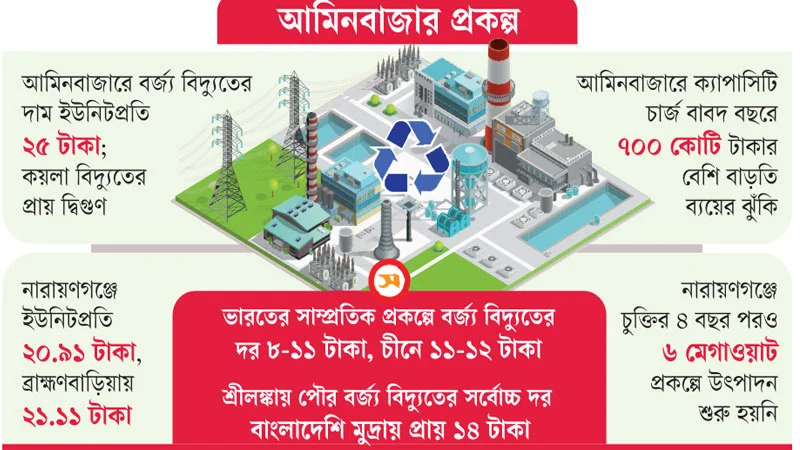
Work is moving forward on a Chinese-funded project in the capital’s Aminbazar to generate 42.5 megawatts of electricity from waste. If everything goes according to plan, this power will be added to the national grid in August 2028. However, the government will buy each unit of electricity from the project at 25 taka. In China, India and other countries, governments are buying electricity from similar projects at comparatively lower prices.
The push to reduce the country’s waste-management crisis while generating electricity is not new. None of the projects taken up over more than a decade have reached production. Against this backdrop, Prime Minister Tareque Rahman directed in July that the Aminbazar and Matuail projects in Dhaka be implemented quickly.
In the country, the production cost of coal-based power is generally 12-14 taka per unit, while furnace-oil-based power averages around 22-24 taka. Internationally, the price of waste-to-energy power varies by project, but in India’s recent projects it runs between 6-8 rupees per unit — roughly 8-11 taka in Bangladeshi currency. In China, the government’s benchmark tariff for waste-to-energy power is 0.65 yuan per unit, roughly 11-12 taka.
On this, energy expert Professor M. Tamim said that evaluating a waste-to-energy project’s economics purely by its tariff leaves out the benefit of waste management itself. He said modern waste management is the core issue here, with electricity as a byproduct. So even though the price may seem high, it becomes reasonable when weighed against the environmental and waste-management benefits.
Major investment in Aminbazar
China’s CMEC Group will invest in the Aminbazar project. The plan is to use 3,000 tonnes of waste daily to generate 42.5 megawatts of electricity. With infrastructure designed for 25 years of power generation, the target is to supply power to the national grid by August 2028.
According to earlier estimates, the project’s cost was 57.45 billion taka. The government has no direct investment in the project but must buy the electricity produced over a long term.
The Awami League government floated the tender to build the plant. Seventeen companies took part, and the Chinese company CMEC won the contract. The agreement was signed in December 2020. Power was originally supposed to come online in 2025. The price per unit was set at 21 cents, which worked out to 21.295 taka at the exchange rate at the time. It now stands at 25 taka.
CMEC has also registered a joint-stock company in Bangladesh to operate the power plant, named WTE Power Plant North Dhaka Private Limited.
The project is being opposed by several organizations, including the Bangladesh Working Group on Ecology and Development (BWGED), Bangladesh Poribesh Andolon (BAPA), and the Bangladesh Environmental Lawyers Association. They allege the project was awarded without open competitive bidding and that the electricity price is unusually high.
According to these organizations, if the plant runs at 85 percent capacity, the cost per unit would be 26.79 taka. If capacity falls to 40 percent, that would rise to 47 taka, and at 20 percent capacity, up to 75 taka. If the plant runs at lower capacity, there is also a risk of capacity charges exceeding roughly $58.87 million, or more than 7 billion taka, annually.
In addition, DNCC has been required to supply 3,000 tonnes of waste daily. If there is a shortfall, a $50-per-tonne fine applies. Environmentalists fear this could create pressure to generate a fixed amount of waste, rather than reduce it.
Environmentalists allege that burning waste can produce pollutants such as dioxins, furans, heavy metals and fine particulate matter. By their estimate, if the Aminbazar project runs at full capacity, it could emit roughly 411,000 tonnes of carbon dioxide annually. Their proposal is that, instead of burning mixed waste for electricity, greater emphasis should be placed on waste segregation for recycling, composting and biogas production.
Meanwhile, after a meeting Thursday between Local Government Minister Abdul Moeen Khan and Chinese Ambassador Yao Wen, State Minister Mir Shahe Alam said the goal is to supply power to the national grid within the next 18 months. A final tripartite and financing agreement is expected to be signed in Beijing on September 2. He acknowledged that 25 taka per unit is high, but said the project is important considering waste-management and environmental benefits. The investing company will pay rent to the city corporation for use of the landfill, and the government will not need to make direct investment.
Matuail could generate 40-50 megawatts
An initiative to generate electricity from waste is also under way at Matuail, under Dhaka South City Corporation. China’s Power China has expressed interest in this project. Preliminary estimates suggest a potential to generate 40-50 megawatts here. Meanwhile, South Korea’s B&F Group is working on a project at Matuail to produce methane gas from waste.
Narayanganj stalled despite signed agreement
An agreement for a 6-megawatt waste-to-energy project in Jalkuri, Narayanganj, was signed on September 1, 2022, between the Power Development Board (PDB), Narayanganj City Corporation, and China’s U&D Environmental Technology.
The plan is to generate electricity using 600 tonnes of waste daily. The government has agreed to buy the electricity at roughly 20.91 taka per unit. The project was supposed to be completed within 455 days, but work has still not begun. The designated site in Jalkuri is still mainly used as a garbage dump. Slow progress on financing and modernizing waste-collection systems is cited as one of the main reasons the project remains stalled.
Cost of 21 taka per unit in Brahmanbaria
An 11-megawatt waste-based power project has also been undertaken in Brahmanbaria Sadar. The government procurement-related cabinet committee approved the project’s bid proposal and tariff in November 2023.
The proposal to buy power at 21.11 taka per unit over a 25-year term was approved. The total estimated cost is roughly 40.68 billion taka. According to the Sustainable and Renewable Energy Development Authority, the project remains at the planning stage. The expected commercial production date is set for June 12, 2027.
Multiple proposals in Chattogram, none implemented
Chattogram has seen multiple proposals over the past decade for waste-to-energy generation. None have been implemented. Most recently, Japan’s JFE Engineering identified the potential to generate 12-15 megawatts using 1,000 tonnes of waste daily.
Land scarcity, prolonged approval processes, and the lack of a comprehensive feasibility study are seen as major obstacles to implementing the project.
Smaller project in Khulna
A waste-treatment facility is being built in Shoilua, Khulna, with financing from the Asian Development Bank. The roughly 520 million-taka project aims to process 375 tonnes of waste daily to produce 15 tonnes of organic fertilizer, 300 kilowatts of electricity, and roughly 5,000 liters of diesel. However, the work has not been completed on schedule, and progress remains slow.
How much higher compared with other countries
In waste-to-energy generation, some of India’s recent projects show a tariff of roughly 6.2 to 7.95 rupees per unit — about 8-11 taka in Bangladeshi currency. China’s benchmark tariff is 0.65 yuan, or roughly 11-12 taka. Under Sri Lanka’s new framework, the maximum rate for municipal waste-based power is roughly 41.72 rupees, or about 14 taka in Bangladeshi currency.