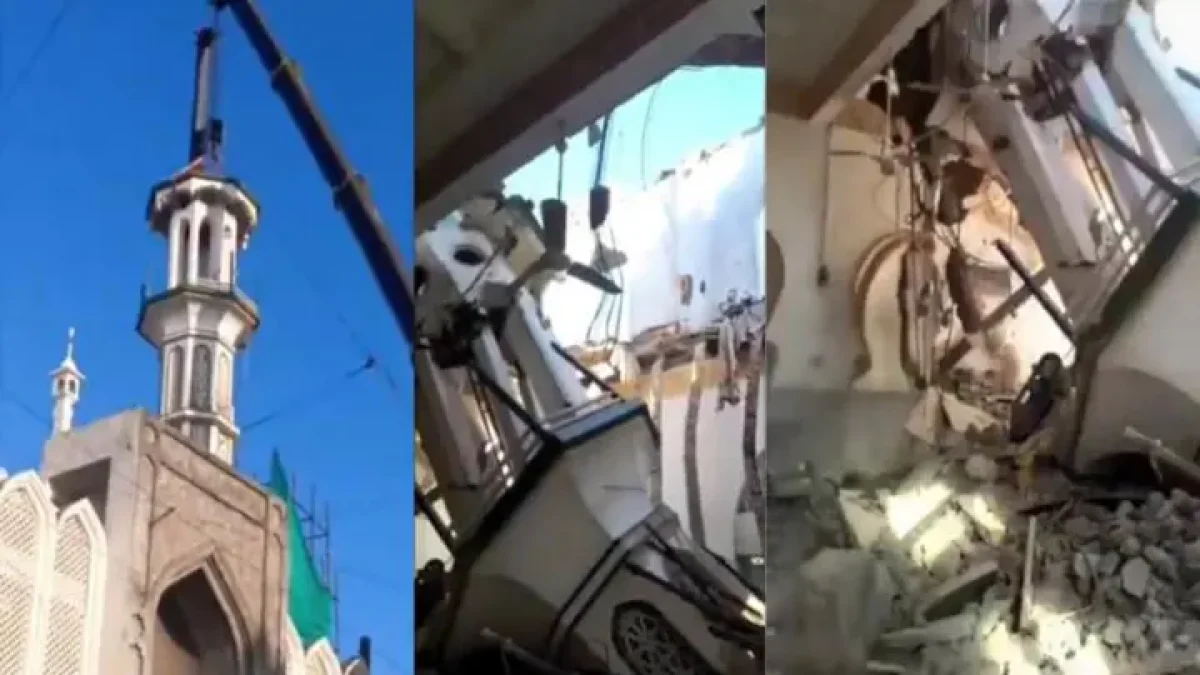
Mosques, shrines, graveyards and Muslim homes have been demolished in Ujjain, in India's Madhya Pradesh, as part of preparations for the Simhastha Kumbh Mela, a Hindu religious festival due in 2028. The demolitions have caused controversy in the country's political and religious circles. An MP from the opposition Congress alleges that Muslim religious sites and homes are being hit hardest in the name of infrastructure development.
The demolition drives are taking place in Ujjain in Madhya Pradesh, which is governed by Prime Minister Narendra Modi's Bharatiya Janata Party (BJP). The city is due to host the Simhastha Kumbh Mela in 2028. The Hindu gathering, held every 12 years, draws millions of pilgrims.
Syed Naseer Hussain, a Congress member of the Rajya Sabha, the upper house of India's parliament, alleged on 22 November that several Muslim religious structures near Madhav Nagar railway station in Ujjain had been razed. They included the Masjid-e-Qalandari, the Shahi Maqbara, several shrines and the homes of caretakers of religious properties.
Hussain claims about 80 religious structures in various parts of Ujjain have already been removed or relocated as part of infrastructure projects.
In a social media post he asked: "Why must Muslims' places of worship, graveyards and homes be bulldozed in the name of Simhastha 2028?"
Accusing the BJP of "bulldozer politics", Hussain said such actions threaten the religious heritage, dignity and safety of the minority community. He also questioned whether due legal process had been followed in the demolitions.
Shahi Masjid damaged when its minaret fell
Ujjain's historic Shahi Masjid has also been caught up in the demolitions. Two petitions were filed challenging a notice from the local municipal authority to remove part of the mosque to widen a road, but the Madhya Pradesh High Court dismissed them.
After the court's decision, the mosque committee and local Muslims agreed to remove the marked portions themselves to avoid damage to the mosque. These included a section projecting from the front of the mosque and a minaret.
But during the demolition carried out by the administration, the minaret broke and fell onto the mosque's dome and first floor, damaging more of the historic building. The authorities put this down to a technical fault in the demolition equipment. The incident has caused anger and concern among local Muslims, who ask how the mosque suffered extra damage despite their cooperation.
Al Jazeera reported on 30 September that the move to remove part of the Shahi Masjid to widen the road had caused tension in Ujjain. Local Muslims staged an overnight sit-in to protect the mosque, and at one point police fired tear gas to disperse the protesters. Several people were injured and several detained. The mosque committee later agreed to remove the marked portions itself.
Preparations for the 2028 Kumbh Mela
Road widening, cleaning and other infrastructure work is under way in Ujjain ahead of the 2028 Simhastha Kumbh Mela. The gathering is due to run from 27 March to 27 May.
The authorities argue that the city's roads and other infrastructure must be upgraded to handle the huge number of pilgrims expected for the festival. But the removal of religious structures under these projects has raised questions among opposition parties and local Muslims.
Parts of 10 temples and a mosque had earlier been removed along the same road-widening route, a fact noted in the court's observations. For this reason the court did not accept the petitioners' claim of discrimination. In the court's view, the municipal authority's action cannot be called arbitrary merely because the structure is a place of worship. The court also took into account the huge crowds, traffic and public safety at the Kumbh Mela.
Muslim organisations and human rights activists, however, have long raised concerns about the use of bulldozers to demolish Muslims' homes, businesses and religious sites in India. They allege that, particularly in BJP-ruled states, these drives fall disproportionately on minority and marginalised communities.
The recent events in Ujjain have again raised the question of whether religious heritage and minority rights are properly protected when development projects are carried out.