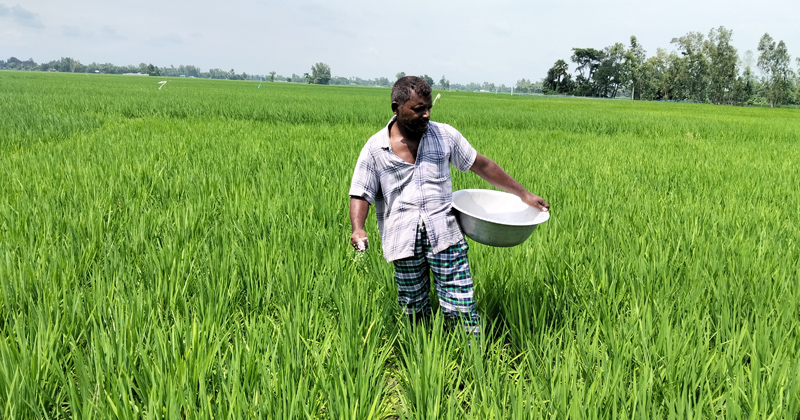
Looking out over the fields brings a sense of calm — the wind rustles through green leaves, and the 45-day-old aman paddy stretches out like a green carpet. But step into those fields and worry is etched on farmers’ faces. Some are clearing weeds, others spreading fertilizer, and still others spraying pesticide to fend off stem borer infestations.
Though busy tending their crops, aman paddy farmers in Kshetlal upazila of Joypurhat are struggling to make the production costs add up. Expenses for irrigation, fertilizer, pesticide, labor and transport have all risen, but paddy prices have barely moved. Farmers now worry how much profit, if any, will be left once the harvest comes in.
According to the upazila agriculture office, aman paddy has been cultivated on 10,860 hectares in Kshetlal this season, five hectares more than last season. Transplanting finished 10-15 days ago, and fields are now in the tending phase.
Farmers say the cost pressure will only grow further through harvesting and threshing.
Under the official price list posted by the agriculture department, the fixed price per 50-kilogram sack is 1,350 taka for urea (27 taka/kg), 1,350 taka for TSP (27 taka/kg), 1,050 taka for DAP (21 taka/kg), and 1,000 taka for MOP (20 taka/kg).
The agriculture department recommends 15 kilograms of urea, 10 kilograms of TSP, 10 kilograms of MOP and 1 kilogram of zinc per bigha (a local land unit, roughly a third of an acre). But some farmers are using as much as 20 kilograms of urea, hoping for a bigger yield.
Farmers complain they cannot always buy fertilizer at the official listed price.
They say that when fertilizer isn’t available at the fixed price when they need it, they often have to buy from dealers or the retail market at higher prices — pushing fertilizer costs to roughly 1,000-1,500 taka per bigha, on top of pesticide expenses.
By farmers’ own accounting, preparing one bigha of land costs about 1,300 taka; seedlings and transplanting, 500 taka; fertilizer, 1,000-1,500 taka; pesticide, 1,000 taka; weeding, 100 taka; irrigation, 1,200 taka; harvesting, 4,000 taka; threshing, 600 taka; and transport, about 4,000 taka. Altogether, excluding land-lease costs, growing aman on one bigha costs a farmer roughly 13,700 to 14,200 taka.
For farmers cultivating leased land, however, costs run even higher.
Farmers say leasing triple-cropped land for a year costs 30,000 to 35,000 taka. Prorated across the three crop cycles, the aman season’s share of that lease works out to roughly 10,000-11,670 taka per bigha. Including the lease cost, total spending to grow aman on one leased bigha comes to about 23,700-25,870 taka.
By the agriculture office’s estimate, a yield of 17 maunds (a local unit, roughly 37.3 kg) per bigha, sold at 1,350 taka per maund, brings in 22,950 taka from paddy alone. Adding another 3,000-4,000 taka from selling the straw, total income could reach roughly 25,950-26,950 taka.
On owned land, with costs of 13,700-14,200 taka against income of roughly 25,950-26,950 taka from paddy and straw combined, farmers could be left with a surplus of about 11,750-13,250 taka — though that figure doesn’t account for the farmer’s own labor or market-price swings. On leased land, the picture changes considerably: with total costs including lease of 23,700-25,870 taka against the same income range, the surplus narrows to just 80-3,250 taka. Factoring in the farmer’s own labor and other unbudgeted costs would shrink actual profit further still.
Aizul, an aman farmer in Kshetlal, said: “The yield looks good, but cultivation costs have gone up a lot. Fertilizer, pesticide, land preparation, transplanting and harvesting together cost nearly 24,000 taka per bigha. After selling 17 maunds of paddy at current market prices, there’s very little profit left in hand. Farming your own land saves something, but on leased land, the margin for profit shrinks even further.”
Another farmer, Sobahan, said: “The current price of paddy in the market isn’t bad. But weighed against costs, the profit is very thin. We’re having to buy fertilizer and other inputs above the government price. Harvesting will cost more still. In the end, how much I’ll actually take home after selling the paddy is what worries me now.”
Rezaul Islam, who farms leased land, said: “Leasing triple-cropped land for a year costs 30,000-35,000 taka. Just for the aman crop, roughly 10,000-11,600 taka of that goes toward the land alone. Then there’s fertilizer, pesticide, irrigation, tending, harvesting, threshing and transport on top. Without a good price for paddy, it’s hard for farmers like us on leased land to survive.”
Kshetlal farmers are demanding a fair price for paddy that reflects production costs. They are also calling for strict administrative monitoring to ensure the government’s fixed fertilizer prices are actually enforced and that fertilizer is available at that price when farmers need it.
Mostafizur Rahman, sub-assistant agriculture officer for Kshetlal upazila, said: “Farmers believe more fertilizer means more paddy. But excessive fertilizer use only raises production costs. We’re visiting fields to advise against unnecessary fertilizer and pesticide use. The upazila administration is running regular mobile courts to ensure fertilizer is sold at the government-fixed price.”
But despite assurances from the agriculture department and administration, worry hasn’t lifted from Kshetlal’s fields. The lush green paddy stirs hope for a good yield, but the weight of production costs is cracking that hope. Farmers are left waiting on a single question: will they get a fair price when it’s time to bring in the harvest?