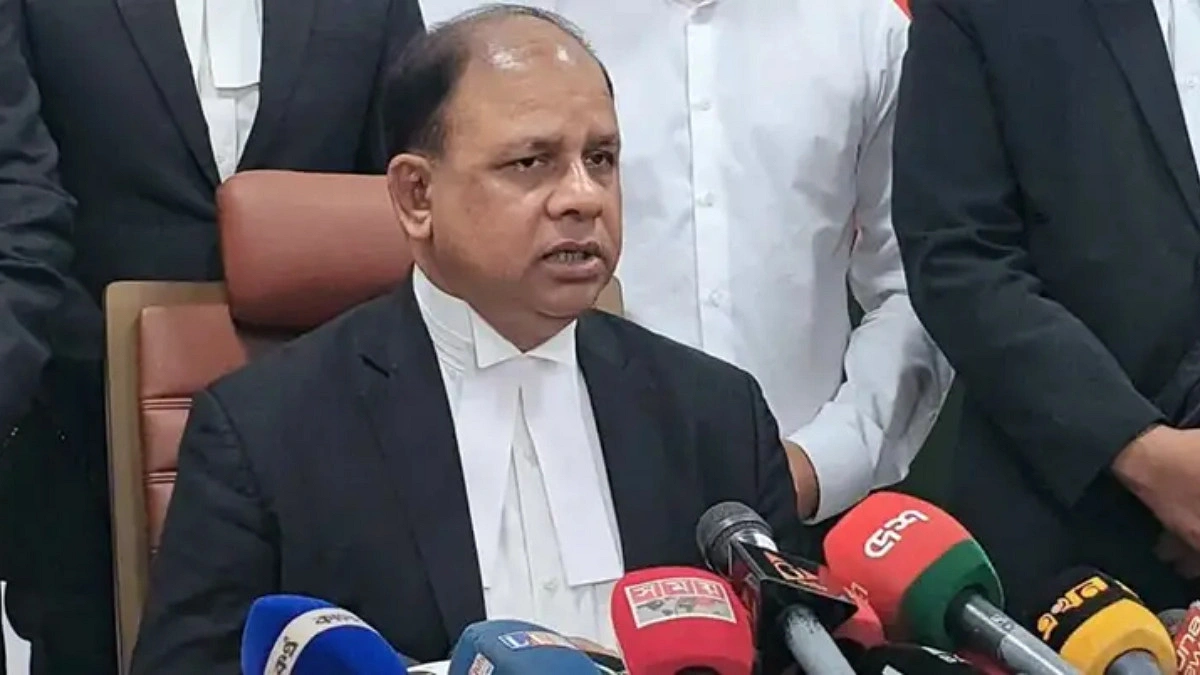
Ousted Prime Minister Sheikh Hasina no longer has the opportunity to appeal against the International Crimes Tribunal’s verdict. Chief Prosecutor Md. Aminul Islam said this at a briefing at his office Monday afternoon.
“Section 21(3) of our law clearly states that an appeal must be filed within 30 days of the verdict being announced. If an appeal is not filed within 30 days, no appeal will be accepted afterward — whether that appeal is Sheikh Hasina’s or Maulana Abul Kalam Azad’s,” the chief prosecutor said.
“Any absconding accused, or anyone in jail, must file an appeal within 30 days. If someone fails to file an appeal within 30 days, whether because they are a fugitive or for any other reason, there will be no further opportunity for that accused to appeal,” he said.
Maulana Abul Kalam Azad, a former member of Jamaat-e-Islami who was sentenced to death over crimes against humanity committed during the 1971 Liberation War, filed an appeal this January after remaining a fugitive for a long time. A hearing has begun on whether his appeal application is admissible.
International Crimes Tribunal Chief Prosecutor Md. Aminul Islam said, “The government has already declared his verdict stayed. We will argue on points including whether an appeal can be filed against a verdict while it is stayed, and whether an appeal can be filed this many years after the conviction.”
He said the hearing on the substantive appeal against the verdict has not yet begun; rather, the hearing currently underway concerns only whether Azad’s appeal is admissible.
The International Crimes Tribunal sentenced Abul Kalam Azad to death in absentia on Jan. 21, 2013. It was the first verdict in a crimes-against-humanity case, 41 years after Bangladesh’s independence.
Azad, who gained recognition presenting Islamic religious programs on various private television channels, was accused of committing crimes against humanity in various areas of Faridpur during the Liberation War.
After remaining a fugitive for a long time, he surrendered to the International Crimes Tribunal on Jan. 21 this year. Earlier, the president had suspended his death sentence for one year. His sentence was suspended on the condition that he surrender and file an appeal.
Mashiul Alam, a lawyer representing Abul Kalam Azad, said the International Crimes Tribunal handed down his death sentence in 2013. His sentence was later suspended for one year following a petition to the president, on condition that he file an appeal.
The Home Ministry issued a notification on the matter on Oct. 22. He then surrendered to the tribunal on Jan. 21, and the court accepted his surrender and ordered the necessary documents be provided for filing an appeal.
Abul Kalam Azad was a rokon, or member, of Jamaat-e-Islami, and had also been a member of the party’s central Majlis-e-Shura. However, all his party memberships were revoked over allegations of violating party discipline.
“When Maulana Abul Kalam Azad’s case was heard in the Appellate Division, I presented the clear provisions of law on behalf of the prosecution. The Appellate Division has already settled this matter in Abdul Quader Molla’s case. Where there is a clear statutory provision on appeal, Article 104 has no application,” the chief prosecutor said.