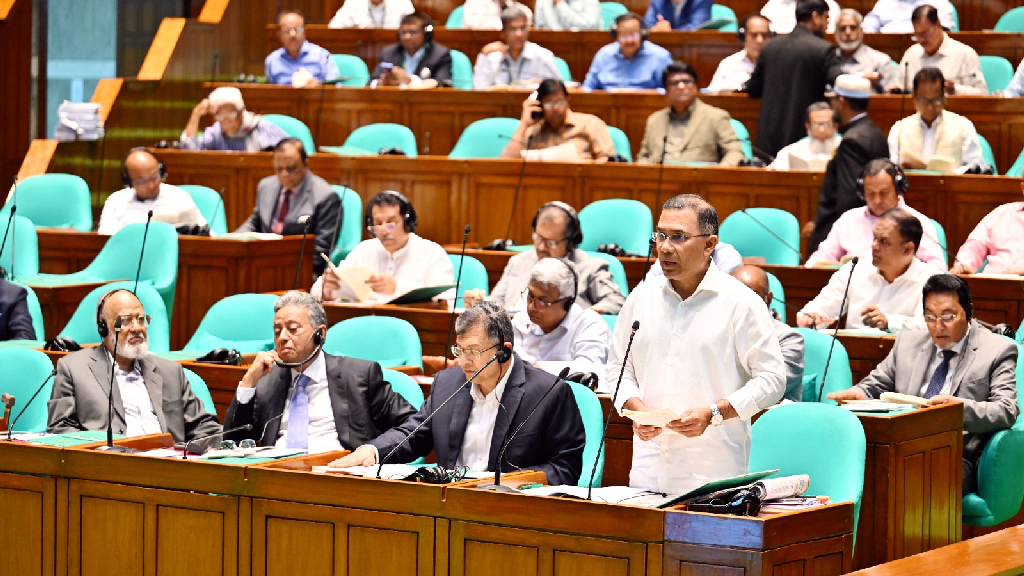
Prime Minister Tareque Rahman has blamed the country’s current energy crisis on the role of the previous Awami League government, now banned. He said state-owned Bangladesh Petroleum Exploration and Production Company (BAPEX) was effectively crippled during what he called the previous autocratic era, resulting in insufficient gas exploration and heavy dependence on imports — the root of today’s energy crisis.
He made the remarks Wednesday in response to a question from reserved women’s seat MP Selina Sultana during the question-and-answer session on the third day of the third session of the 13th Jatiya Sangsad. The session, which began at 3:30 p.m., was chaired by Speaker Hafiz Uddin Ahmed.
The prime minister said the government has adopted a coordinated action plan to pull the country out of the current energy crisis. To boost domestic gas production, drilling of 10 new wells and 30 workover wells has already been completed. Those wells have added roughly 450 million standard cubic feet per day (MMSCFD) of gas to the national grid. Once seven wells currently being drilled are completed, another 85 MMSCFD will be added. Projects for the remaining wells are being taken up in phases.
The prime minister said a plan has also been adopted to explore new sources of domestic gas, including 5,600 line-kilometers of 2D seismic surveys and 4,200 square kilometers of 3D seismic surveys.
Tareque Rahman said the process of buying two more new rigs is underway to strengthen BAPEX, describing the initiative as part of an effort to build up the company’s capacity.
The prime minister said a bid round has been called following approval of the Offshore Model PSC-2026, while approval of an additional offshore model PSC is still in process. He said gas found through offshore and onshore exploration would play a significant role in securing the country’s energy security.
Describing efforts to expand LNG infrastructure, Tareque Rahman said talks are underway with interested companies to build a floating LNG terminal at Kutubjom, in the deep sea off Moheshkhali in Cox’s Bazar. The terminal is expected to be able to supply regasified LNG, or gas, by December 2028.
The prime minister said this would increase LNG imports by a further 600 MMCFD within the next two years. Alongside that, a feasibility study is underway for one or two additional floating LNG terminals, on an urgent basis, near the Payra or Mongla port areas or along the southwestern coast.
If these proposed floating LNG terminals are built, the prime minister said, the country’s overall energy security would be further strengthened.