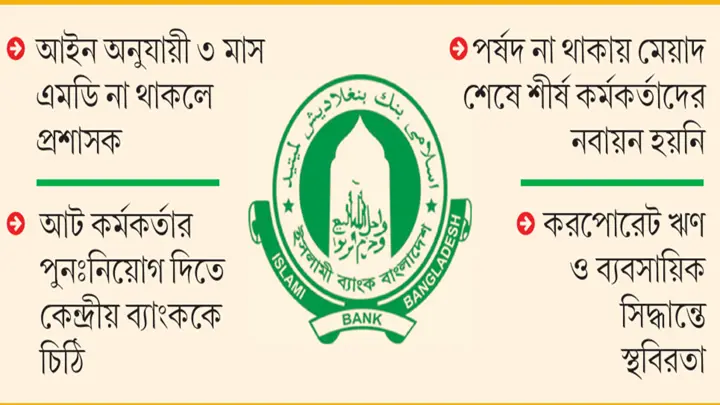
The country’s largest Islamic bank is running without a full board of directors or a managing director (MD). The MD’s post has been vacant for more than three months, even though the law requires it to be filled within three months of becoming vacant. In breach of that rule, the bank has been run all this time by an acting MD. The appointments are reportedly stuck amid a dispute between two factions, leaving the bank unable to take many important decisions, with an impact on customers.
Meanwhile, under rules set during the S Alam era, senior officials remain employed on a contractual basis. With no full board in place, applications to extend the contracts of eight senior officials, including the current acting MD, are also stuck.
Bangladesh Bank executive director Md Zahir Hossain, who is currently handling board responsibilities, is also not making any decision on the matter. Overall, a kind of paralysis has developed at the bank. The central bank has not taken any initiative to resolve this situation.
Asked about it, Zahir Hossain, the Bangladesh Bank executive director handling board duties, said the bank does not have a full board. “I am only one part of the board. A full board is needed to take these decisions,” he said.
Bank officials said that if this situation continues for a long time, the bank’s financial and management weaknesses could deepen further. They warned that fresh instability at Islami Bank amid the country’s ongoing crisis would have consequences for the economy.
It is learned that on May 24, Islami Bank chairman Professor M Zubaidur Rahman resigned on Bangladesh Bank’s advice. The same night, former Bangladesh Bank deputy governor Khurshid Alam was appointed independent director and chairman.
Fresh instability then began at the bank from early June. Customer protests, agitation and deposit withdrawals plunged the bank into a severe liquidity crisis. The issue also triggered heated discussion between the ruling and opposition parties in parliament.
Despite 170 billion taka in support from Bangladesh Bank to manage the crisis, the situation failed to come under control, and the bank’s entire board was ultimately dissolved on June 14.
The same day, Bangladesh Bank executive director Zahir Hossain was handed responsibility for the bank’s board. He has held responsibility for all the bank’s decisions for nearly three months since. However, multiple sources at the bank say he is unable to decide on many important matters.
Rule broken, yet no MD appointed
Meanwhile, Islami Bank’s regular MD post has also been vacant for nearly three and a half months. Prior to this, the bank’s MD was Omar Faruk Khan. On April 13, the then board sent him on leave. He was unable to rejoin the bank after his leave ended, and subsequently resigned.
No regular MD has been appointed since. The bank’s day-to-day operations are being run by an acting MD.
Yet under relevant Bank Company Act and Bangladesh Bank policy, there is no scope to keep the MD’s post vacant for a long period. Despite this, Bangladesh Bank executive director Zahir Hossain, currently handling board duties, is taking no initiative.
Under the Bank Company Act, when a bank’s MD post falls vacant, the person temporarily holding charge is responsible for fulfilling the MD’s full duties. However, the post cannot remain vacant for more than three months under any circumstances. If it remains vacant beyond three months, Bangladesh Bank can appoint an administrator at that bank.
Senior officials’ terms expired, no renewal
Under government service rules and Bangladesh Bank policy, the regular retirement age is 60, with contractual employment permitted up to age 65.
However, after the S Alam Group took control of Islami Bank, a provision for contractual employment of senior officials was introduced. This made the appointment and reappointment of top-level officials dependent on board decisions.
With that system still in place, one senior official’s contract after another is expiring. Officials whose terms have expired have applied for reappointment, but Bangladesh Bank executive director Zahir Hossain, currently handling board duties, is not deciding on their applications. Several more senior officials are due to see their contracts expire by December.
Three senior Islami Bank officials have already seen their employment terms end. Additional managing director Mohammad Jamal Uddin Mazumder’s term ended on September 11, while deputy managing director Mahbub Alam and senior executive vice president Aminur Rahman’s terms ended on September 9. Even after their terms ended, no decision has been made on their reappointment.
Bank sources say the bank has already written to the central bank seeking reappointment for eight officials. Although board approval alone is normally sufficient for reappointment at these levels, the matter has been sent to Bangladesh Bank given the current situation. Bank officials say the bank adopted various plans to turn itself around after August 5, 2024, which senior officials began implementing, allowing the bank to recover within a short time.
However, when fresh instability erupted over the new board, large-scale deposit withdrawals followed. The bank subsequently sought to survive with liquidity support from the central bank. While withdrawals have now stopped, there is virtually no fresh progress in the bank’s business. Only deposits are being collected. That cannot be a bank’s core function.
Meanwhile, even as those who have played a major role in the bank’s turnaround see their terms expire, they are not being extended, raising fears the bank could fall into fresh risk.
Corporate client decisions also stalled
Islami Bank still handles salary and wage payments for workers at several hundred garment factories and other industrial enterprises. These businesses need letters of credit opened and working capital for their regular import-export operations. But because of the bank’s current situation, many businesses are not getting the financing they need.
Some are facing delays in opening LCs. This has put a portion of the bank’s long-standing good customers at business risk.
A major industrialist, speaking on condition of anonymity, said: “Salary and wage payments and LCs for my four garment factories go through Islami Bank. More than 4,000 workers are employed at these enterprises. But we’re not getting the support we need from the bank recently. The officials who’ve handled my file for a long time are also telling me they feel helpless.”
He said running a business had already become difficult amid the gas and power crisis, and the lack of bank support has added further pressure. If the situation continues like this, he said, paying workers’ wages will also become difficult. If wages go unpaid, workers could take to protest, which would create an embarrassing situation for the government as well.
Several officials in the bank’s corporate division said that proposals related to loans for large corporate clients proceed through the regular process but get stuck at the final approval stage. Loan renewals, limit increases, new credit facilities, and large import-export financing proposals all require high-level approval. But with no full board in place, making these decisions has become difficult.
A senior official said news of the bank’s instability is reaching foreign banks through various channels, creating complications in opening LCs. With a full board and MD in place, decisions could be made quickly, he said, but that isn’t currently possible.
No initiative from the central bank
Although Islami Bank’s previous board was dissolved three months ago, Bangladesh Bank has taken no initiative to provide a new board. Sources in the central bank’s relevant department said no decision on providing the bank’s board has been communicated from the top level, so no initiative is being taken on the matter.
Asked about the board and MD appointments, Bangladesh Bank director and assistant spokesperson Shahriar Siddiqui said there is no rule allowing the MD post to remain vacant for more than three months. When it becomes vacant, the rule is to appoint an administrator. However, the central bank can extend that period if there is reasonable cause. Since Bangladesh Bank personnel are currently in place, he said, it would not be appropriate to appoint an administrator.
He added that suitable people are being sought to provide a full board, and once found, a full board will be given.
Financial indicators also declining
Meanwhile, the biggest blow from the fresh instability has come to the bank’s deposits. Deposits fell from 1,850 billion taka to 1,610 billion taka.
The instability has also affected the bank’s income and expenditure figures. Operating losses stood at around 12.85 billion taka in the first six months. Non-performing loans remain the bank’s biggest long-term problem. By the end of June this year, non-performing loans had risen again to 989.14 billion taka — 52 percent of the bank’s total loans, and the highest non-performing loan figure in the country’s banking sector.
Economists say a prolonged vacuum at the top of a bank’s leadership can erode customer confidence. Corporate clients in particular expect quick decisions and service. If decision-making remains slow, they may turn to alternative banks, which could have a negative long-term impact on Islami Bank’s business.