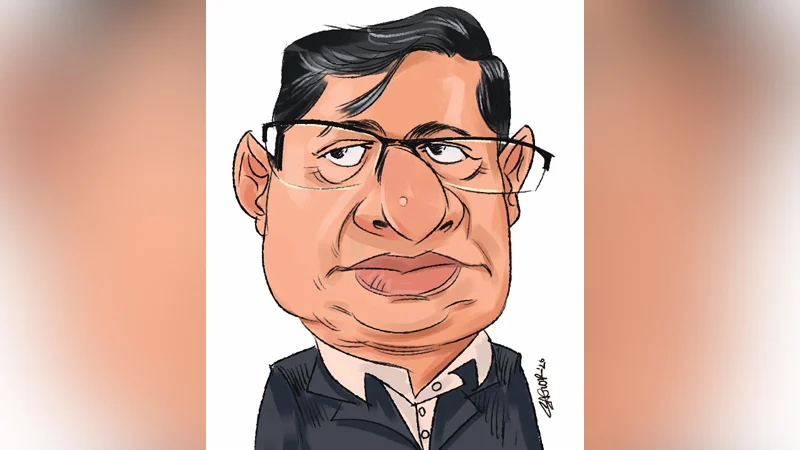
Rupashi Rice and Nutrition Mills, a family-owned company of Local Government, Rural Development and Cooperatives State Minister Mir Shahe Alam, has sought a waiver of tax, VAT and other duties on imports of vitamins and minerals used to produce nutrition-fortified rice, flour and biscuits. The company’s managing director, Mir Shakrul Alam Simanto — the minister’s son — submitted the application to the chairman of the National Board of Revenue (NBR).
According to NBR sources, the application for a tax waiver or special concession for Rupashi Rice and Nutrition Mills was submitted recently with State Minister Mir Shahe Alam’s visiting card attached. The NBR has not yet made a decision on the matter.
In its letter, Rupashi Rice Mills said the company, located at Betgari Mirbari in Shibganj, Bogura, was established in 2022 and produces fortified rice kernels. Since 2023, the company has been supplying rice kernels to the Directorate General of Food. It has supplied roughly 1,198 tonnes of kernels to the government’s Food Friendly and VGD programs so far, alongside roughly 20 tonnes of kernels and 2,000 tonnes of nutrition-fortified rice to the private sector.
Asked about the matter, Dr. Iftekharuzzaman, executive director of Transparency International Bangladesh (TIB), said using a government position for personal business advantage is a clear ethical lapse and runs counter to state policy. He said such conduct is not merely a misuse of office but creates a conflict of interest that cannot be accepted under any circumstances.
Iftekharuzzaman said such an exercise of power from an important state position is in no way desirable, and that an institution like the NBR should carry out its duties impartially rather than yielding to this kind of pressure.
Nutrition-fortified rice is produced by blending kernels with ordinary rice at a ratio of 100 to 1. Producing the kernels requires vitamin A, vitamin B1, vitamin B12, folic acid, iron, zinc, magnesium and calcium carbonate as key ingredients. The same vitamins and minerals are used to produce fortified flour and fortified biscuits.
The letter states that these raw materials are not produced in Bangladesh. As a result, the country’s 14 kernel-producing companies currently import the vitamins and minerals as a premix, under a single HS code, from abroad. Because the premix costs more than the individual vitamins and minerals would separately, roughly $3 million in foreign currency leaves the country each year on these imports — a figure expected to rise further as demand grows.
In its letter, Rupashi Rice Mills said it has recently become the country’s only company to set up a premix production plant. There, it plans to import the necessary vitamins and minerals separately as raw materials to produce its own premix. The company claims this would cut import costs by roughly 50%, and that other kernel-producing companies could then buy premix from it at a lower price — reducing kernel production costs and saving foreign currency.
Rupashi Rice Mills argues that if it receives a waiver or special concession on VAT, tax and other duties for importing raw materials, it would help build a new domestic industry, save foreign currency and create new jobs. It also argues that cheaper premix would lower the price of nutrition-fortified rice, fortified flour and fortified biscuits, making these nutritious foods more accessible to the poor and general public and helping meet nutritional needs.
Reached for comment, the company’s managing director, Mir Shakrul Alam Simanto, hung up immediately after answering the phone. He did not answer subsequent calls. Text messages were later sent to his mobile phone and WhatsApp seeking comment, identifying the inquiry as coming from a newspaper. He did not respond to those either.
An NBR official who declined to be named said there is no scope to give a private company an individual duty or tax waiver. If a waiver is given, it must be given to everyone; specific waivers apply only to government entities. However, the official said, if a particular product is manufactured by only one company in the country, a limited-time special concession could be considered for that company.
However, former NBR member Md Farid Uddin said Article 19 of the constitution does not allow this kind of benefit to be given to a single company. A tax waiver can be granted if it benefits every company in a particular sector, he said. He added that even if the NBR recommended granting such a waiver to a single company, neither the finance ministry nor the law ministry could legally approve it.