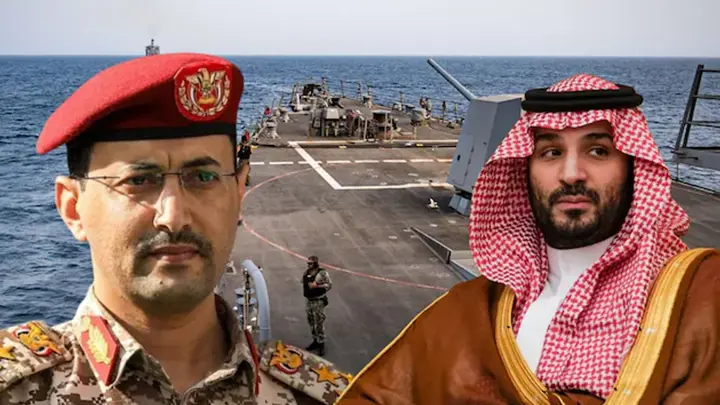
Renewed conflict with the Houthis in Yemen has put Saudi Arabia in a difficult position. The matter is no longer confined to Yemen’s own battlefield. Protecting the security of Saudi territory, its economy, and preventing the regional conflict from spilling further across the border are now major challenges facing Riyadh.
Recent Houthi attacks have made this clear. Missile and drone strikes have hit Abha, Khamis Mushait, Jizan and Najran, wounding numerous civilians. Fires have broken out in several locations, and energy facilities have suffered temporary disruptions. These attacks have come as fighting in Yemen and conflict along the western coast intensifies. At the same time, the Houthis continue to threaten shipping in the Red Sea and Bab al-Mandeb.
As a result, Saudi Arabia now faces two interconnected threats: attacks on its own territory on one hand, and attempts to disrupt a critical regional and international trade route on the other.
This situation has created a difficult strategic equation for Riyadh. Over the past few years, Saudi Arabia has scaled back its direct military role in Yemen in favour of diplomacy, de-escalation and a political solution. A return to prolonged war would undo that strategy, and raise political and economic costs as well.
But restraint does not mean repeatedly accepting attacks on Saudi territory.
The security picture has changed
Saudi Arabia’s security situation today is quite different from when the Yemen war began. The country has strengthened its air and missile defences, increased coordination between its military and security agencies, and gained extensive experience countering drones and ballistic missiles. As a result, Saudi Arabia is now far better prepared to defend its territory than it was a decade ago.
But the Houthi threat has also evolved. The group now possesses ballistic and cruise missiles alongside increasingly advanced drones. Even when most missiles and drones are intercepted, these relatively low-cost weapons can force Saudi Arabia into far higher defence spending. At the same time, they can create uncertainty around airports, industrial facilities, border-area settlements and energy installations.
So relying on air defence alone cannot guarantee security. No defence system can promise 100 percent protection indefinitely.
In this context, Saudi Arabia’s strategic goal should be building deterrence — making clear to the Houthis that any political or military advantage they hope to gain by attacking Saudi territory will cost them far more than it is worth.
This does not require launching a large-scale military campaign like before. Riyadh now has many more options available, including increasing intelligence activity, strengthening Yemeni government forces, tightening border security, disrupting missile and drone supply networks, and, if necessary, carrying out limited strikes on facilities directly linked to attacks on Saudi Arabia.
In other words, Saudi Arabia does not have to choose between remaining passive or returning to full-scale war.
Economic pressure too
The economic impact of Houthi attacks is also significant. Saudi Arabia is one of the world’s largest energy exporters, so the impact of an attack on its oil infrastructure could be greater than the physical damage alone. Recent attacks have damaged energy facilities, creating fresh concern in an already volatile global oil market.
There is an apparent contradiction here. Regional instability that pushes oil prices up could temporarily benefit Saudi Arabia’s oil revenue. But it would be wrong to view war-driven price increases as an economic gain.
Saudi Arabia’s Vision 2030 economic plan increasingly depends on stability, investment, tourism, logistics, technology and major non-oil projects. Continued missile and drone attacks could raise insurance and transport costs, while also changing how investors perceive regional risk.
An even bigger strategic concern is maritime security.
Saudi Arabia sits between two of the world’s most important energy corridors — the Strait of Hormuz to the east and Bab al-Mandeb to the west. A major disruption to either route would pose a serious challenge not just for Saudi Arabia, but for the global economy as well.
This is why the Red Sea dimension of the Yemen conflict matters so much. Bab al-Mandeb links the Indian Ocean to the Red Sea and the Suez Canal. A sustained Houthi threat to shipping there would raise transport and insurance costs. Ships forced to reroute around Africa would face even longer transit times and higher costs.
Saudi Arabia does hold one important strategic advantage: its energy infrastructure is not entirely dependent on the Gulf. Through the East-West oil pipeline, Saudi Arabia can send a significant volume of oil to terminals on the Red Sea, giving Riyadh some strategic flexibility as an alternative to Hormuz.
However, this does not fully insulate Saudi Arabia from security risks elsewhere in the Red Sea, particularly around Bab al-Mandeb. Protecting Bab al-Mandeb, therefore, cannot be viewed as merely a Saudi or Yemeni concern — it is also a matter of international economic and security importance.
Avoiding the Houthi trap
The biggest risk for Riyadh is not just military but political. If the Houthis can drag Saudi Arabia back into a large-scale war, they stand to benefit — they could then present the conflict not as a fight among Yemenis themselves, but as a war between Yemen and an outside power.
Saudi Arabia should avoid this trap.
Primary responsibility for countering the Houthis should rest with Yemenis themselves. The internationally recognised Yemeni government and its forces must take the lead in halting the Houthi advance. Saudi Arabia can provide political, economic, intelligence and defence support.
This matters even more along the western coast. If the Houthis manage to consolidate their hold over strategic areas of the Red Sea and Bab al-Mandeb, the consequences will extend well beyond Yemen’s borders.
The goal should not be another large-scale air campaign to retake Sanaa, nor an indefinite regional war. The goal should be to prevent the Houthis from using their military strength to shift the regional balance of power, threaten neighbouring countries, or create risks to international shipping lanes.
Deterrence alongside diplomacy
Saudi policy in this situation can move along several tracks. First, further strengthening air and missile defences and boosting security at critical facilities. Second, providing more support to Yemeni government forces without becoming directly involved in ground combat. Third, increasing regional and international cooperation on the security of the Red Sea and Bab al-Mandeb.
At the same time, the door to diplomacy must remain open.
Saudi Arabia’s position in favour of a negotiated solution in Yemen has been made clear many times. But diplomacy will only work if both sides conclude that the cost of escalation is too high to bear.
So diplomacy must be backed by credible military capability.
Saudi Arabia has a strong interest in preventing Yemen from becoming yet another permanent regional battlefield. Its economic transformation requires stability. Secure borders, uninterrupted energy exports and unhindered maritime traffic are also part of Riyadh’s geopolitical interests.
But restraint has its limits. If attacks on Saudi cities, civilians and energy facilities continue, Riyadh will stop viewing this purely as intervention in Yemen’s civil war. There will be a growing tendency to treat it instead as a matter of defending Saudi territory itself.
That distinction will become crucial in shaping what comes next.
Saudi Arabia does not need another long war. Neither does Yemen. But avoiding one will require restoring deterrence on one hand, while keeping the door open for a political solution on the other.
The most effective path for Riyadh, then, may be limited and calculated pressure: defending its own territory, strengthening legitimate Yemeni institutions, securing the Red Sea, keeping diplomacy open, and making clear what the consequences of attacking Saudi territory will be.