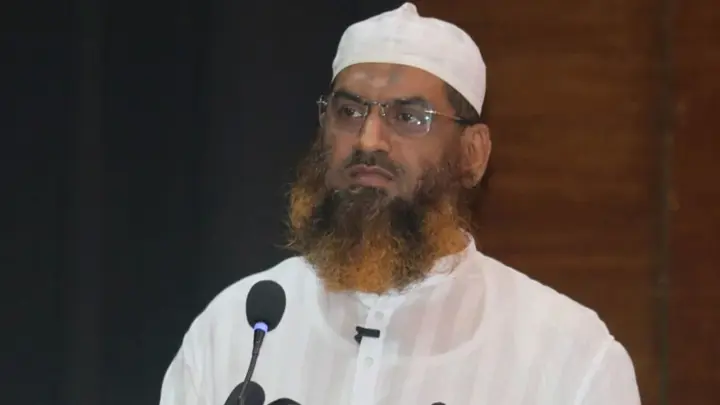
Bangladesh Khelafat Majlish Ameer Maulana Mamunul Haque has expressed deep concern over the hasty parliamentary passage of the Property Transfer (Amendment) Bill, 2026. He said there is no room to bypass mandatory Shariah provisions in the name of protecting elderly parents. Mamunul Haque has demanded that Sections 122A and 122B of the law be reconsidered and amended as needed, based on the opinions of Islamic scholars, muftis, jurists and Shariah experts.
In a statement Monday, he said the law was passed in parliament Sunday (Sept. 6). He said the new provision allowing property transfer while retaining lifetime usufruct rights urgently needs to be reconsidered from a Shariah perspective.
Mamunul Haque said ensuring the security of elderly parents is necessary. But, he said, that should not be used as grounds for any provision that creates room to bypass the rules of heba (gift), wasiyat (bequest) and faraiz (inheritance) as set by Allah. In his words, a heba made during one’s lifetime and inheritance under faraiz after death are two entirely separate matters. He said it needs to be ensured that the new law is not being used as a tool to deprive any heir of their Shariah-mandated rights.
He said heba in Islam is not merely a matter of writing property over on paper; it has a specific Shariah structure. Under Hanafi fiqh, offer (ijab), acceptance (qabul) and possession (qabz) are the essential elements of heba, with the recipient’s actual possession and control being particularly important. Yet the new law allows the donor to retain the enjoyment and use of the property for their lifetime even after transferring ownership, he said, raising the question of how far genuine transfer and possession are actually being realized.
Mamunul Haque also cited the Prophet Muhammad’s (peace be upon him) guidance on fairness among children in distributing heba. Referring to a hadith narrated by Numan ibn Bashir (RA) in Sahih Bukhari, he said that when Numan’s father gave him a special gift, the Prophet (peace be upon him) asked whether he had given the same to his other children. On hearing that he had not, the Prophet said, “Fear Allah and be just among your children.” His father then took the gift back.
He also cited the Prophet’s (peace be upon him) strong warning against taking back a completed heba. Quoting another hadith in Sahih Bukhari, narrated by Ibn Abbas (RA), Mamunul Haque said the Prophet (peace be upon him) said, “The one who takes back his gift is like a dog that returns to eat its own vomit.”
He said heba is a distinct provision of Islamic Shariah, with clear rules governing ownership, possession, control and revocation. He alleged that the new law reflects a disregard for Islam’s rules on heba and faraiz.
Criticizing the law minister’s remarks defending the law, Mamunul Haque said they reveal either ignorance or disregard for Islamic rulings. He said drafting laws related to Muslim family law without properly understanding the fundamental distinctions between heba, wasiyat and faraiz is in no way acceptable.
Although the government has said the new provision will not affect ordinary heba or heba under Muslim law, Mamunul Haque questioned this. He said it needs to be examined whether the law is, in practice, creating a new system of property ownership and control that bypasses the Shariah structure of heba.
He said that in particular, when a donor transfers property to a specific person while retaining its enjoyment and control during their own lifetime, Shariah questions could arise over genuine possession, full ownership and the finality of the transfer.
Mamunul Haque further said it must be ensured that heba does not become a route for granting a specific heir special advantage by bypassing the faraiz ordained by Allah. He said if a person transfers property to a specific heir during their lifetime in a way that effectively deprives other heirs after their death, there is a risk this would conflict with the justice of Islam’s inheritance system.
Noting that the bill was passed quickly even after calls arose for Shariah experts’ opinions before its passage, he said it is natural that this has raised questions and doubts among the public. He said that before enacting laws touching on important Shariah rulings like heba, wasiyat and faraiz, the opinions of the country’s leading scholars, muftis, jurists and Shariah experts should have been sought.
Referring to various political commitments made by BNP, Mamunul Haque said the party has pledged to uphold religious values and morality and to build a justice-based state grounded in full trust and faith in Allah. It has also pledged not to enact any anti-Islamic law. He questioned, then, why a law touching on such clear Shariah provisions as heba and faraiz was passed so hastily.
Mamunul Haque demanded that Sections 122A and 122B of the “Property Transfer (Amendment) Bill, 2026” be reconsidered and amended as necessary. He said that while ensuring the security of elderly parents is important, it cannot be used as a pretext to weaken the Shariah rules of heba or the faraiz ordained by Allah.
He called on Bangladesh Khelafat Majlish and religious people generally to unite against any attempt to establish man-made law as a substitute for the rulings ordained by Allah.