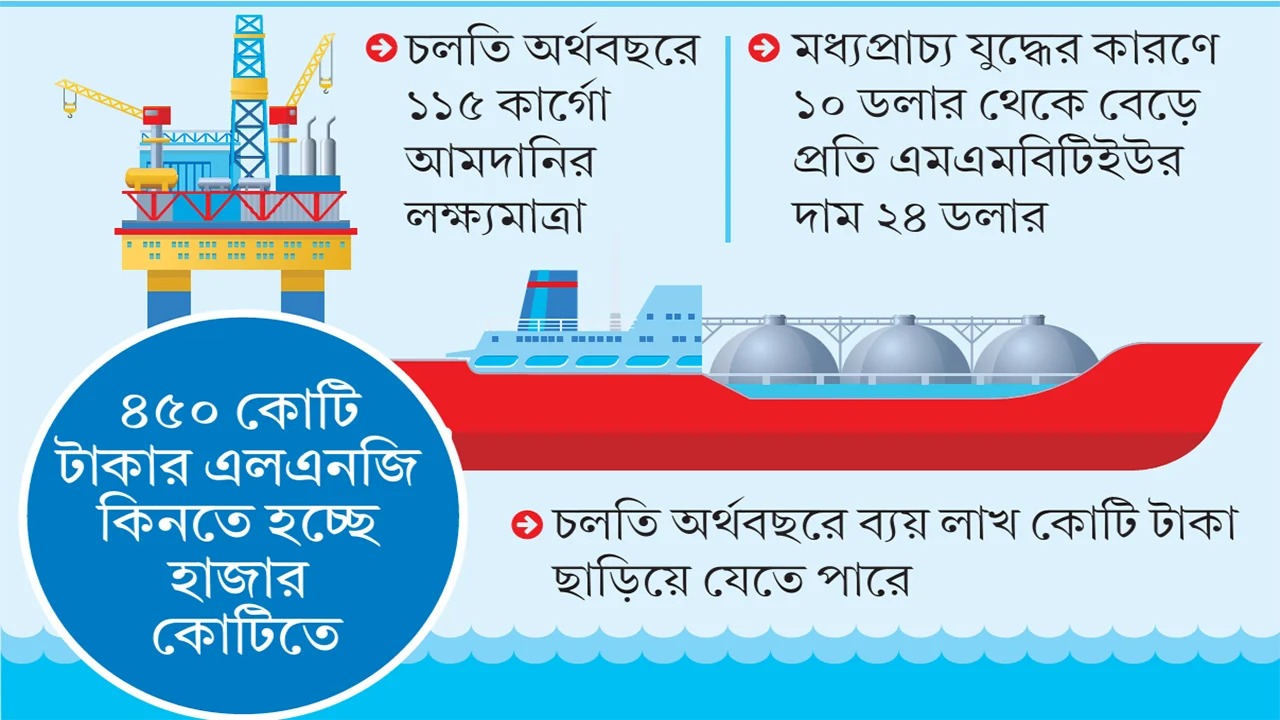
Because of the Iran-US war in the Middle East, Bangladesh is having to buy liquefied natural gas (LNG) from the spot market at more than double the price. Before the war began in February this year, the government was buying spot-market LNG at $10-12 per million British thermal units (MMBtu). Now it is paying more than $24. As a result, a cargo of LNG that used to cost 410-490 crore taka is now costing well over 1,000 crore taka.
Energy experts fear that if shipping through the Strait of Hormuz does not return to normal, the government’s spending on LNG imports alone in the current 2026-27 fiscal year could exceed 90,000 crore to 120,000 crore taka.
According to available information, given the crisis in the international market, the government has recently moved to buy two cargoes of LNG at higher prices from South Korea and the United Kingdom. The cabinet committee on procurement approved the proposal to import this LNG from the open market at its meeting on August 24. Under the decision, one cargo of LNG is being bought from South Korea’s POSCO International Corporation, at a finalized price of $24.625 per MMBtu. Another cargo is being bought from the UK’s TotalEnergies Gas & Power Limited, at $24.25 per MMBtu. Each cargo is costing 1,013 crore taka, compared with the normal pre-war spot-market price of 410-490 crore taka per cargo. The two cargoes are due to arrive in the country in the second and third weeks of September. In early August, the government had approved buying one cargo from Singapore’s Aramco Trading at $21.55, two cargoes from BP Singapore at $21.878 and $21.778, and, on August 19, another cargo from Aramco Trading at $23.93.
Bangladesh first began importing LNG in 2018. Before that, the country generated electricity solely from domestically produced gas. In FY2018-19, importing 43 cargoes of LNG cost 18,813 crore taka, with the government’s LNG subsidy that year at 2,500 crore taka. In FY2019-20, 40 cargoes were imported at a cost of 20,000 crore taka. In FY2020-21, global prices rose, and even though the volume imported fell by one cargo, spending doubled from the previous year to 40,000 crore taka. In FY2021-22, 44 cargoes were imported at a cost of 40,563 crore taka. In FY2022-23, 39 cargoes were imported at a cost of 35,274 crore taka. In FY2023-24, importing 40 cargoes cost 42,800 crore taka. The following year, FY2024-25, LNG imports more than doubled: the government spent 40,752 crore taka importing 86 cargoes. In the fiscal year that just ended, FY2025-26, importing 109-113 cargoes cost 59,713 crore taka, with the government paying out 16,600 crore taka in LNG subsidies that year.
Under the 2026 annual plan, the government has set a target of importing a total of 115 cargoes of LNG this fiscal year. The main national budget for FY2026-27 allocates 17,345 crore taka overall for the power and energy sector, including an initial subsidy allocation of 6,500 crore taka for LNG imports. But officials say that because of geopolitical tensions in the Middle East and rising global prices, 43 percent of the annual subsidy allocation has already been spent in just the first month and a half of the fiscal year.
Because of the Middle East crisis, top long-term supplier QatarEnergy declared force majeure and cut its long-term contracted supply by roughly half. Eight cargoes arrived from Qatar between January and the first week of March. After that, with the long-term contract disrupted, the government began emergency purchases from the spot market — for instance, preparing to bring in nine cargoes this August alone to keep grid supply steady. Officials say a total of roughly 40-50 LNG-laden cargoes have arrived in the country in the first eight months of the year.
Mizanur Rahman, Director (Finance) of the Bangladesh Oil, Gas and Mineral Corporation (Petrobangla), said Monday that while this year’s target is set at 115 cargoes of LNG, actual imports could come in somewhat lower, because the floating terminals are not able to operate at full capacity — various issues have already disrupted their output to some extent. He said 15 cargoes of LNG were imported in the first two months of the fiscal year (July-August), and that the government has already disbursed 14,900 crore taka for LNG imports. He said he expects the finance ministry to release further funds as needed through the proper process going forward.
Experts in the sector say the current energy crisis is one the present government inherited.
Energy expert Dr Badrul Imam, honorary professor in the Department of Geology at Dhaka University, said that over the past 17 years, energy-rich Bangladesh was made import-dependent. He said that if Bangladesh had extracted sufficient gas from its own wells, it would not have had to spend so much valuable foreign currency importing LNG.
Describing Bangladesh as a country geographically rich in mineral resources, he said the country has substantial oil and gas reserves underground. But he said the outgoing government focused more on imports than on exploring or extracting those reserves, sidelining the country’s own scientists while wasting valuable foreign currency on oil and gas imports.
He said that to avoid facing such a complicated situation again in the future, the government needs to prioritize oil and gas exploration and production right away. He recommended using domestic experts for onshore exploration, adding that since Bangladesh lacks much experience in deep-sea exploration, foreign expertise could be brought in for that.