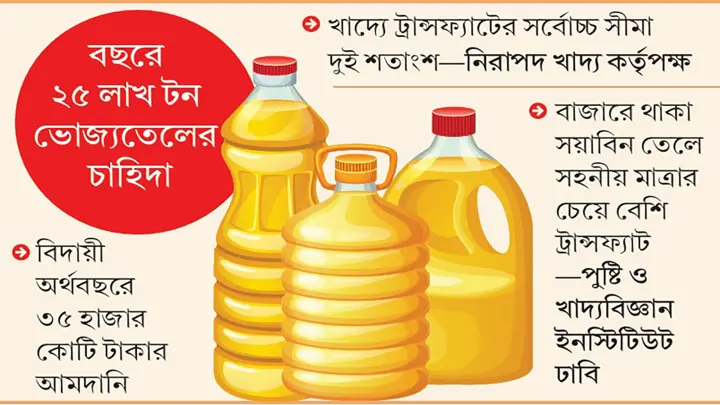
Bangladesh must meet 90% of its roughly 2.5 million-ton annual edible oil demand with imported soybean and palm oil, draining a huge amount of foreign currency from the country every year. Among all the types of edible oil currently used in the country, Bangladesh is not self-sufficient in the raw materials for any of them. Yet despite a golden opportunity to produce about 750,000 tons of healthy “rice bran oil” annually from domestically produced rice husk, the product has failed to secure a lasting place in ordinary households’ kitchens even after a decade and a half. Soybean oil, by contrast, has become an indispensable ingredient, used freely in everything from breakfast to dinner.
Many questions surround the quality and health risks of the widely used double-refined or fortified soybean oil on the market. As a result, the country is failing to tap the vast potential of domestic raw materials and instead must rely on imports, spending large sums of foreign currency every year to meet edible oil demand. Industry insiders say that although the country has the capacity to produce rice bran oil, very little of it is being supplied to the local market. As a result, a large portion of factory capacity sits unused, while the product also remains hard for consumers to find in their kitchens.
According to the Ministry of Commerce, the country needs about 2.5 million tons of edible oil per year. About 90% of that comes from refining imported crude soybean and palm oil. The share of oil from domestic sources, including rice bran, remains comparatively very small.
According to the Bangladesh Bureau of Statistics’ (BBS) Household Income and Expenditure Survey, per capita edible oil consumption was about 31 grams per day in 2022, up from about 27 grams in 2016. This shows that people’s edible oil consumption is rising every year.
Recent import data further illustrates this picture. An analysis of National Board of Revenue data shows that in the just-concluded fiscal year, importing 2.223 million tons of soybean and palm oil cost about 30,440 crore taka. Adding customs duties, value-added tax and other charges brings the total import cost to about 35,000 crore taka. In fiscal year 2024-25, by comparison, importing 2.45 million tons of soybean and palm oil cost about 31,904 crore taka, with total costs including duties and VAT reaching about 34,896 crore taka.
Research shows that rice bran oil, made from rice husk, is among the safest and healthiest edible oils in the world today. By the standards set by the World Health Organization (WHO) and the American Heart Association (AHA), it maintains a balance of saturated, monounsaturated and polyunsaturated fats. Considered in medical science a nutraceutical, or “food substitute for medicine,” the oil contains no trans fat and is rich in vitamin E complex, antioxidants and gamma-oryzanol, which help lower harmful cholesterol in the blood, reduce the risk of heart disease, fight free radicals and improve the body’s immune function. According to the Bangladesh Council of Scientific and Industrial Research (BCSIR), this oil has the highest nutritional value after olive oil. Research at the University of Rochester in New York has also highlighted rice bran oil’s special role in cancer prevention and weight control. Allergen-free and mild in taste, the oil absorbs about 20% less than other oils during cooking, resulting in lower-calorie food.
Government procurement is rising
Demand for rice bran oil is rising at the government level. This year, the government and Trading Corporation of Bangladesh (TCB) have decided to purchase the oil in multiple rounds. In May, the government purchase committee approved buying 10 million liters of refined rice bran oil, at an estimated cost of 179.5 crore taka. Before that, an even larger purchase had been approved in March.
A July report also disclosed a government decision to procure 18 million liters of rice bran oil. This trend in government procurement shows there is a guaranteed market for the product. However, because a lasting demand has not developed in ordinary consumers’ everyday market, producers are unable to take the risk of large-scale production.
What people are eating
In current dietary habits, soybean oil has become an everyday kitchen staple, used extensively from breakfast to nearly every lunch and dinner dish. Experts say most packaged soybean oil is either “double refined” or “fortified,” appearing much more transparent and thin. The more transparent an oil is, the more chemical processing it has undergone; natural oils are generally somewhat darker and have a distinct smell. According to recently published international research, excessive and uninformed use of soybean oil poses a serious risk to public health, largely because it contains harmful trans fat at levels many times higher than the permitted limit.
A 2021 study by Dhaka University’s Institute of Nutrition and Food Science found that about 67% of bottled soybean oil samples from various companies on the market contained trans-fatty acid levels above the permissible limit. Professor Najma Shahin of the same institute, who led the research team, said the study revealed a concerning picture of the quality of soybean oil available in the domestic market, which could have negative long-term effects on public health. She said the government has set a maximum permissible level for harmful trans fat in edible oil in line with WHO guidelines, and that strengthening monitoring and oversight during production could significantly reduce trans-fat levels in edible oil.
The Bangladesh Food Safety Authority formulated the “Trans-Fatty Acid Control Regulations” for food products in 2021, which took effect on Dec. 31, 2022. Although the regulations set a maximum trans-fat limit of 2% in food, recent research found soybean oil samples containing two to four times that level. In addition, procedural flaws in soybean oil refining, along with the practice of repeatedly reheating and reusing the same oil for frying at homes or restaurants (burnt oil), further and alarmingly increase the levels of this harmful substance.
Health experts say trans fat is a harmful form of fat that alarmingly lowers levels of beneficial or “good” cholesterol (HDL) in the blood while simultaneously raising levels of harmful or “bad” cholesterol (LDL). This bad cholesterol accumulates in the blood and blocks blood vessels, directly causing cardiovascular complications.
According to a Bangladesh Bureau of Statistics (BBS) survey on heart disease statistics and mortality risk, about 224,000 people in the country died from heart disease (heart attacks and other heart conditions) in 2020. Heart disease is currently the single biggest cause of premature death in the country, and the presence of excessive trans fat in soybean oil is acting as one of its major contributing factors. The Institute for Health Metrics and Evaluation at the University of Washington in the United States estimates that more than 205,000 people die of heart disease in Bangladesh each year — meaning 562 people die of heart disease every day. Researchers have warned that this severe heart disease risk cannot be reduced without modernizing soybean oil refining systems and stopping the practice of reusing the same oil multiple times.
An opportunity to reduce import dependence
Rice bran oil could serve as an important alternative to reduce the volume of imports in the country’s edible oil market, since its main raw material is a byproduct of domestically grown rice. This would ease pressure on foreign currency reserves while also creating opportunities for additional value addition for rice mills, farmers and local industry.
Experts say that to realize the potential of rice bran oil, an effective raw-material collection network must first be built. This should be followed by making full use of factory capacity, reducing production costs, increasing the supply of smaller packages, and ensuring availability in retail markets. They say the most important factor of all is winning consumer trust.
Alongside promoting rice bran oil as healthy, scientific and verifiable information must also be provided. Rather than needlessly presenting one oil as “the best” and another as “harmful,” accurate information on nutrition and usage should be clearly presented. This is because the question of cooking oil in the kitchens of tens of millions of people in this country is not simply a matter of building a market for one industry — it involves food security, savings in foreign currency, the use of agricultural byproducts and, above all, consumer trust.