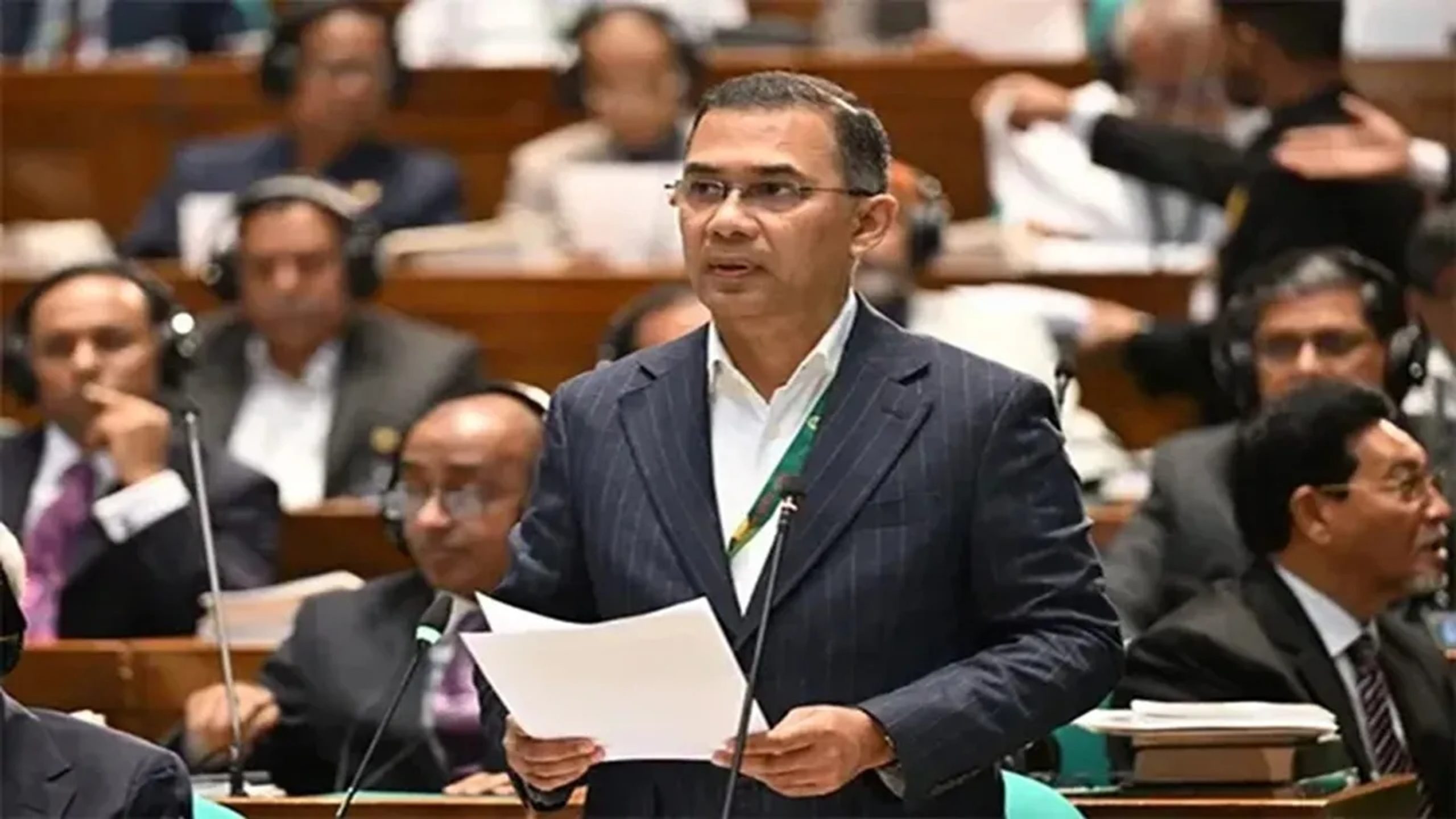
The government has taken a tough stance to curb the recurring trend of timeline extensions and cost overruns in state development projects. To address the problem, it has adopted a number of landmark measures, including close monitoring from project formulation through implementation, ensuring accountability, and punitive action against those responsible.
Prime Minister Tareque Rahman made the remarks Wednesday (Sept. 9) while responding to lawmakers’ questions during question hour in a session of the National Parliament, presided over by Speaker Hafiz Uddin Ahmed.
During the session, Cumilla-10 constituency lawmaker Md. Mobashwer Alam Bhuiyan asked the prime minister whether the government had any directives to curb the recurring trend of project timeline and cost overruns, and if so, what monitoring plans existed to implement them.
In response, Prime Minister Tareque Rahman said, “Timeline and cost overruns in Bangladesh’s state development projects are usually not caused by a single factor. Rather, this problem arises from multiple, interconnected weaknesses in project formulation, approval, land acquisition, financing, procurement and management.”
He said that after these issues came to the current government’s attention, specific causes of the timeline and cost overruns in development-project implementation were identified. Among the most notable are weak feasibility studies, inaccurate cost estimation, poor selection of project sites, delays in land acquisition and utility relocation, delays in the procurement process, failure to appoint project directors on time, and a lack of inter-ministerial coordination.
Government’s 13-point plan to address the problem
The prime minister outlined the notable steps taken by the government in parliament to curb these delays and wastage:
- Ensuring accurate feasibility studies before adopting new projects.
- Accelerating implementation preparations after project approval.
- Updating existing guidelines on project formulation, processing, approval and revision, an effort that is ongoing.
- Setting up dashboards in relevant ministries and divisions to strengthen monitoring of ongoing project implementation progress.
- Increasing regular project reviews and close field-level monitoring.
- Strengthening coordination among relevant agencies to speed up land acquisition and utility relocation.
- Directing that, if a project is not completed on schedule, the causes of delay and cost overruns be identified and necessary action be taken against responsible individuals and institutions in accordance with regulations.
- Requiring ministries and divisions to take appropriate steps such as restructuring, changing scope or continuing implementation for projects with less than 30% implementation progress, based on an assessment of their utility and effectiveness.
- Directing that projects be adopted in clusters under integrated programs rather than in isolation.
- Expanding the use of the electronic Government Procurement (e-GP) system.
- Giving top priority to professional qualifications, skills and practical experience in appointing project directors, and ensuring continuity in their responsibilities; existing policy is being updated to this end.
- Placing emphasis on adopting projects under the public-private partnership (PPP) model.
- Taking an initiative to update the “Public Procurement Rules 2025” to make government procurement more competitive and accountable.