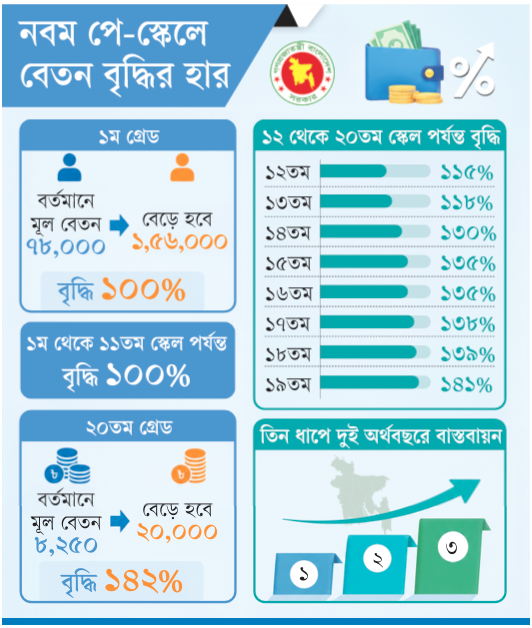
Salaries for government officials and employees have increased by 100 percent to 142 percent. Basic pay for secretaries (grade 1) through grade 11 has doubled. Basic pay for grades 12 through 20 has risen by 115 percent to 142 percent.
The new pay structure for government officials and employees was approved at a cabinet meeting yesterday, Monday afternoon. Prime Minister Tareque Rahman chaired the meeting. The government has approved a new pay structure for government officials and employees for the first time in nearly a dozen years.
Once the new pay structure is implemented, the basic salary of a secretary-level or grade-1 official will rise from the current 78,000 taka to 156,000 taka. The basic salary of someone in grade 20 will rise from 8,250 taka to 20,000 taka. Given the significant impact implementation would have on the economy, it will be rolled out in three phases between July of the current fiscal year and the 2027-28 fiscal year.
The new pay structure also brings good news for retired pensioners.
Once implemented, the new pay structure will benefit roughly 2.4 million civilian and military officials and employees, along with more than 900,000 retired employees and other eligible beneficiaries. This will cost the government an estimated additional 105,580 crore taka a year.
Following the cabinet meeting, Cabinet Secretary Nasimul Gani held a press conference at the information ministry’s PID conference room to detail the pay structure. He said the cabinet approved the new pay scale after considering the government’s fiscal capacity, the country’s overall economic situation, inflation, the cost of living, government employees’ standard of living, and the need for a balanced, rational pay structure. With fairness in mind, the ratio between the lowest and highest grade salaries has been reduced from the existing 1:1.945 to 1:1.78.
Under the new pay structure, a grade-1 official’s basic salary will rise from the current 78,000 taka to 156,000 taka. Similarly, the basic salary of someone in grade 20 will rise from 8,250 taka to 20,000 taka.
The cabinet secretary said that, considering retired pensioners’ standard of living and financial security in old age, a decision was made to significantly raise slab-based net pensions. Net pension will rise 100 percent for those receiving a monthly net pension of less than 9,000 taka; 75 percent for those receiving 9,001 to 20,000 taka; 65 percent for those receiving 20,001 to 30,000 taka; 60 percent for those receiving 30,001 to 40,000 taka; and 55 percent for those receiving 40,001 taka or more.
The government has also decided, for the first time, to introduce a disability allowance for government employees’ children with special needs. Employees will receive a monthly allowance of 3,000 taka for each child with special needs. The government has also decided to expand the scope of the mobile allowance in view of internet and digital communication costs. Until now, the mobile allowance applied only to grade-5 employees. Under the National Pay Scale 2026, employees at every grade will receive the mobile allowance.
Implementation in three phases
At the press conference, the cabinet secretary said the new national pay scale would be implemented in phases for all employees starting July 1. In implementing the pay scale, priority will be given to grade 10 through grade 20 employees in view of their lower income. Basic salary will be implemented in a total of three phases between July 1 and July 1, 2027. Allowances will take effect together starting January 1, 2028. A similarly phased increase in net pension will apply to pensioners.
Nasimul Gani said a separate committee has been formed for the judicial service. Based on that committee’s report, a Bangladesh Judicial Service pay scale will be approved, which will take effect in phases from July 1, in the same manner as the National Pay Scale 2026.
The last, eighth, pay structure for government officials and employees was approved in 2015. Nearly a dozen years later, on July 27, 2025, the then-interim government formed the 23-member “Ninth National Pay Commission.” Led by former finance secretary Zakir Ahmed Khan, the commission submitted its main report to then-interim government Chief Adviser Professor Dr Muhammad Yunus on January 21 this year.
Reacting to media after the cabinet approved the new pay structure yesterday, Saleh Uddin Ahmed, finance adviser to the previous interim government, said they had taken the initiative for this considering the need. He said this new pay structure should have come sooner. However, he said, it will inevitably create a certain kind of pressure on the private sector — that much is true. Taking inflationary pressure into account, a new pay structure is needed across the private sector too, including in the media. He added that unnecessary staffing in the public sector could also be reduced.