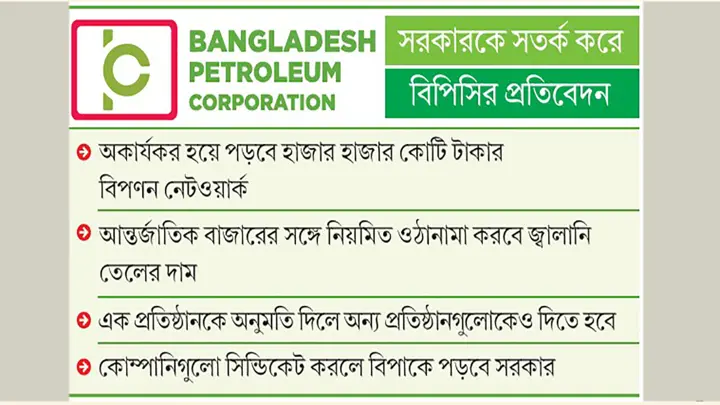
Bangladesh Petroleum Corporation (BPC) has submitted a report warning the government even before a policy on private-sector refined fuel oil imports and marketing has been finalized. The report was prepared based on the opinion of an 11-member special committee made up of senior officials from BPC’s marketing wing and all marketing companies, and has already been sent to the ministry.
The report states that leaving the country’s refined fuel oil imports and marketing to the private sector is extremely risky, carrying nine types of risk related to artificial shortages and hoarding. BPC sources said the government has begun work on a Private-Sector Refined Fuel Import, Storage, Transport and Marketing Policy 2026, and this BPC report is expected to play an important role in shaping that policy.
A copy of this confidential BPC report has been obtained by local media. It states that Bashundhara Oil and Gas Company Limited (BOGCL) on May 24, and Bakhtiar Ahmed General Trading and Co. on Nov. 11 last year, applied to the Energy and Mineral Resources Division for permission to import refined fuel oil (diesel, octane, petrol and furnace oil) on their own and conduct sales and marketing. In response, the division ordered the formation of a high-powered committee combining senior officials from BPC and the companies. The 11-member committee was headed by BPC Director (Operations) A.K. Mohammad Samsul Ahsan as convener, with Manager (Trade and Operations) Md. Ishtiaque Hossain as member secretary. Other members were BPC Director (Finance) Nazneen Parveen, Director (Planning) Muhammad Asadul Haque, Senior General Manager (Accounts) A.T.M. Selim, General Manager (Finance) Muhammad Morshed Hossain Azad, General Manager (Marketing) Ferdousi Masum Himel, General Manager (Trade and Operations) Mohammad Zahid Hossain, Jamuna Oil Managing Director Md. Yousuf Hossain Bhuiyan, Padma Oil MD Md. Mafizur Rahman, and Meghna Petroleum MD Md. Shahirul Islam. The report was completed on July 19 and sent to the ministry.
It states the country’s fuel oil demand is 6.8 to 7 million tonnes. BPC’s only refinery, Eastern Refinery, produces about 1.5 million tonnes of various grades of refined fuel oil annually from crude processing. In addition, about 600,000 tonnes of refined fuel oil are procured annually at government-set rates from local condensate- and naphtha-based government and private mini-refineries. The rest of the country’s demand is met through imports.
Diesel accounts for roughly 65% of total demand, or about 4.55 million tonnes, growing at a minimum of 5% a year. Currently, about 650,000 tonnes of diesel come from Eastern Refinery, 100,000 tonnes from private mini-refineries or fractionation plants, and the remaining 3.8 million tonnes are imported.
The need for refined fuel imports will ease once the new 3-million-tonne-capacity ERL-2 refinery is completed. Globally, rising production and demand for electric and hybrid vehicles is also easing pressure on fuel demand, meaning future demand may fall rather than rise.
The report says that under the law, the exclusive authority to import, stockpile and market refined fuel oil rests with the government, through BPC. Granting permission to one or more private companies would set a precedent that could force similar permissions for others. If the private sector enters refined fuel imports, the government would lose significant revenue, and BPC’s marketing arms — Padma, Meghna and Jamuna — would become sick enterprises. If that happens, the government could become hostage to a refined-fuel cartel similar to the LPG cartel. If global fuel prices rise or the U.S. dollar supply tightens, privately licensed importers could halt imports, sharply worsening any fuel crisis. Amid the ongoing Iran-U.S.-Israel war and its impact on the public, BPC has kept fuel supply steady through government-decided subsidies — something no private company would agree to do at subsidized prices.
The BPC committee also warned of several strategic and economic complications: domestic prices would rise when global prices rise, but might not fall when global prices fall; importers could delay or cut imports when global prices rise; over- and under-invoicing could enable capital flight; a few large firms could form a cartel to artificially inflate prices; and pressure could build on the government to match international price hikes, since private firms prioritize profit over public welfare. Supply disruptions from private firms are also more likely when global prices rise.
BPC pointed to instability in Sri Lanka, Pakistan and the United Kingdom after those countries handed control of fuel to the private sector. Sri Lanka is cited as a stark example: after partially privatizing its fuel market and bringing in Lanka IOC (LIOC) and other foreign and private firms, private importers halted oil imports amid a dollar shortage during the 2022 economic crisis. The state-run Ceylon Petroleum Corporation alone could not handle the pressure, leading to miles-long fuel queues, halted public transport, and inflation reaching 300%.
In Pakistan, a large share of fuel imports is handled by private oil marketing companies, which stockpile fuel to create artificial shortages for higher profits whenever global prices or the dollar rate shift. Petrol pumps there regularly display “no petrol” signs, causing severe public hardship.
In the 1980s and ’90s, the United Kingdom privatized its entire energy and utilities sector. In recent years, as global energy prices rose, many private suppliers went bankrupt, and ordinary people saw their electricity and gas bills double or triple within a year, pushing millions of households into “fuel poverty.”
The report outlines nine types of risk from artificial shortages and hoarding if fuel imports and marketing are handed to the private sector: 1) Private companies could create artificial shortages by controlling supply if policy disagreements arise with the government. 2) Firms may hoard fuel anticipating higher profits when global prices are expected to rise. 3) Since supplying remote or hard-to-reach areas is costly, private firms may cut or halt supply there, focusing only on profitable, major industrial areas, leaving a large section of the population without reliable fuel access. 4) Since energy is a core driver of the economy, the government could become helpless during a crisis if control shifts to private hands. 5) The tendency to adulterate fuel for maximum profit could increase. 6) Handing over fuel marketing and management to the private sector would sharply raise the cost of living and negatively affect the overall economy, raising the cost of doing business as well. 7) Many private power plants depend on liquid fuel; if oil prices rise, electricity prices could rise in several rounds too. Costs would rise for WASA and other water-supply pumps, raising water bills, and healthcare costs would climb, leaving poorer people without adequate medical care. 8) Rising cost of living would reduce people’s purchasing power. 9) Once fuel prices rise, the resulting price increases across the market rarely reverse easily.
The report further notes that BPC’s subsidiaries — Padma Oil Company Limited (POCL), Jamuna Oil Company Limited (JOCL) and Meghna Petroleum Limited (MPL) — market various grades of fuel nationwide at fixed prices, backed by an extensive stockpiling, transport, procurement and marketing infrastructure. These marketing companies operate a total of 27 depots — river-based, railhead-based and road-based — for fuel storage. To ensure supply reaches consumers, BPC has 2,379 filling stations, 667 packed-point dealers, 2,640 agencies, 129 marine dealers, 3,111 LPG gas dealers and 17 bunker dealers nationwide, along with adequate arrangements for transporting fuel by water, rail and road. BPC has kept fuel supply steady through various disasters. Even as the ongoing Iran-U.S.-Israel war has caused fuel shortages elsewhere in the world, BPC and the government’s dedicated efforts, sense of accountability to the public, and concern for public hardship have kept supply intact through heavy subsidies — something no private company would be able to sustain. Given that refined fuel oil is a sensitive, strategic commodity, it is safer for exclusive control over its import, storage, marketing and supply to remain with BPC.
BPC has paid the government a total of 71,872 crore taka in revenue over the past five years — 14,798 crore taka in fiscal 2021-22, 14,793 crore taka in 2022-23, 14,648 crore taka in 2023-24, 12,675 crore taka in 2024-25, and 14,857 crore taka in 2025-26. If the private sector is granted permission to import refined fuel oil, government revenue would fall significantly.
The high-level committee believes that, to protect the public interest, maintain state stability, and taking into account lessons from the ongoing Iran-U.S.-Israel war, exclusive government authority over the import, storage and marketing of refined fuel oil as a strategic commodity should be preserved. Under the Private-Sector Refinery Establishment, Crude Oil Import, Storage, Processing, Transport and Marketing Policy-2023, private companies could instead be encouraged, where needed, to set up refineries and import crude oil.