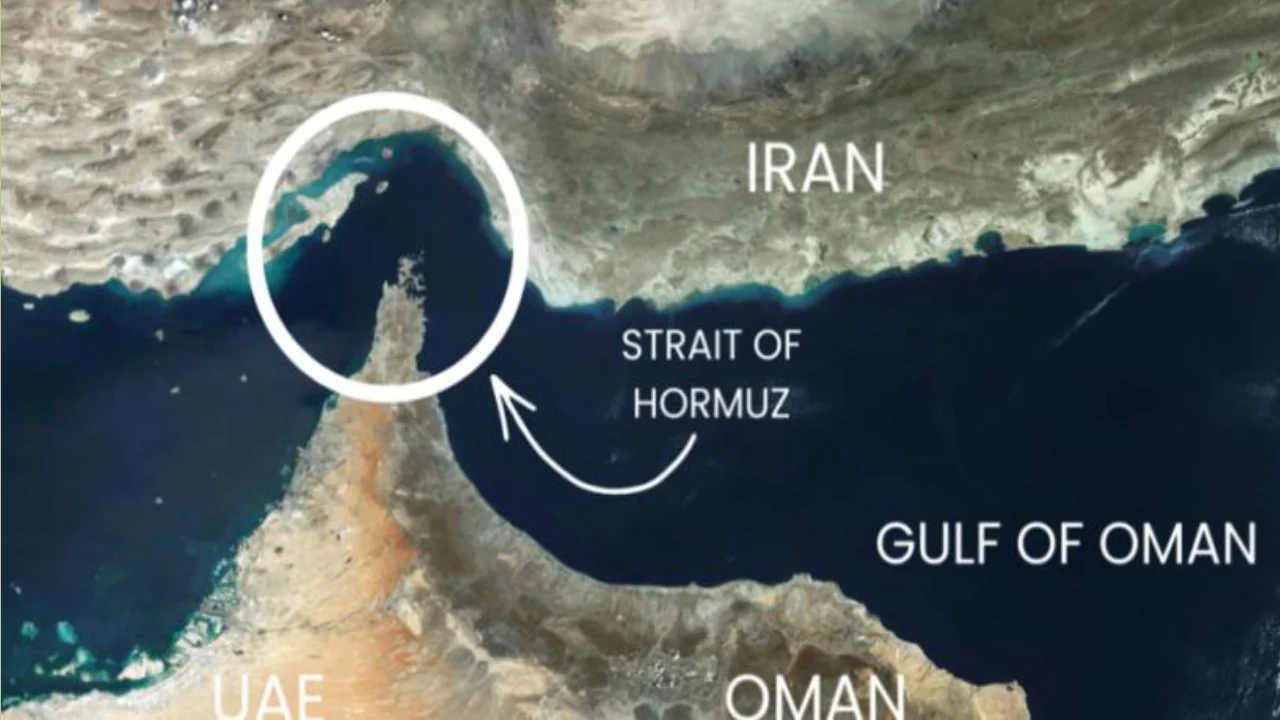
Why did Iran, despite long threatening to fully close the Strait of Hormuz, in practice hold back from doing so — and why did that calculation change after the 2026 war? Because closing Hormuz is a “last resort” weapon for Iran. Shutting the strait wouldn’t just hurt the US, Israel or the Gulf Arab states — it would also severely damage Iran’s own economy and oil exports.
These observations come from an analytical article published August 28, 2026, in South Asia Monitor titled “Iran and the Strait of Hormuz Blockade: Why Tehran Did Not Close the Strait Earlier,” written by retired Brigadier Sanjay Agarwal.
Why Hormuz matters so much to Iran
The Strait of Hormuz is an extremely important strategic asset in Iran’s geography. A large share of the Persian Gulf’s oil and gas reaches international markets through this narrow waterway. That gives Iran, if it chooses, the military means to disrupt shipping. But fully closing the strait and imposing limited control or obstruction are not the same thing. Iran has long viewed the latter as the more effective option.
A full closure would hurt Iran too
Iran itself depends on sea routes for oil exports, imports and foreign trade. So if Hormuz were fully closed: Iran’s oil exports would fall; its foreign-currency earnings would suffer; importing food and essential goods would become harder; international pressure on Iran would increase further; and the risk of a military response from the US and its allies would rise. In other words, the very weapon that could strike an enemy would also strike back at Iran’s own economy. That is why closing Hormuz has, until now, been an extremely costly decision for Iran.
So what did Iran do instead?
Rather than a full blockade, Iran has at various times demonstrated control through measures such as regulating shipping, issuing warnings, conducting inspections, running military patrols and restricting the movement of specific vessels. As recently as May 2026, Iran’s Revolutionary Guard said shipping through Hormuz was moving only with its permission and coordination. That created an important strategic message for Iran: “I can create problems for your trade and energy supply without fully closing the strait.” In other words, Hormuz has served Iran not just as a blockade weapon, but as a means of creating diplomatic and military pressure.
Why did the calculus change in 2026?
After the 2026 Iran-US conflict, the situation reached a point where Hormuz was no longer just Iran’s potential “last resort” weapon — effective control of the strait and its shipping became directly part of the military conflict itself. In the current situation, the US is trying to keep naval traffic safe in Hormuz, while Iran is using its military capability to try to maintain control over the strait. The events of August 31 — the US strike on Iran’s rocket-launch site on Larak Island and Iran’s subsequent counterattack — showed that Hormuz has now become one of the central arenas of direct military conflict.
Iran’s new ‘Hormuz paradox’
A crucial strategic contradiction has emerged here. The longer Hormuz remains closed or unstable, the more countries around the world will look for alternative routes. Saudi Arabia and the United Arab Emirates have already placed greater emphasis on alternative pipelines and export routes. As a result, the world’s long-term dependence on Hormuz could decline. In other words, if Iran keeps using Hormuz as a weapon for a prolonged period, the importance of its most valuable geostrategic asset could gradually diminish. That is the Hormuz paradox: the more Hormuz is used as a weapon, the more the world will try to avoid it.
Why does it matter for China, India and Asia?
Hormuz’s importance isn’t confined to the Middle East. A large share of Gulf energy goes to Asian countries. So a prolonged crisis in Hormuz risks driving up oil and energy prices in China, India, Japan, South Korea and South Asian countries. India, for one, has already strengthened its naval security measures during the Hormuz crisis to keep its own shipping and energy supply secure. The matter is significant for Bangladesh too, since higher global energy prices can affect import costs, transport costs, power generation and inflation.
The bottom line is this: Iran has not fully closed Hormuz until now, because doing so would have been a decision that struck at its own economy. But the 2026 war has upended that old calculation. Hormuz has now itself become the primary battlefield of war, economy and diplomacy.
And in the long run, Iran’s biggest problem could be this: the longer Hormuz is kept unstable, the more Saudi Arabia, the UAE, other Gulf states and the international energy market will build alternative routes. As a result, Iran’s most powerful geostrategic lever could gradually weaken.