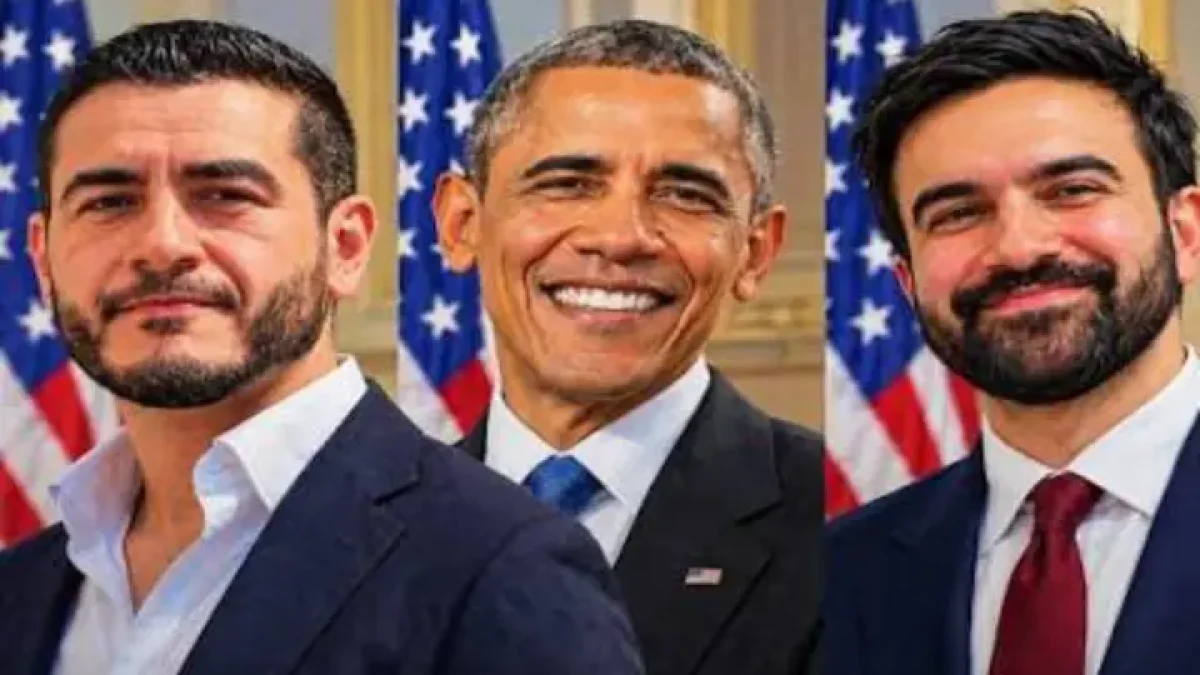
Three names now come up again and again in discussion of the future leadership and direction of the US Democratic Party: Barack Obama, Abdul El-Sayed and Zohran Mamdani. The three differ in the length of their political careers, their experience and their positions. But the debate around them shows some common threads.
Chief among them are ordinary people’s economic worries outside the established power structure, the rise of new leaders, the representation of a multicultural society and grassroots political organising.
In the US midterm elections of 3 November 2026, Democrat Abdul El-Sayed defeated Republican Mike Rogers for a Senate seat in Michigan. The Associated Press and CBS News confirmed his victory on 4 November.
With it he became the first Muslim in US history elected to the Senate. The Michigan race was not just a contest for one Senate seat; it was also seen as an important test of how far progressive politics is accepted inside the Democratic Party, and of electoral strategy.
El-Sayed, 42, was born in Michigan to an Egyptian immigrant family. He is a physician, a public health expert and a former government official. He earned a doctorate in public health at the University of Oxford, where he was a Rhodes Scholar, took his medical degree at Columbia University and also studied at the University of Michigan.
Before entering politics he was executive director of Detroit’s health department, so his political identity is bound up with public health, medicine and social policy.
He first drew attention in 2018, running in the Democratic primary for governor of Michigan. He lost to Gretchen Whitmer, but the campaign made him a familiar face of progressive politics. Universal healthcare, safe water for all, debt-free higher education, renewable energy and reducing corporate influence in politics were central to his platform. In the 2026 Senate race, that political outlook reached a wider audience.
The main slogan and priorities of his campaign were “get money out of politics, keep money in people’s pockets, and Medicare for All”. He spoke of guaranteeing healthcare for everyone through Medicare for All, easing the burden of medical costs and debt, taxing the wealth of billionaires and limiting the political influence of corporate money.
He also opposed US military aid and arms sales to Israel, arguing that American taxpayers’ money should go to the health, education and living standards of people at home rather than to foreign militaries.
That stance put him at odds with part of the Democratic Party’s established leadership. Some Jewish leaders and political opponents criticised his remarks on Israel. A particular controversy arose over an advertisement by an outside political action committee backing his campaign.
The ad linked America’s economic hardship to US funding for Israel’s military operations in Palestine. Critics saw in its language historical echoes of antisemitic propaganda. El-Sayed’s campaign distanced itself from the ad and said it had not made it. He has said criticism of the Israeli government’s policies should be kept separate from charges of antisemitism.
His religious identity also became a target during the campaign. President Donald Trump and his allies questioned his patriotism and political loyalty. Allegations of links to extremist groups were also raised, though no credible evidence was presented to support them.
Meanwhile, Haley Stevens, his rival in the Democratic primary, endorsed Republican Mike Rogers at the last minute, bringing questions of party unity and ideological division into the closing stage of the race. Despite all this, El-Sayed’s win carries fresh meaning for supporters of progressive politics.
This is where Zohran Mamdani comes in. Mamdani, the mayor of New York, congratulated El-Sayed on his victory. His remarks focused on ordinary people’s cost of living, access to healthcare and reducing the influence of money in politics.
He said the core messages of El-Sayed’s campaign mattered not only to the people of Michigan but to New Yorkers as well. He sees the effort to put working people’s interests back at the centre of politics as part of a wider political movement.
Mamdani did not, however, cast El-Sayed as a mirror image of himself. He stressed instead the distinct political experience and fields of work of each. Still, their messages and campaigns share some features.
Both have put the cost of living, housing, healthcare, ordinary people’s incomes and corporate influence at the centre of political debate. The economic issues Mamdani raised in New York’s local election were reflected in El-Sayed’s campaign in Michigan.
Then there is Barack Obama. Comparisons between El-Sayed’s rise and Obama are not new. Since his 2018 run for governor, his speaking style, personal story, education and grassroots outreach have drawn mentions of Obama.
The two share some comparable traits: the experience of an immigrant family, advanced education, representing social diversity and organising supporters outside the established political structure.
But their political positions and historical roles cannot be treated as one. Obama was the 44th president of the United States and, with his historic win in 2008, the country’s first Black president. His campaign drew heavily on the ideas of “hope” and “change”, grassroots organisation and a message of broad national unity.
El-Sayed’s message is more explicitly centred on progressive economics, universal healthcare, curbing corporate money and criticism of US policy in the Middle East. The comparison with Obama may be one way to gauge his potential political influence, but it is no proof of a shared political project.
The three also differ in their positions and responsibilities. Obama is a former president, Mamdani is mayor of New York and El-Sayed is senator-elect. Their political experience, the scope of their duties and the reach of their power are different. So the fact that their names come up in the same conversation does not mean they represent the same kind of leadership or the same political current.
Still, a larger question has emerged around them: will the Democratic Party’s future politics give more weight to new social and economic realities beyond its established leadership? In particular, how will the political hopes of young voters, children of immigrant families, Muslim and Arab-American communities, Black citizens and working people shape the party’s policies and leadership?
The Michigan election is an important example. Religious identity, immigrant background and ethnic diversity remain contested in American politics, but El-Sayed’s win has shown that people with those identities can reach national leadership.
At the same time, his success does not prove that all Democratic voters agree with his platform. Rather, it shows that in a competitive state, issues such as healthcare, the cost of living, political funding and foreign policy can play an important part in an election.
El-Sayed now faces the challenge of delivering on his promises. Winning an election and carrying a programme through Congress are not the same thing. To reform healthcare, limit the political influence of corporate money or change US policy on Israel and Palestine, he will have to work not only within his own party but with the wider political realities of Congress.
Barack Obama, Zohran Mamdani and Abdul El-Sayed are therefore more than the names of three politicians. They stand for three separate chapters in America’s changing political society, its new hopes for leadership and the Democratic Party’s ideological debate.
There are real similarities between them, and important differences. How much influence this strand of politics will have depends not only on winning elections but on putting policy into practice, building organisation and making visible changes in ordinary people’s lives.
বাংলায় মূল প্রতিবেদন পড়ুন · Read the original Bengali report