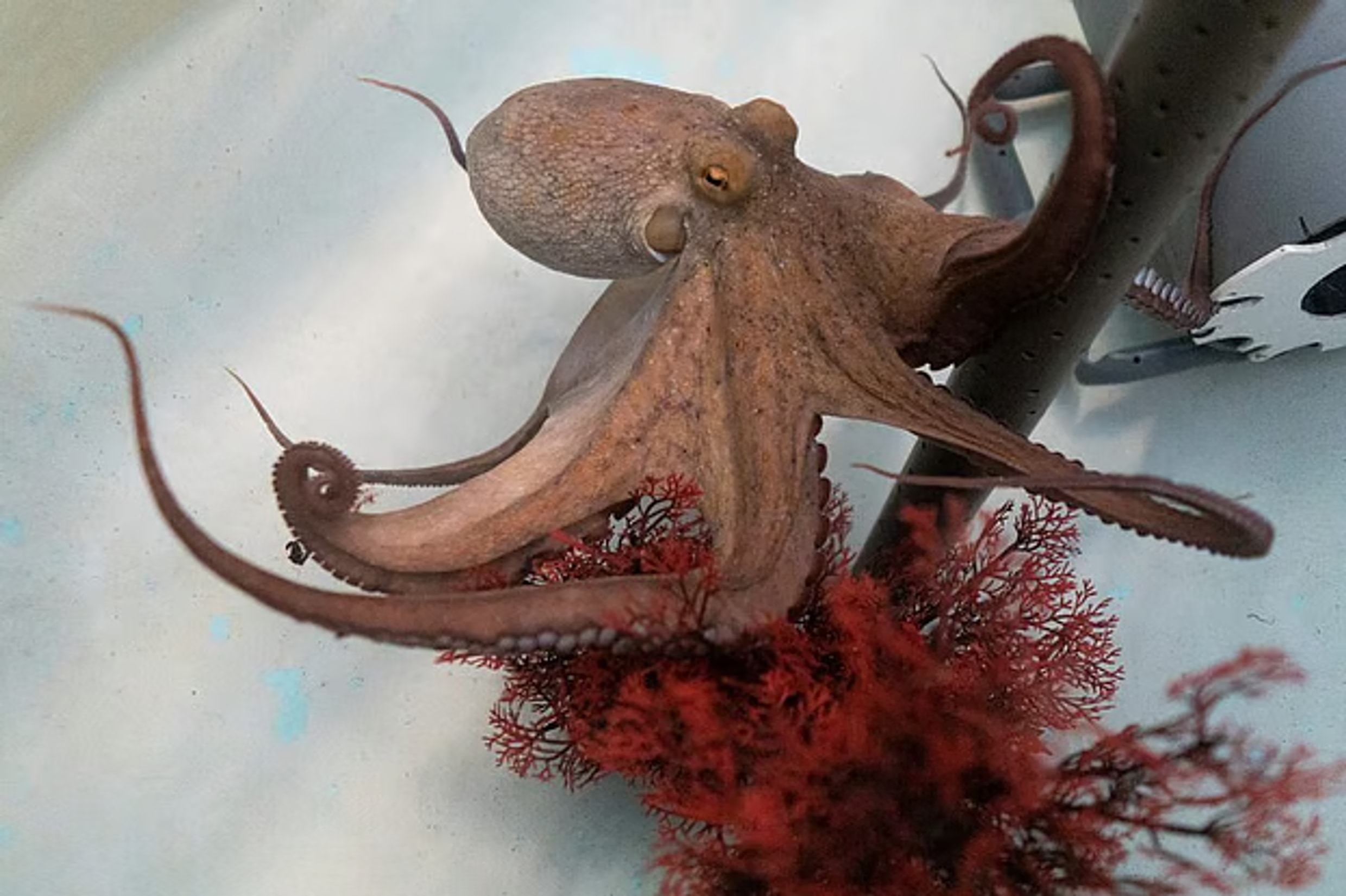
An octopus can slip through impossibly narrow gaps with ease. Scientists have now worked out in detail how the animal does it, and plan to build robots on the same model.
Octopuses have no rigid skeleton like humans. Their bodies are made of a “muscular hydrostat”, so the eight arms can bend at will and the middle of the body can change shape. Even when the body is squeezed to enter a tight space, the muscles of the main blood vessels keep blood circulating.
Octopuses living on rocky coasts use the sensitive touch of their arms to probe narrow cracks, mainly to escape predators and to catch prey hidden in hard-to-reach corners.
Researchers in Singapore and Italy found that they use two main methods to pass through small holes. If the opening is wider than the distance between the octopus’s two eyes, it follows a three-step process.
It first tests the hole with one arm, then pushes several arms inside, and finally pulls its whole body and head through by bracing on them. If the hole is narrower than the distance between its eyes, it uses a four-step method: it pulls the remaining arms through one by one before squeezing its head and mantle through.
The scientists hope the octopus’s technique will make it possible to build advanced robots for search and rescue in disaster rubble.
Rescue robots in use today are usually long and thin so they can pass through small spaces. A robot inspired by the octopus could carry more, including sensors, tools and communication equipment, with the help of flexible arms.
Building such a flexible robot is a big challenge for engineers, though. To pass through narrow passages its arms must be soft, yet strong enough to pull the whole body after them.
বাংলায় মূল প্রতিবেদন পড়ুন · Read the original Bengali report