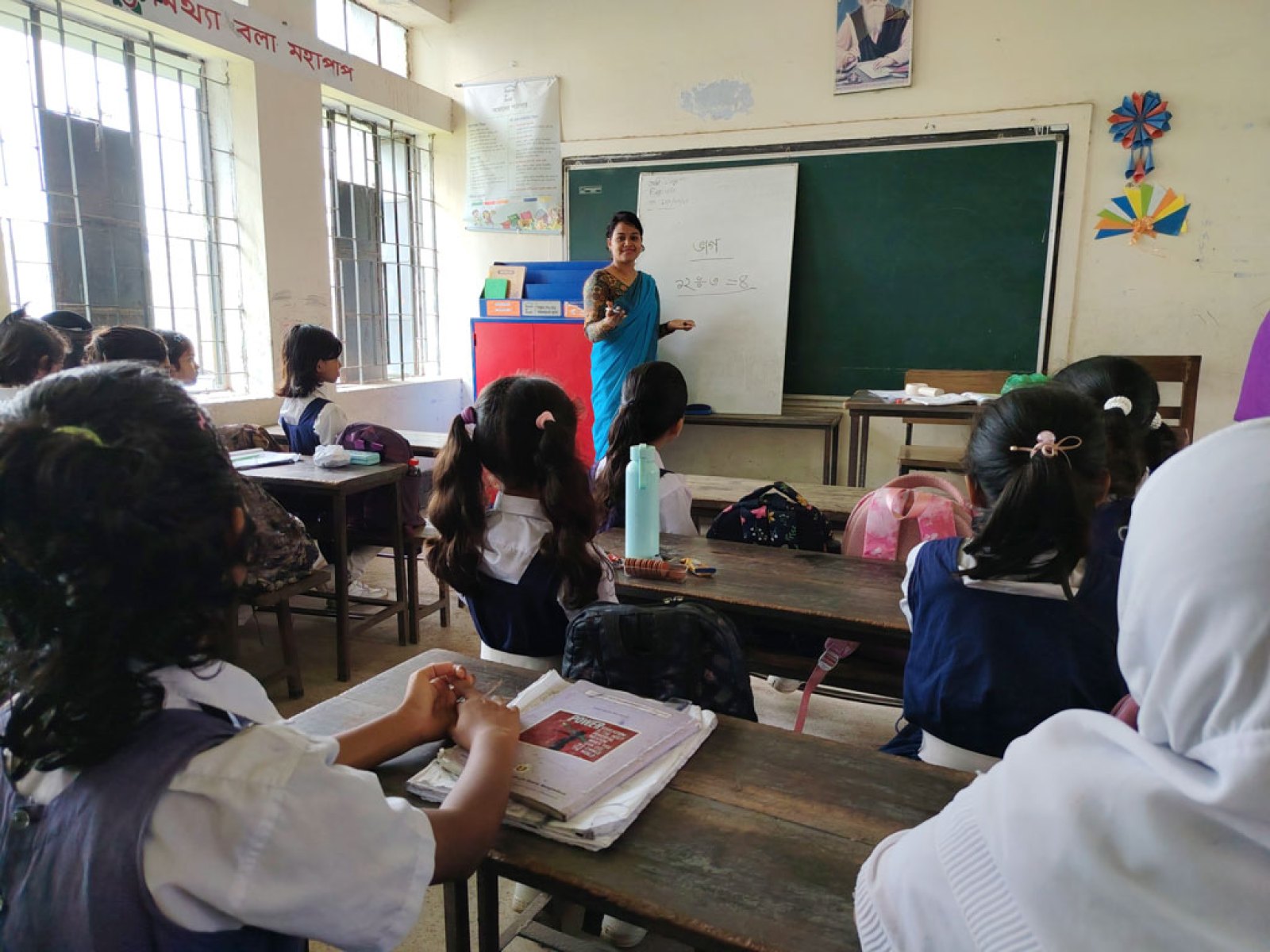
- Access to primary school has grown, but Bangladesh lags in basic learning skills.
- The World Bank is providing Tk 3,720 crore to raise the quality of education.
- The money will be spent on improving learning for 26 million children.
Bangladesh has put almost every child in primary school. But one child in two who goes to school is not learning what children of that age should. Nearly 50 percent of 10-year-olds cannot read a simple text and understand it. The World Bank has identified this weakness in learning as a major challenge for the country’s primary education system.
Against this background, the World Bank has approved $300 million, about Tk 3,720 crore, to improve primary education in the country. Its board of executive directors approved the financing last Friday.
The money will be spent on improving learning for 26 million children from pre-primary to class five. It comes through the International Development Association (IDA), the World Bank Group body that gives loans and grants to low-income countries. The loan runs for 25 years, with a grace period on repayments for the first five.
Giving the details in a press release on Saturday, the World Bank’s Dhaka office said the programme, the Learning Enhancement and Acceleration in Primary Education Program, will raise children’s basic skills in reading, writing and maths. The financing will also support the government’s Fifth Primary Education Development Programme.
According to the World Bank, about 50 percent of 10-year-olds in Bangladesh cannot read and understand a simple age-appropriate text. The rate is 42 percent in Malaysia, an upper-middle-income country, and 47 percent in Brazil. In other words, access to primary education has grown, but Bangladesh still lags in children’s basic learning.
Jean Pesme, the World Bank’s division director for Bangladesh and Bhutan, said quality primary education is one of the foundations of a workforce able to compete in the global market. Over the past two decades, the World Bank has helped Bangladesh get almost every child into school. The new financing will help children learn better and stay in school, and the World Bank hopes it will lay the foundation for better jobs in future.
Under the programme, special teaching packages will be introduced to raise pupils’ basic literacy and maths skills, with teaching materials, structured lesson plans and teacher training. In addition, 90 percent of government primary school head teachers will be trained in leadership and school management, and school governance and management systems will be strengthened.
Beyond regular lessons, extra classes have been planned for children who are falling behind, with particular attention to districts where pupils lag furthest. There will also be steps to improve teachers’ skills, build effective leadership at school level and make education budgets accountable.
According to the World Bank, Bangladesh’s primary education system has more than 20 million pupils across government schools, NGO-run schools, kindergartens and madrasas. The programme will also improve pre-primary education in government primary schools, so that children gain the skills they need before they enrol. The World Bank expects the programme to create 843,000 new and relatively well-paid jobs in the government primary school system.
Tashmina Rahman, a senior education specialist at the World Bank and the programme’s team leader, said building a strong foundation in learning is the first step to gaining the skills needed for good jobs. So that no child is left behind, the programme provides special lessons for pupils who are falling behind. It also aims to increase the use of data in decisions on education and to make sure budgets are used effectively.
বাংলায় মূল প্রতিবেদন পড়ুন · Read the original Bengali report