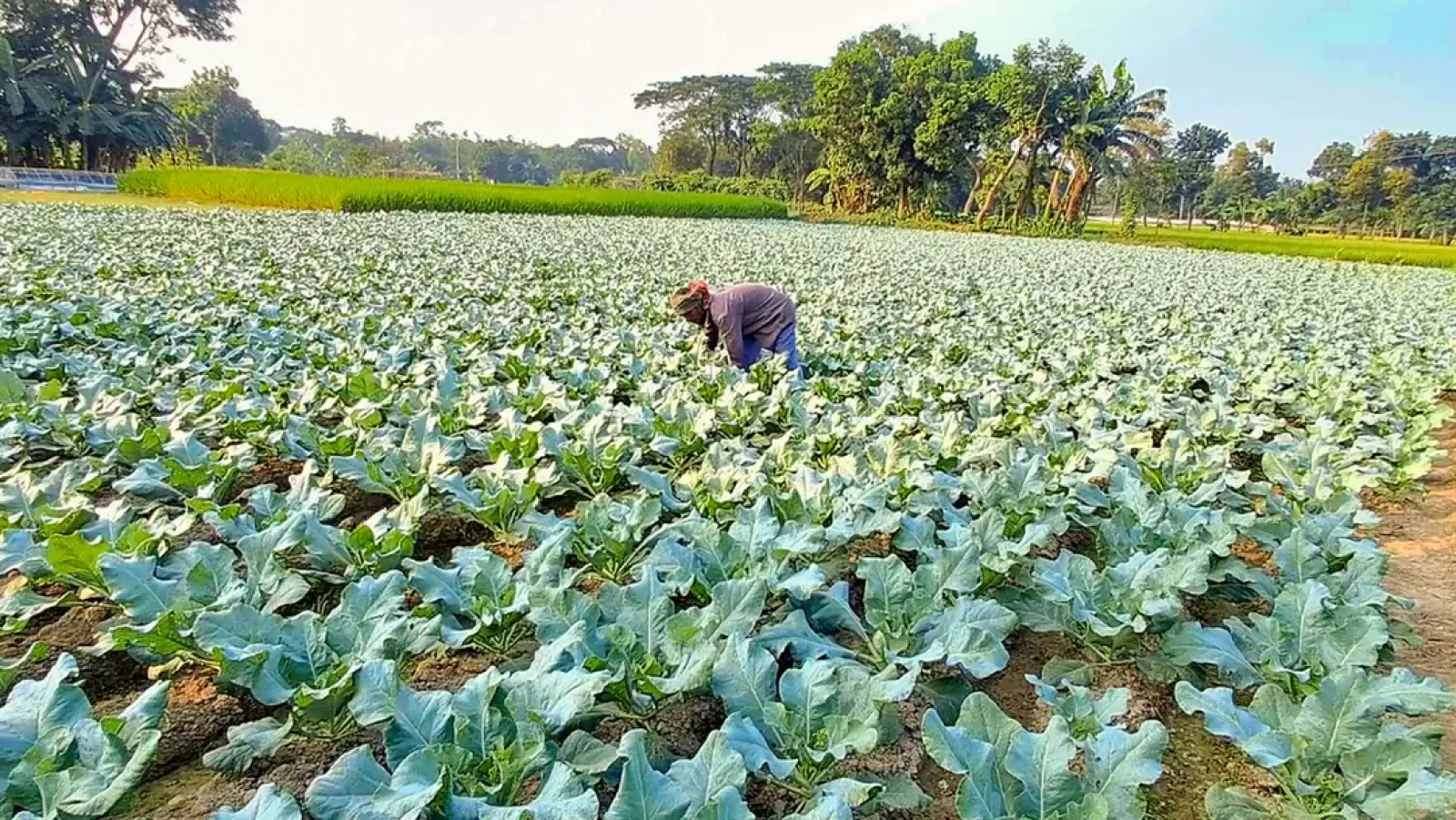
Winter has changed the look of the fields in Pakundia upazila of Kishoreganj. In some plots cauliflower and cabbage are growing between green leaves; in others, gourds and beans hang from bamboo trellises. Elsewhere there are rows of radish, aubergine, tomato and chilli, and farmers are also busy with spinach, red amaranth and coriander. They are working day and night in the hope of getting early vegetables to market and earning a good price.
But with production costs up, many say they cannot make the sums add up this year. Alongside hopes of a good harvest and good prices, they fear a loss.
Farmers said that a few years ago an early crop of cauliflower and cabbage brought a fairly good profit. Fertiliser, pesticide and other inputs were cheaper then, so production costs stayed under control. Over the past two years, however, the cost of almost everything has risen: fertiliser, pesticide, ploughing, farm machinery and labour. That has made vegetable growing a hard sum. Even with a good yield, they fear a loss if they do not get a fair price at market.
Pakundia grows vegetables on a large scale every year. After meeting local demand, its produce is sent to Dhaka and other parts of the country. At the start of the season, the upazila’s farmers have taken up early vegetables as well as a range of winter crops.
In Tarakandi, Char Kaona Muniarikanda, Jangalia, Char Faradi and Chandipasha Baro Ajoldi, among other areas, the fields were full of work on winter vegetables. Some farmers were preparing land, some planting seedlings, others weeding and irrigating. In some plots they were tending cauliflower and cabbage; in others radish, beans, gourds, aubergine and tomato were being grown, and some had sown spinach, red amaranth and coriander.
Nazrul Islam, a farmer in Baro Ajoldi village of Chandipasha union, said he has grown early varieties of cauliflower and cabbage regularly for several years. This year he has planted cauliflower on 40 decimals of land, which will be ready for sale within the next two weeks. He hopes to make a profit if prices hold.
Nazrul Islam said he raises his own seedlings of cauliflower, cabbage, tomato and other vegetables. As well as planting them on his own land, he sells seedlings to other farmers, which gives him extra income.
Giash Uddin, a farmer in the same village, has planted cauliflower, cabbage, gourds and other winter vegetables. “You can’t say anything in advance,” he said. “If God wills it and the market is good, there may be a profit.”
Farmer Nasir Uddin said vegetable growing used to pay well. But for several years the prices of farm machinery, fertiliser and pesticide have risen, pushing production costs much higher. “Now we grow vegetables with the fear of profit or loss hanging over us,” he said, adding that he hopes for some profit if market prices are good.
Mohammad Jahangir Alam, the sub-assistant agriculture officer in charge of the Chandipasha block, said farmers in Baro Ajoldi had again planted early cauliflower this year. The crop will be ready for market within two weeks, and farmers can profit if prices are good.
He said farmers are being advised to use organic fertiliser to keep the soil healthy. Excessive use of chemical fertiliser is upsetting the soil’s acid balance, and farmers are being advised to apply dolomite lime to reduce the problem. That will help preserve soil quality while cutting the use of chemical fertiliser.
Nur-e-Alam, the Pakundia upazila agriculture officer, said the rabi season is one of the busiest of the year for the upazila’s farmers. About 2,500 hectares are planted with rabi crops in the season, including about 1,300 hectares of potato, 350 hectares of onion and 140 hectares of wheat. Cauliflower, cabbage, tomato, chilli and other winter vegetables are also grown.
He said these vegetables are grown in almost every part of the upazila, and farmers have already begun planting winter crops. If the weather stays favourable, he expects a good harvest this season and fair prices for farmers.
বাংলায় মূল প্রতিবেদন পড়ুন · Read the original Bengali report