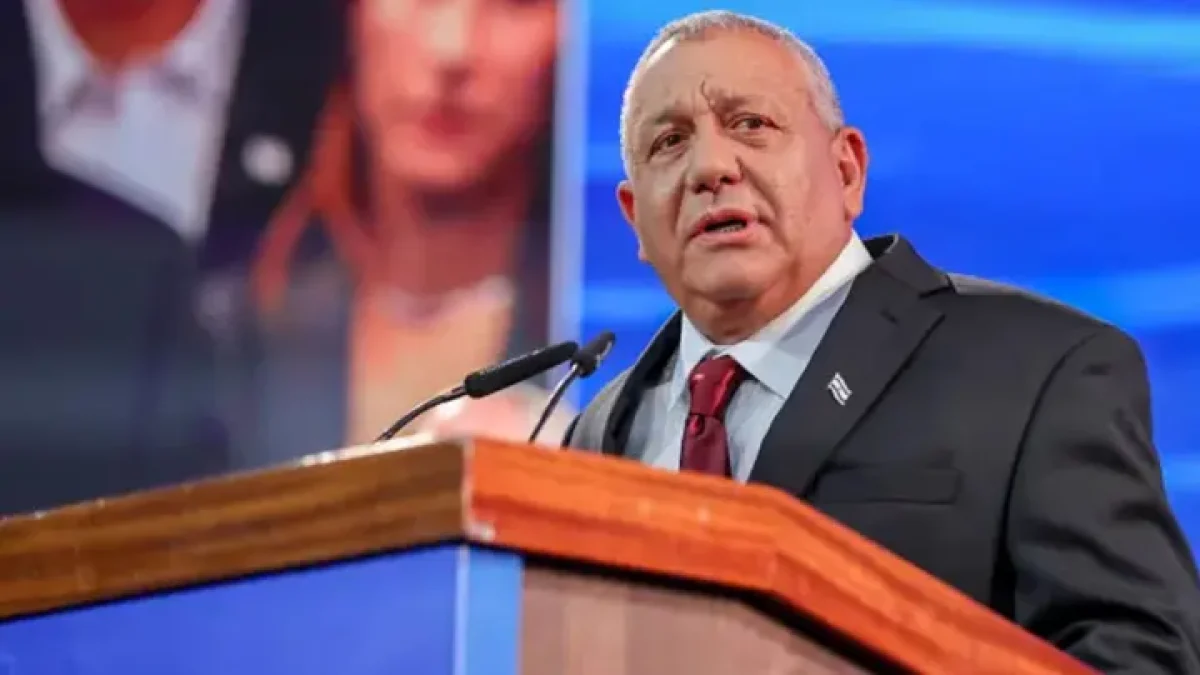
Israeli President Isaac Herzog has given Gadi Eisenkot the task of forming the country’s next government. Herzog made the announcement on Saturday. Sixty-seven members of the Knesset, Israel’s parliament, recommended Eisenkot for the mandate, against 46 who backed outgoing Prime Minister Benjamin Netanyahu. Seven abstained.
Although a majority of lawmakers support Eisenkot, the political deal needed to form a new government is still a long way off.
The differences among his potential coalition partners run so deep that Herzog himself asked Eisenkot last weekend to explain how he intends to overcome them.
Of the 67 lawmakers who recommended Eisenkot, 19 belong to Arab parties. The Zionist parties of the change bloc hold only 48 seats on their own. To form a government they need the support of the Haredi, or ultra-Orthodox, parties. Without the seven seats of United Torah Judaism and the six of Shas in particular, a majority is hard to reach.
But Shas leader Aryeh Deri has already sided with Netanyahu. Haredi political sources believe there is little chance of Shas joining a coalition with Eisenkot. United Torah Judaism has agreed to talks, but Shas’s support remains uncertain.
Liberman shifts his position
Avigdor Liberman, leader of the Yisrael Beytenu party, has backed Eisenkot’s effort to form a government. His earlier objections to a coalition with the Haredi parties have also softened. He is willing to negotiate a compromise on the military conscription law based on a framework proposed in 2018.
Haredi sources say the mutual objections between Liberman and the ultra-Orthodox parties have eased and that representatives of the two sides have begun talking.
Liberman has, however, ruled out a minority government that relies on the support or abstention of Arab parties in parliament. In his view, a government that depends on the backing or absence of Ra’am or the Joint List is unacceptable. That leaves the option of forming a government with Arab votes uncertain as well.
The conscription law stands in the way
The biggest point of disagreement in Eisenkot’s potential coalition is the military conscription of young Haredi men. The Haredi parties want a legal arrangement that keeps yeshiva students out of military service. Their secular and Zionist would-be partners are demanding compulsory conscription and equal duty for all.
Naftali Bennett has not yet publicly agreed to a compromise with the Haredi parties. His party has said his silence on the matter should not be taken as consent. Meanwhile, talks between Yair Golan’s Democrats and the Yashar party are reported to have made progress.
Eisenkot has also announced four policy conditions for joining his government: recognising Israel as a Jewish and democratic state; accepting the values of the Declaration of Independence; making military, national or civilian service compulsory; and a commitment to recognise Hamas as a terrorist organisation and dismantle its military and governing power.
A push to take control of the Knesset
Alongside the coalition talks, the change bloc is moving to establish its influence in the Knesset. After the new parliament is sworn in on Tuesday, it plans to remove Speaker Amir Ohana. Liberman is backing Yair Lapid for the post, although no final candidate has been chosen.
The bloc also plans to set up special parliamentary committees, establish a state commission of inquiry into the events of October 7, and repeal several laws passed by the Netanyahu government.
Liberman sees himself as a possible candidate for a second attempt if Eisenkot fails to form a government. In that case, however, the mandate would not pass to him automatically.
In all, although Eisenkot has the mandate with the support of 67 lawmakers, his main challenge is to bring parties with opposing positions on the conscription law and other policy questions into a working majority coalition.
বাংলায় মূল প্রতিবেদন পড়ুন · Read the original Bengali report